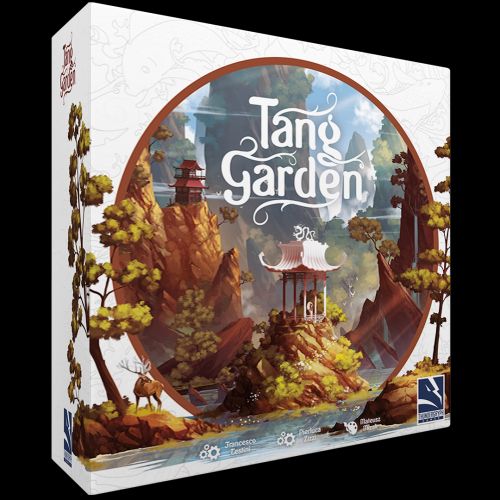
Tang Garden
Tang Garden Rulebook
Table of Contents
Table of Contents
Components
- 1 Game Rulebook
- 1 Garden Board
- 1 Double-sided Starting Tile
- 60 Garden Tiles
- 54 Decoration Cards
- 60 Coins
- 16 Lantern Tokens
- 4 Solo Lantern Tokens
- 4 Player Boards
- 12 Character Cards
- 12 Character Miniatures
- 8 Large Landscape Tiles
- 12 Small Landscape Tiles
- 8 Large Landscape Tokens
- 8 Small Landscape Tokens
- 36 Decorations
- 12 Cubes
- 4 Characters Tokens
- 1 Engineer Token (First Player Token)
Credits: Game Design: Francesco Testini and Pierluca Zizzi. Illustrator: Mateusz Mizak. Publisher: ThunderGryph Games.
Setup
-
Place the garden board in the center of the table.
-
Place the starting tile in the center of the garden board with either side face up. It can be oriented in any direction.
-
Separate the four types of garden tiles by their backs and shuffle each pile. Place them face down in four stacks in the designated areas in each corner of the garden board. Flip the top tile of each pile face up.
-
Shuffle the 54 decoration cards and place them face down on the table near the garden board.
-
Place the 36 decorations near the garden board.
-
Give each player three cubes and a player board in their chosen player color. Place the cubes on the starting space of each track. Give each player one of each of the four types of lantern tokens (one for each special ability). Place them in the designated areas on each player's board.
-
Find the six starting character cards with a colored square icon in the top right corner of the card. Shuffle them and deal one to each player. Each player places their character card in front of them and places the matching character miniature on it. This indicates that the character's skill is active. Each player advances their cube one position on their player board in the category shown in the upper right corner of their starting character card. Take all the remaining character cards. Shuffle them and place them face down to form the character deck.
7.1. Reveal the top two characters from the character deck.
7.2. Place all unused character miniatures next to the garden board.
-
Separately shuffle the twelve small landscape tiles and the eight large landscape tiles. Place them face up in two groups next to the garden board. Insert the four top small landscape tiles into each of the four starting spaces. Place the top landscape tile from each stack next to the pile. In this way, two small landscape tiles and two large landscape tiles are always visible.
Order of Play
Starting with the first player and proceeding in clockwise order, each player takes a turn. Each turn consists of a mandatory main action, and three possible optional actions.
- Main Action (mandatory):
- Build the Garden, or
- Place a Decoration.
- Influence a Character (optional): After the main action, the player may influence a character if they have reached the required level on their player board.
- Use a Lantern (optional): Once per turn, a player may activate one of their lantern abilities along with their main action by flipping one of their lantern tokens face down.
- Refresh a Lantern (optional): During their turn, a player may spend three landscape tokens of the same size in their possession to refresh a previously used lantern token by flipping it to its unused side. Exception: In a 2 player game, spend four landscape tokens.
Build the Garden
The active player chooses one face up garden tile from the top of one of the four stacks in the corners of the garden board and places it on one of the available spaces on the garden board.
- The placed tile must be adjacent to a tile already placed on the garden board.
- The terrain types on all the edges of any adjacent tiles must match. Exception: Some tiles have a wall on one of their edges. Walls can be matched to any terrain type and can enclose terrain spaces, granting one level of advancement for that element.
After placing the garden tile, examine the newly placed tile and collect rewards based on the following criteria:
- Advance the cube for the corresponding element on the player's board for each edge that matches the terrain type of any adjacent tiles.
- Terrain is considered enclosed when a greenery, water, or rock region is completed and can no longer be added to by placing new tiles. If a terrain becomes enclosed as a result of the placement of the new tile, advance the cube matching the enclosed terrain type by a level. Walls may be used to enclose terrain. If terrain goes to the edge of the garden board, it is not considered enclosed.
- Gain a coin if one edge of the newly placed tile matches a footpath edge.
- If the newly placed tile matches two footpath edges, the player may gain two coins or instead, advance the level of any one track on their player board.
These bonuses are cumulative. It is possible to advance one or more spaces on one or more tracks and get one or more coins with the placement of a single tile.
IMPORTANT: After completing a Build the Garden action, if there are less than two face up garden tiles on the board, flip the top tile of each stack so that four tiles are face up.
Inserting a Landscape Tile
There are five slots on each of the four sides of the garden board where landscape tiles can be inserted. The inner row of slots is for inserting small landscape tiles, while the outer row is for inserting large landscape tiles.
When placing a tile, if the player covers a space with a landscape token on it, they immediately gain the token and must insert a landscape tile of the corresponding type (small or large) into the garden board. They select one of the two face up landscape tiles in the size required. The landscape tile can be inserted into any slot of their choice, matching the size of the landscape tile to the slot size. Once the landscape tile is inserted, reveal a new landscape tile if needed, so that there are two of each size visible.
Special Garden Tiles
There are some special garden tiles that are mixed among the regular garden tiles. These tiles have special rewards and their edges do not need to match the edges of adjacent tiles when placed. Additionally, all edges of a special garden tile can enclose terrain, which can help earn additional advancement.
- Hehua ting, lotus temple (blue wall): Gain one coin + one coin for each adjacent water edge.
- Hua ting, flowers temple (green wall): Gain one coin + one coin for each adjacent greenery edge.
- Simian ting, rock temple (brown wall): Gain one coin + one coin for each adjacent rock edge.
If on a future turn, a player places a garden tile to the edge of the special garden tile with the corresponding terrain type, the player gains a coin.
Place a Decoration
The active player draws two cards, plus one card for each face down tile on top of each of the four garden tile piles. The player examines the drawn cards, chooses one to decorate the garden with, and places it face up in front of them with any previously played cards, sorting them by type. Next, the player takes the corresponding decoration from the supply and places it in the garden on one of the designated areas, gaining the one-time bonus indicated on the decoration card. Cards not chosen are discarded face up near the deck of decoration cards. If there are no areas left on the garden board of the designated type, or if there are no decorations of the designated type available to pick, the card cannot be selected.
A decoration card shows:
- Decoration Name
- Placement Indicator: The area of the garden board where the corresponding decoration must be placed (example: fish go on a tile with water).
- One-time Bonus.
- End Game Scoring Icons.
IMPORTANT: In the event that there are no free spaces to place decorations from the drawn decoration cards, the player discards all the drawn decoration cards, and their turn ends. Optional actions can still be performed.
IMPORTANT: At the end of a Place a Decoration action, the player must flip all face down garden tiles on the top of each pile on the garden board face up.
Decoration Card Iconography
Icons on decoration cards are scored at the end of the game.
- Birds & Fish: 6 coins if the player has a single pair of birds and fish cards. 0 coins if the player only has a single birds or fish card. Multiple pairs award coins, while having excess cards of one type does not award additional coins.
- Lotus & Peonies: 6 coins if the player has a single pair of lotus and peonies cards. 0 coins if the player only has a single lotus or peonies card. Multiple pairs award coins, while having excess cards of one type does not award additional coins.
- Bridge: 2 coins per bridge card.
- Pavilions: 12 coins to the player with the most Pavilion cards. 6 coins to the player with the second most Pavilion cards. If players are tied for the most Pavilion cards, divide 18 coins among the tied players ignoring any remaining coins. In this case, players with the second most do not gain coins.
- Trees: 1-4-9-16-25 coins depending on how many different trees the players have. If the players have multiple sets of tree cards, each set awards coins.
One-time bonuses shown on decoration cards may be: Advance greenery track, Advance water track, Advance rock track, Advance any track, or "Remove a landscape token of your choice from the garden board, place it in the player's area, and insert the corresponding landscape tile into the garden board."
Area of the garden board where the player must place the decoration:
- Greenery area: trees, peony, birds
- Water area: lotus, fish
- Bridge area: bridges
- Rock area: pavilions
Influence a Character
After a player's main action, they may choose to influence a character. Each player begins the game with a character and may take advantage of their character's skill during their turn.
To influence a new character, the player must have advanced each of their three cubes to the level required by the character or higher, as designated by a small icon on the player board. Additionally, there must be at least one free character placement spot on the board.
A character card shows:
- Name
- Starting Bonus
- Character Skill
- Sight Preference
To influence a character the player must:
- Choose and take one of the two revealed character cards. Alternatively, the player may draw a face down character card from the deck. Then, take the corresponding character miniature.
- The player then selects one of their characters and places its corresponding miniature on the garden board on one of the available character spots — either on a garden tile, a bridge decoration, or a pavilion decoration. They then turn the character miniature so it's facing one of the four cardinal directions.
The player earns coins for each character on the garden board at the end of the game based on their position and which direction it is facing, taking into account the character's sight preference.
- Characters with the "line of sight" icon (eye inside a diamond) will earn coins by seeing specific tiles on the garden board.
- Characters with the "active Landscape" icon (eye inside a circle) will earn coins by seeing specific icons on landscape tiles.
Additionally, each character will earn one coin for each decoration in their line of sight.
Each player always has one character miniature on top of the corresponding card. That character's skill represents the player's active skill.
IMPORTANT: After placing a character miniature on the garden board, its skill is no longer available.
- If the player chose one of the revealed character cards, reveal a new card from the deck and place it face up on the table so that there are always two face up character cards for players to choose from.
IMPORTANT: If there are no spots on the garden board to place a character, or if the player doesn't want to perform the Influence a Character action, the player instead takes a character token. A character token can be used on later turns to perform the "Influence Character" action. It is possible to influence only one character per turn. If the player reaches the next threshold to influence a new character, the player will immediately lose any character tokens they have.
Player Board Coins Bonus
When a single cube reaches the level required for the coin reward, as designated by the icon on the player board, the player immediately gains the corresponding coin bonus.
Each cube in a player's element track triggers each of these bonuses. If a player reaches the end of the track with each of the three cubes, they will have earned a total of 21 coins.
Use a Lantern
The active player may choose to use a lantern ability once per turn. To do this, the player flips a lantern token on their player board face down, and activates the chosen lantern ability. There are four different abilities.
- When taking a Build the Garden action, the player places two garden tiles, scoring both. Both garden tiles must be face up at the beginning of the turn.
- When taking the Place a Decoration action, the player places two decorations from the cards drawn, gaining the one-time bonus from both cards.
- The player moves one of their characters on the garden board to any available spot, adjusting the facing if desired. Alternatively, the player may adjust the facing of their character without moving it. The player can only move or adjust one of their characters already on the garden board.
- When influencing a new character, the player may choose a specific character from the character deck instead of taking one of the face up ones and then shuffling the deck after making the selection OR during the placement of a landscape tile, the player may choose any of the non-visible tiles and then shuffle the stack after making the selection.
REMINDER: Each player may use only one lantern per turn.
Refresh a Lantern (Optional)
During their turn, a player may spend three landscape tokens of the same size to refresh a previously used lantern token by flipping it to its unused side. Once used, return the landscape tokens to the game box. Exception: In a 2 player game, spend four landscape tokens.
End of Game
The end of the game is triggered when there are three or fewer landscape tokens on the garden board, or when one of the four piles of garden tiles is depleted. The game continues until the player to the right of the player with the Engineer token completes their turn, so all players get an equal number of turns. Then complete scoring to determine the winner.
Scoring
Count the coins obtained during the game, then add:
- Coins awarded for decoration cards in front of each player. Examples:
- Gain six coins for each single pair of lotus and peonies cards.
- Gain six coins for each single pair of birds and fish cards.
- The player with the most pavilion cards gains 12 coins. The player with the second most pavilion cards gains six coins. In case of a tie for the most, divide 18 coins among the tied players evenly, ignoring any remainder and do not award coins for the second most. If there is no tie for the most, but there are multiple players tied for second most, divide six coins among the tied players evenly, ignoring any remaining coins.
- Gain 1-4-9-16-25 coins for having 1-2-3-4-5 different tree cards. If the players have multiple sets of tree cards, each set awards coins.
- Gain two coins for each bridge card.
- Coins earned from characters.
- Gain one coin for each decoration in the line of sight of each of the player's characters.
To determine if a decoration is in a character's line of sight, start at the character's spot and follow the tiles in the direction in which the character is facing to the end of the garden board. A decoration on the same tile as a character is also considered to be in their line of sight.
- Gain coins based on the character's sight preference. Each character's sight preference is listed at the bottom of their character card and may include the line of sight (eye icon inside a diamond) or the active Landscape (eye icon inside a circle) icon. The active Landscape is composed of five landscape tiles, three small and two large, slotted into the side of the garden board in the direction the character is looking.
The player with the most coins is the winner. In case of a tie, the player with the most landscape tokens among the tied players is the winner. If the tie persists, the player with the most cubes in the furthest position of the tracks on their player board among the tied players is the winner. If the tie continues to persist, all the tied players share the victory.
Solo Variant "Yin & Yang"
In this game mode, your goal is to complete the central part of the garden board, which is comprised of 28 spaces around the starting tile.
This game mode does not use the spaces around the edges of the board. Decoration cards are not collected, character's abilities are not available, and player boards are not used.
As play continues, any time there are no legal moves available or one stack of garden tiles is depleted and you cannot continue the game with the help of a lantern, the game ends immediately. You have been defeated. If you are able to cover all of the spaces in the central part of the garden board, you have won.
In this case, score your performance and compare your score against the chart to see how well you did.
Solo Setup
Setup for the solo variant is identical to the multiplayer game with the following changes:
-
Shuffle the starting character cards. Draw two and keep one face up in front of you. Find the matching character miniature and place it on the card. The character's skill is not used during the game, while their sight preference is used as usual.
After a character is placed in the garden, examine the unselected card. Find the matching character miniature and place it on the garden board in any available spot. Then return the unselected character card to the game box.
Character miniatures placed this way are considered "neutral". They do NOT award coins, but they occupy character spots on the garden board. A neutral character's line of sight has no importance in the solo variant.
Shuffle the remaining four starting character cards with the other six. These cards comprise the characters deck of ten characters. Place it face down next to the main board and reveal the top two characters.
-
Shuffle the 54 decoration cards and place the deck face down.
2.1. Reveal the top four decoration cards and place one face up, next to each garden tile stack.
-
Shuffle four small landscape tokens and four big landscape tokens. Place them face up in the spaces indicated in the setup diagram. Remember: In this mode, you cannot place garden tiles on spaces outside the central garden, as indicated by the green area in the setup diagram.
-
Place the four special lantern tokens for solo play in front of you. Return all remaining lantern tokens and all player boards to the game box.
IMPORTANT: Player Boards are not used in the solo variant.
Solo Build the Garden
Since player boards are not used in this solo variant, the player cannot advance on the element tracks.
When a garden tile is placed, gain a coin for each edge that matches the adjacent terrain (greenery, water, or rock). For each newly enclosed terrain, gain an additional coin. Garden tile edges showing walls enclose any type of terrain, while the outside edge of the central garden does not enclose terrain.
IMPORTANT: You do not gain coins for matching one or more footpath edges.
Solo Landscape Tokens
After gaining a landscape token, insert one of the two available landscape tiles of the size indicated on the token into the garden board. Then insert the other face up landscape tile of the indicated size into the board on the opposite side of the garden board directly across from the first tile inserted. Reveal a new landscape tile, so that there are two of each size visible (two small and two large).
At any time, you may spend four landscape tokens of the same size to return any decoration on the garden board to the game box.
Solo Order of Play
Each turn you must select and place one available garden tile and the decoration represented by the card next to it. It must be possible to place both the tile and the decoration, otherwise the pair cannot be selected. At any time, if you cannot select any of the available pairs of garden tile and decoration card, and you cannot continue the game with the help of a lantern, the game ends immediately and you are defeated.
Once the pair is selected (1), place both the tile and the decoration on the board according to the game rules, then discard the decoration card to a discard pile (2). Find the garden tile and decoration card in the opposite corner from the pair you selected (3). Discard this decoration card to the discard pile and place the garden tile face up in a "garden tile display" beside the garden board.
Then reveal two garden tiles so that there are four garden tiles showing. Finally, reveal and place a new decoration card next to each of the newly revealed garden tiles. There should now be four pairs of garden tiles and decoration cards to choose from.
If the deck of decoration cards is depleted, shuffle the discard pile and form a new one.
Solo Influencing Characters
Once you have enough coins, you may influence a character. You may influence one new character each time you gain at least 10, 20, or 30 coins. It's not possible to influence more than four characters (including the starting one).
Each time you influence a new character, pick one of the two character cards in the display and discard the unselected character card. Place the selected card in front of you with it's miniature on it. Then place the miniature for the unselected character on any available spot as a neutral character (as during setup). Then reveal two new characters from the character deck to create a new display.
At the end of the game, each influenced character will be placed on the garden board for scoring if you have not been defeated. Characters placed on the garden board this way will award coins based on their sight preference, as in the multiplayer game.
Solo Lantern Tokens
Lantern token abilities in the solo variant:
- Select a pair, but only place the garden tile, ignoring the paired decoration card. Discard the paired decoration card as well as the decoration card in the opposite corner. Move the face up garden tile in the opposite corner to the "garden tile display". Finally, refill the garden tiles and decoration cards as usual.
- Select a garden tile from the tiles in the "garden tile display" placing the tile using the usual rules.
- Discard all four decoration cards in play and replace them with new cards from the decoration deck.
- Re-use the ability of one of your exhausted lantern tokens.
IMPORTANT: In the Solo Mode, you cannot spend landscape tokens to refresh a lantern token.
Solo Final Character Placement
If your game ends in victory, place your character miniatures on any available spot on the garden board facing any direction to gain additional coins based on the character's sight preference, as in the multiplayer game.
Add up the coins gained during the game and the coins gained from placing characters to determine your final score. Compare your score to the table below to see how well you did:
- up to 60: Craftsman (工匠)
- 61-75: Designer (设计师)
- 76-95: Engineer (工程师)
- 96 or more: Inspector (总监)
Solo End of Game
The game ends in defeat if any of the following conditions apply before covering all the spaces of the central garden with garden tiles:
- One stack of garden tiles is depleted.
- You can't place any pair of garden tile + decoration card.
The game ends in victory if all 28 spaces of the central garden are covered by garden tiles.
Character Descriptions
Starting characters are marked with an asterisk ().*
- Architect — Starting Bonus: Greenery. Character Skill: Gain two coins each time the player places a pavilion or a bridge on the garden board. Sight Preference: Gain three coins for each Construction icon on the active Landscape.
- Child — Starting Bonus: Rock. Character Skill: Gain two coins each time the player places a bird or fish decoration. Sight Preference: Gain two coins for each Animal icon on the active Landscape.
- Empress — Starting Bonus: Water. Character Skill: Gain two coins each time the player places a lotus or a peony flower decoration. Sight Preference: Gain nine coins. If either the Emperor or Lady is in the Empress's line of sight, lose three coins for each.
- Hermit — Starting Bonus: Rock. Character Skill: Gain one coin each time the player advances one or more spaces on the rock track. Advancing two spaces with the same tile will still grant a single coin. Sight Preference: Gain two coins (maximum ten coins) for each garden tile with rock terrain in the Hermit's line of sight.
- Poet — Starting Bonus: Water. Character Skill: Gain one coin each time the player advances one or more spaces on the water track. Advancing two spaces with the same tile will still grant a single coin. Sight Preference: Gain two coins (maximum ten coins) for each garden tile with water terrain in the Poet's line of sight.
- Student — Starting Bonus: Greenery. Character Skill: Gain one coin each time the player advances one or more spaces on the greenery track. Advancing two spaces with the same tile will still grant a single coin. Sight Preference: Gain two coins (maximum ten coins) for each garden tile with greenery terrain in the Student's line of sight.
- Emperor — Character Skill: N/A. Sight Preference: Gain five coins for each Dragon icon on the active Landscape.
- Lady — Character Skill: N/A. Sight Preference: Gain six coins if only the Sun icon or the Moon icon is on the active Landscape; get twelve instead, if both the Sun and the Moon icons are on the active Landscape.