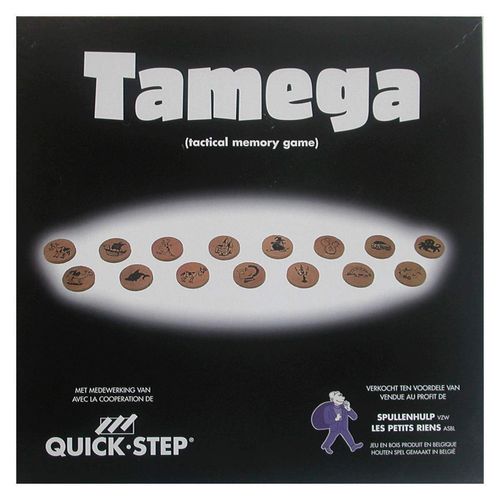
Tamega
Tamega Rulebook
Table of Contents
Table of Contents
Contents and Presentation
- A game board with 45 spaces
- 44 memory pieces ("mémopièces"). Each has an identical "back" side and a "face" side with an image. Each image is reproduced on two pieces, so there are 22 pairs of images.
- 1 red piece
- 4 pawns in different colours
- Game rules
Setup
- Place the red piece on the central space of the board.
- Place all the pieces at random on the 44 spaces of the board, back side up. The images are therefore hidden.
- Each player chooses a coloured pawn and places it on the memory piece of their starting space, according to whether the game is played with 2, 3 or 4 players (figures 1, 2 and 3). Any remaining pawns are put away.
Goal of the Game
Collect the largest number of pairs of images (of identical pieces).
Playing the Game
- Chance determines who starts.
- Play then passes to the next player, and so on, clockwise.
- On a turn, the player moves their pawn one space (horizontally, vertically or diagonally) onto an adjoining piece, and then turns over the memory piece they have just left. That piece is turned face up, showing its image, and remains face up.
- Each move is from one memory piece to another. A move is only allowed if the destination memory piece is face down (back side up) and adjacent to the space the pawn is on. Pieces face up and empty spaces are therefore not possible destinations.
- The red piece may be used as a bridge between two face-down memory pieces, provided that both of those pieces touch the red piece (figure 4).
- Play continues in this way until a player uncovers the second memory piece of a pair. At that moment:
- The player removes the pair of images from the board and keeps it.
- They give their opponents time to memorise the positions of the face-up memory pieces before turning all of them back to the back side.
- They may (but are not obliged to) move the red piece to an empty space of their choice. The red piece stays at that new position until another pair is turned over.
- They turn over a face-down memory piece of their choice and place it face up.
- They move their pawn one space and turn over the memory piece of the space they have just left.
- If the two memory pieces turned over form a pair, this player keeps the pair and repeats the same procedure (steps 1 to 5).
- If the two memory pieces are different, play continues normally. The next player therefore moves their pawn one space and turns over the memory piece they have just left, and so on, until a new pair is discovered. Steps 1 to 5 are then repeated.
- A player who can no longer move their pawn (surrounded by face-up memory pieces, empty spaces or opposing pawns) must pass their turn. They may be able to play again once a pair has been discovered by one of their opponents. When that happens, all the memory pieces are turned back to the back side.
End of the Game
The game ends when all the players are blocked and it is therefore no longer possible to make a permitted move.
Winner
The winner is the player who, at the end of the game, has collected the largest number of pairs.
Strategy
- Try to get ahead of your opponent by isolating them in a corner or on a small island.
- When you find a new pair, you may turn over a memory piece of your choice. Choose one that either lets you quickly form a new pair, or cuts off your opponent's path.
- Always place the red piece on a strategic space. This matters most near the end of the game, where it plays a very important role. Weigh the pros and cons carefully to make the right choices.
Duration and Number of Players
- Duration: about 15 to 25 minutes.
- Number of players: 2 to 4 (see the variants below for larger groups and for one player).
Variants
Two Players
- Each player may take 1 or 2 pawns to move (taking turns).
Four Players
- Each player may play for themselves, or the players may play 2 against 2. In a team game, the teams play alternately.
More Than Four Players
- Place 2 game boards, each with a set of memory pieces (all well mixed), side by side.
- Players may move from one board to the other across the adjoining sides.
- The game may be played in teams or with each player for themselves. In the individual version, give the pawns of the same colour a distinguishing mark (a rubber band, a string, etc.) so they can be told apart.
One Player
- Proceed in the same way as in the standard game: move the pawn, turn over the memory piece just left, continue until a pair is found, remove that pair, turn all the face-up pieces back to the back side, move the red piece if you wish, and so on.
- You win when you have been able to remove all the pairs except one. That last pair is made up of the piece your pawn stands on and its matching twin. You will find this is not as easy as it sounds, and memory plays a very important role.
- Try to reach the same result without moving the red piece.