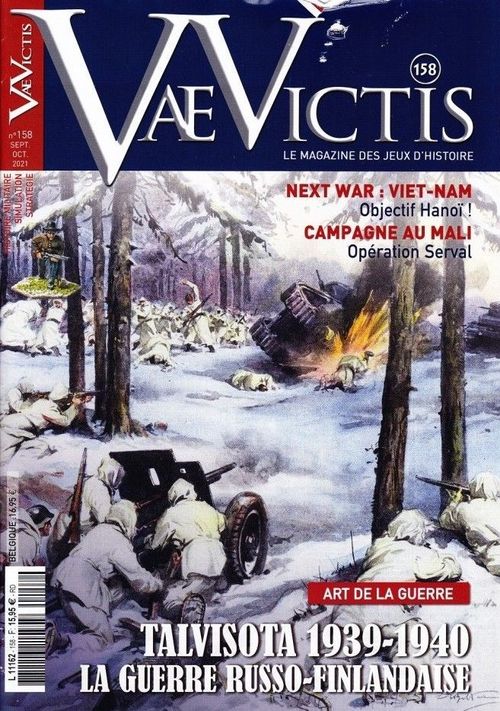
Talvisota 1939-1940: La Guerre Russo-Finlandaise
Talvisota 1939-1940: La Guerre Russo-Finlandaise Rulebook
Table of Contents
Table of Contents
- 1 - PRESENTATION
- 2 - PREPARATION OF THE GAME
- 3 - HOW TO PLAY?
- 4 - COMBAT RESOLUTIONS
- 5 - ENVIRONMENT MARKERS
- 6 - SOVIET PROGRESSION
- 7 - MORALE
- 8 - FORTIFICATION LINES
- 9 - SOLO PLAY
- Results Combat Table
- Order of Battle
1 - PRESENTATION
1.1 - GENERAL POINTS
The game includes a rule sheet, an A3 map and 108 counters.
The following terms are used in the rules:
- Soviets: all the Russian troops of the Red Army.
- Force: for simplicity's sake, one to six combat units (maximum).
- Corps: group of three Soviet divisions; these counters facilitate the use of other counters.
- Controlled spaces: the spaces controlled by one of the players, either because one force is present or because there is a Soviet control marker.
- Soviet logistic continuity: a number of spaces linked through connections. The starting point is one of the Soviet logistics centres that corresponds to one of the Soviet fronts (Mourmansk and Kandalaksha for the Lapland Front, Belomorsk and Petrozavodsk for the Ladoga Front, Leningrad for the Karelian Front [Front de Carélie]). The spaces must link the supply centre to the units in Finnish territory. The spaces in Finnish territory are occupied by Soviet units or control markers. This line may be broken by the action of the Finnish units.
- Precision: the Finnish combat units may never enter the Soviet territory.
1.2 - VICTORY CONDITIONS
In this game, one player commands the Soviet forces and the other commands the Finnish forces. To win, each player must lower his adversary's combat will to zero by accumulating victory points (VP) that proportionally lower the enemy's morale.
The victory conditions are:
- Seizing Helsinki: immediate Soviet victory.
- Lowering the Finnish political will to 0 on the morale scale: immediate Soviet victory.
- Lowering the Soviet political will to 0 on the morale scale: immediate Finnish victory.
If these conditions are not met, the game result is determined by comparing the morale of the two belligerents.
1.3 - THE MAP
1.3.1 - General points
The map represents Finland and the bordering Soviet territories from which the Russian invasion originated. The map is composed of spaces and connections. The connections represent the trails or roads and the country's railways.
Blue spaces represent Finnish cities and red spaces represent Soviet cities.
Each Finnish space contains a name and a number that represent its defensive value in combat and the number of points subtracted from the Finnish morale if the city is seized by the Soviets.
The spaces surrounded by a dotted line represent the Finnish defence lines (see 8).
Each Soviet space has a name. Spaces that have the name of a front are logistic centres.
Important: the connection that links Orianenburg and Koivisto is only active as of the March I 1940 turn.
1.3.2 - Terrains and climate conditions
The map represents Finland in winter. In this game, the terrain and climate conditions and their impact on the operations are simulated by markers in the combat actions under the term Environment (see 5).
Since the Finnish territory was very hostile, the Environment introduces various realities as penalties for the Soviet troops.
1.3.3 - Scales
On the map, 1.5 cm represents about 40 km, one game turn represents about 15 days of conflict, a combat unit represents one to two infantry divisions, one mechanised division, one Tank brigade, one air squadron, one artillery regiment or one special unit of Finnish scouts or elite shooters. The game is played in 8 turns. Each month is composed of two game turns.
1.4 - THE COUNTERS
There are four types of counters: Combat Strategies, Combat Units, Tactical Supports, Markers. The counters only have a front side. The back of the counter shows the national flag of each side.
Exception: the corps counters have a front side representing three fusilier units, a back side representing one fusilier unit to better manage the units.
- Combat Units counters: The information on the counters includes the colour, indicating the side to which they belong (blue and beige), a name, and an outline indicating the type of unit (ELI, FUS, MECA, TAN for the Soviets, SCT, WD, SK, DIV, RES for the Finns) described in rule 9, a number indicating combat strength, and tactical capacity as a bonus applicable to its strength, or as a penalty applicable to the enemy strength.
- Combat Strategies counters: These counters represent the military plans of the belligerents; each side has four. They feature a colour (blue for the Finns and beige for the Soviets), a name to designate the strategy, and three numbers that represent, in order:
- for the Soviets the number of spaces to conquer, the number of engaged combat units, the number of tactical supports provided;
- for the Finns, in order, the number of engaged units, the number of Environment markers used, the number of tactical supports provided.
- Tactical Support counters: Their colour indicates their camp, an outline indicates their outline, a tactical impact for the combats in the form of a bonus or penalty and/or specific properties described in rule 3.3.3.
- Markers: These help with game play. The various markers are witnessing markers (Turn, Morale, Soviet Possession, International Events), Environment markers, and the Infiltration marker (see 6).
1.5 - COMMAND SHEET
Each player has a command sheet composed of several boxes:
- One box for each front: Lapland, Ladoga, Karelian; each one has boxes to place the "Combat Strategies" of each front. The Lapland front contains one Combat Strategy box, and the others have two.
- One Losses (Pertes) box and one Reinforcements (Renforts) box to place the units lost in combat that then return to the Reinforcements box and then become available the following turn in one of the front spaces.
2 - PREPARATION OF THE GAME
2.1 - GENERAL PLACEMENT
The turn marker is placed on the Turn-Counter track.
The Events marker is placed on space 0 of the International Events track.
The Soviet and Finnish Morale markers are placed on the game's morale track; the former on space 23 and the latter on space 19.
2.2 - INITIAL SOVIET PLACEMENT
The Soviet forces in play are divided into three fronts: Karelian, Lake Lagoda, Lapland. The initial placement of the Soviet combat unit counters respects the historical deployment of the 450,000 men engaged in the conflict; the following units are placed at the players' discretion on the command sheet, in each of the front spaces.
For the Soviet player: 13 FUS divisions or four corps and one division of FUS or any other combination of these elements, three ELI divisions, four MECA divisions, three TAN brigades.
- Soviet reinforcements arriving in January 1940: two commander supports (Meretskov and Timoshenko), one support "T-34/KV-1", three corps of fusiliers (COR) equivalent to nine divisions of FUS, three divisions of FUS, three Elite divisions (ELI), three mechanised divisions (MECA) and three tank brigades (TAN).
The Soviet Possession markers are placed on the side of the game, on hold (see 6).
2.3 - INITIAL FINNISH PLACEMENT
Since the Finnish player is on the defence for the majority of the conflict, he does not place any of his counters on the map, but places all of them on his Command Sheet, hidden from his adversary (his four Combat Strategies, eight Tactical Supports, two Entrenchment (Retranchement) counters, five Environment markers, and 29 combat units).
The Finnish player has: three Scouts units (SCO), three Elite shooter units "White Death" (WD), six Suojeluskunta or Civil Guard units (SK), nine divisions (DIV), six Reservist units (RES), two Entrenchment (RET) counters.
Note: historically, the Finnish army had 127,000 active military (nine divisions), 100,000 reservists, 100,000 Civil Guards, 100,000 members of the Lotta svärd (female troops).
2.4 - GAME TURN
The game is divided into eight turns. Each turn is organised according to the same phases:
- Organisation phase for the turn
- Advancement of the Turn-counter marker.
- Determination of the international situation (modification of Finnish morale).
- Special movement of the Soviet units. Starting on December I 1939, the Soviet units may move from the Command Sheet to one of the spaces composing a logistics line, free of any Finnish units. The Soviet player places the control markers on one of the logistics lines.
- Actions phase
- Placement of the Soviet and Finnish Combat Strategies on the map.
- Resolution of combats in the order chosen by the Soviet player.
- Finnish harassment.
- End of the turn
- Any morale modifications for the two sides.
- Verification of the victory conditions.
3 - HOW TO PLAY?
3.1 - DETERMINATION OF THE INTERNATIONAL SITUATION
International events are simulated on a track composed of three spaces: -2, 0, +2, and an Event marker positioned on space 0 at the beginning of the game.
Each turn, the Finnish player rolls 1d6:
- on a 1 or 2, the marker is placed on space -2 and the Finnish player loses -2 morale points this turn;
- on a 3 or 4, the marker is placed on space 0, the Finnish player loses no morale points this turn;
- on a 5 or 6, the marker is placed on space +2 and the Finnish player wins +2 morale points this turn.
Note: historically, Sweden and Norway strongly supported Finland, the League of Nations and the United States denounced the Soviet aggression, and Europe was split on the question. Affirmed support alternated with attempts at mediation, Nazi Germany finally pushed Finland to negotiate, while Sweden and Norway suspended their aid to avoid offending the USSR. France and England were considering direct intervention when the conflict came to an end.
Precision: always wait until the end of the turn to determine the definitive morale of the two camps, even if an international event has a national morale of 0.
3.2 - DEPLOYMENT OF COMBAT STRATEGIES
3.2.1 - General points
On his Command Sheet, concealed from his adversary, each player positions his Combat Strategies counters in the specific boxes for each Front of his Command Sheet. Then, he allocates the number of units and "Supports" that correspond to each type of "Combat Strategy" counter.
Next, the Soviet player deploys his "Combat Strategy" counters, one after another, on the map, in the spaces he chooses to attack on the three fronts. At the same time, the Finnish player responds by placing his own "Combat Strategy" counters in the space of the future confrontation.
Once the deployment is complete, the players resolve the combats one after another by revealing the resources allocated for each combat.
Reminder: each Combat Strategy counter has specific qualities and must be used according to these properties.
Note: players must distribute their Combat Strategies among the various fronts, thereby requiring them to make choices regarding their objectives and the allocation of their troops.
3.2.2 - Soviet Combat Strategies
- Prudent advance (PRUD): the Soviet player may attack space with up to three units of his choice (FUS, ELI, TAN or MECA) and one Tactical Support of his choice. The tactical bonus of the mechanised units and infantry is doubled.
- Massive attack (ATT): if the first attack results in a space being conquered, the player may launch a second attack in a space connected to the first. Each attack may be led with a maximum of six units of his choice; he may use two Tactical Supports of his choice but the tactical bonus of the infantry units does not apply.
- Armoured attack (BLIN): the Soviet player may attack up to two successive spaces, with at least three TAN or MECA for six units maximum; he may use up to two Tactical Supports. The tactical bonus of the armoured units is doubled.
- Coordinated Manoeuvre (MAN): the Soviet player may attack up to two successive spaces with a maximum of four units of his choice including two infantry (FUS or ELI) and may use up to three Tactical Supports. The tactical bonus of all the Soviet units is doubled; if there are Finnish marker(s) that cancel the use of the combat bonus, it is not eliminated but is reduced to +1 regardless of the unit.
Precision: the Soviet troops always remain on the map and may only be activated by a Combat Strategy counter once per turn; therefore, the player may not use one or several of his Combat Strategy counters and/or choose to end his game turn without using all of them.
The support counters with a "commander" name are added to those defined by the "Combat Strategies".
Example: as of January 1940, the Soviet player may use two support counters for a "PRUD" Combat Strategy: one normal support and one commander support.
Restrictions: for all the turns in January 1940, the Soviet player may only use one support for each of his Combat Strategies, to which he may add one commander support.
3.2.3 - Finnish combat strategies
For the Finnish side, the Combat Strategies represent the military efforts put into place to face off against the Soviet attacks. They are:
- The Defensive Position (DEFENSE): engages three Finnish combat units of the player's choice as well as one Retranchements (Entrenchments) counter, one Environment marker, two Tactical Supports.
- Counter-attack (CON-ATT): engages four Finnish combat units of the player's choice, one Environment marker, two Tactical supports.
- Motti (MOTTI): engages three Finnish combat units of the player's choice, two Environment markers, two Tactical Supports.
Note: Motti is a Finnish military slang term that designates an encirclement tactic in which the columns or the enemy combat groups are isolated into smaller formations and encircled first with light and mobile troops, especially scout skiers, during the winter periods. This technique proved particularly effective against certain mechanised units of the Red Army that could only move slowly on the roads.
- Fierce Resistance (RESIST): engages three Finnish combat units of the player's choice, one Environment marker, one Entrenchments counter and two Tactical Supports.
The Finnish player divides his troops and his Supports as he wishes for each strategy; the combat units used for a strategy can only be activated once per turn and then are removed from the map.
3.2.4 - Combat follow-up
If the Soviet player employs a Combat Strategy that allows him to attack two spaces, the opposing Finnish strategy will be the same on the two spaces.
3.3 - TACTICAL SUPPORT
3.3.1 - General points
The Tactical Supports simulate the battle manoeuvres or the support provided to the combat units (artillery, aviation…). They may only be used once per turn, as the player chooses, for a Combat Strategy and throughout the progression of this strategy. For this, they are placed on the "Front" box on the player's Command Sheet at the beginning of each turn, then, during the Actions Phase of a turn, allocated to a Combat Strategy on the Command Sheet.
3.3.2 - Soviet Tactical Supports
There are nine:
-
Meretskov Support (MER x 1): player's choice, reduces the effects of the Finnish defence lines to -1 (instead of -4) or doubles the impact of an artillery tactical support. This Support also makes it possible to use the connection between Orianembaum and Koovisto as of March 1940.
-
Timoshenko Support (TIMO x 1): player's choice, doubles the enemy's losses if an Artillery Support was used or provides a bonus of +1 to the tactical bonus of all the units in a coordinated Combat Strategy Manœuvre.
-
Air Support (AIR x 1): imposes a penalty of -1 on each Finnish unit.
-
Artillery Support (ART x 1): imposes a penalty of -2 on a Finnish unit.
-
NKVD (NKVD x 1): cancels the retreat from a combat result, but doubles the losses result.
-
Reinforcements (RENF x 1): makes it possible to use up to two additional units from the space occupied by an attacking force or an adjacent space to participate in a combat action.
Attention: the total number of units engaged by a force may never exceed six.
-
Lack of munitions (MUNI x 1): imposes a penalty of -2 on each Finnish unit.
-
Supply (RAV x 1): the Soviet player receives +1 on his combat die (possibly transformed to -1 on the Finnish d6).
3.3.3 - Finnish tactical support
There are eight:
- Mannerheim Support (MANN x 1): as the player chooses, cancels out the retreat but imposes twice the losses or a penalty of -2 to a Soviet unit.
- Artillery Support (ART x 1): imposes a penalty of -2 on the Soviet force.
- Reinforcements (RENF x 1): adds two combat units of the player's choice to his force's strength.
- Anti-Tanks (A-T x 2): imposes a penalty of -2 on the Soviet tank units or a penalty of -1 on the Soviet force if there are no Soviet TANK counters present.
- Air Support (AIR x 1): renders one counter of Soviet air units present inefficient or imposes a penalty of -1 on the Soviet force if no Soviet AIR counter is present.
- Embuscade (Ambush) (EMB x 2): imposes a penalty of -3 on each Soviet unit; no Soviet unit may apply its combat bonus.
4 - COMBAT RESOLUTIONS
4.1 - ORGANISATION OF THE FORCES OF THE TWO CAMPS
The Soviet player determines the order of the combats.
To resolve a combat, each player has deployed the combat units and Tactical Supports chosen for the Combat Strategy put into play on the map.
Once both players have organised their Combat Strategies, they reveal their Combat Strategy counters on the map and reveal their Command Sheet; they then resolve the confrontation of the Combat Strategies one by one.
4.2 - CALCULATION OF COMBAT VALUES
The Soviet player calculates the combat strength of his force by adding up the combat values of his units and their combat bonus, potentially modified by the Combat Strategy he used, and subtracting any Finnish penalty; the Finnish player does the same.
Precision: do not forget the impact of the Environment markers and the potential defensive value of the space.
Each player announces his combat potential, beginning with the attacker; the player with the higher combat potential rolls 1d6, the result is listed in the column corresponding to the difference between the two announced forces.
If one side reaches a strength of 0 or less through this calculation, it is automatically considered to have a strength of 1; same thing if both the Finnish and Soviet forces reach 0.
4.3 - COMBAT RESOLUTION TABLE
There can be a difference between the forces of: +0 to +6 and more. See the Results Combat Table at the end of this rulebook.
4.4 - COMBAT ROUNDS
A combat lasts a maximum of two rounds, which means the player may attack once with his force, resolve the combat, then attack a second time with his remaining forces in the same manner.
Reminder: it is possible to attack several spaces successively with certain Combat Strategies, and thereby engage in two rounds of combat several times.
4.5 - COMBAT RESULTS
4.5.1 - General points
The combat results are double:
- the losses due to the combat itself and given by the combat resolution table;
- the consequences of the Combat Strategies in lost morale points (see 7).
When the combat result corresponds to a 1 or 2, the concerned player (Soviet attacker or Finnish defender) loses that many combat unit counters.
These lost units are chosen by the owner and are placed in the Losses space of the player's Command Sheet.
4.5.2 - Soviet victory
After a combat, if all the Finnish units have been eliminated or have retreated, the Soviet player is considered victorious and the Soviet forces may occupy the conquered space.
The Soviet player's victory lowers the Finnish morale by n points where n is determined by the Soviet Combat Strategy that was used (see rule 7) plus the value of the conquered space if it has a dotted outline (see rule 8) and/or has a number.
Note: the addition of the value of the spaces with a dotted outline to the morale points illustrates the impact of the fortified zones in this conflict; to make the game more difficult, the player may ignore this point and keep only the morale points attributed to the Soviet combat actions.
Example: the Soviet seizes Kotka (east of Helsinki) with a Prudent Advance strategy, the Finn loses 2 morale points for the captured city and 1 morale point because the Soviet strategy was successful (rule 7.1); the Soviet seizes Koivisto (east of Kotka) with a Prudent Advance strategy, the Finn loses 2 morale points for the captured city AND 2 morale points because it is a fortified space, the Soviet wins 1 morale point for his successful strategy, 2 for seizing the city and 2 because it's a fortified space for a total of +5!
4.5.3 - Finnish victory
If all the Finnish units are neither eliminated nor pushed back, the Soviet player is considered defeated. The Finnish Combat Strategy is removed from the map and the Soviet force:
- retreats to its starting space, if half or fewer of its units have been eliminated;
- retreats 2 spaces if more than half of its units have been eliminated.
Reminder: the Soviet units retreat towards a space controlled by the Soviets; a retreat stops if a force enters the Soviet territory.
4.5.4 - Losses and reinforcements
For the Soviet player, the units placed in the Losses space spend the following turn in the Reinforcements space. There is a cost for recovering combat units in the Reinforcements space: the player must spend 1 morale point to recover two FUS units or one ELI or MECA or TAN unit (returned to the Forces space).
For the Finnish player, the units placed in the Losses space, then are placed in the Reinforcements space on the following turn, and once again become available to the player on the subsequent turn.
Note 1: the principle of this mechanism is to limit the strength of the Finnish forces who must wait one turn before recovering their eliminated combat units, and therefore convey the historical weakness of the troops of the Finnish army.
Note 2: to facilitate the Soviet action, the player may pay 1 morale point for three FUS units or two ELI or MECA or TAN units that are recovered.
5 - ENVIRONMENT MARKERS
This war was fought in a difficult environment, and the Finns were able to use to their advantage their mastery of the terrain and the numerous obstacles it represented for the Soviet army. Consequently, the Finnish player benefits in the game from the terrain advantages in the form of Environment markers used in his Combat Strategies. There are 5 such markers:
- Neige/Snow (one marker): penalty of -1 for the strength of each Soviet infantry unit (FUS and ELI) that also cannot use their tactical bonus, and -3 for the MECA or TAN units. No air support for either player.
- Bois/Woods (one marker): bonus of +1 for the strength of each Finnish unit, penalty of -1 for the Soviet TAN.
- Forêt/Forest (one marker): penalty of -2 for the strength of each Soviet unit, the units of Soviet TAN may not use their combat bonus.
- Marais/Swamp (one marker): penalty of -1 for the strength of each Soviet unit.
- Brouillard/Fog (one marker): no possible air support for either player, +1 for each Finnish unit.
6 - SOVIET PROGRESSION
6.1 - GENERAL POINTS
We call the Line of Progression the continuous succession of spaces from a space in Russian territory to the space occupied by an attacking Soviet unit. This continuous line represents the logistic organisation and the Red Army's supply line.
To maintain this continuity, the conquered Finnish spaces must be occupied in order to avoid any break (an empty space) in the Soviet progression axis. To do so, the Soviet player has two possibilities:
- leave one or more combat units in the conquered space (the presence of a Soviet unit allows it to control the space); OR
- leave one of his Possession markers there.
The Soviet player has four "Possession" markers at his disposal which he may use to not leave any forces in a conquered space (see 2.4 - Organisation Phase).
6.2 - FINNISH HARASSMENT AND RUSSIAN LOGISTICS BREACH
As of the December [I] 1939 turn, the Finnish player may attempt to breach the Russian logistics continuity through an attack on one of the spaces controlled by the Soviet player. To do so, during the Actions phase, he may place his Infiltration marker on one of these spaces on the map.
With the Infiltration marker, the Finnish player must use one to three Finnish SCT combat units maximum (taken from the Forces spaces on the Command Sheet) left in the attacked space.
The player then rolls 1d6 modified as follows:
- +1 for each Finnish SCT combat unit that attacks the space;
- -2 for each Soviet combat unit present in the space;
- -1 for each Soviet combat unit present in a space adjacent to the attacked space.
Results:
- On a 6 or more, the Finnish attack is successful, the Soviet player immediately loses two morale points + n morale points where n is the value of the space in which the attack took place.
- On a score of 4 or 5, the Soviet player loses one morale point and the Finnish player one SCT unit.
- For any other score, the Finnish player loses one morale point and one engaged SCT unit.
At the end of the combat, the engaged SCT units that have not been eliminated are once again available and may be used on the following turn. They may also remain in the space attacked by the "Infiltration"; to take the space back, the Soviet player must launch a combat against this Finnish force.
If the combat is a success for the Finnish player, the Soviet player loses control of the space, the units no longer have logistic continuity and are called "isolated". At the end of each turn, as long as the break in logistics continues, one "isolated" Soviet unit is eliminated, respecting the following order: TAN units, MECA units, FUS units.
7 - MORALE
7.1 - SOVIET MORALE
Stalin's attack against Finland is based on strategic imperatives (notably to protect Leningrad, the country's second most important city). However, the more Finland resists, the more decisive the political impact.
Soviet morale begins at 23 points. If the Soviet player reaches a morale level of 0 before he defeats the Finn, he loses the game. Soviet morale may never exceed the original value of 23.
- For each victory won, the Soviet player lowers the Finnish morale by n points, where n is determined by the Soviet Combat Strategy used (see rule 3.2) plus the value of the conquered space if it has a dotted outline (see rule 8) and/or a number.
- For a "PRUD" Combat Strategy, if the Soviet player suffers a loss and does not conquer a space, he loses 1 morale point; otherwise the Finn loses 1 morale point and any points from the conquered space.
- For a "MASS" Combat Strategy, if the strategy is victorious, the Finn loses 2 morale points per conquered space as well as the points for each space; the Soviet loses 3 morale points if he does not progress.
- For a "BLIN" Combat Strategy, if he conquers 1 space, the Finnish player loses 2 points, if he conquers 2, the Finnish player loses 4 points as well as any points from the conquered spaces; if he doesn't conquer any spaces, the player loses 3 morale points.
- For a "MAN" Combat Strategy, for each Finnish space that is conquered, the Finn loses 4 morale points as well as the points of each conquered space; if the Soviet force suffers a loss, he loses 4 morale points and stops his progression.
7.2 - FINNISH MORALE
The Finnish have a morale of 19 points; the country's military, human and political weakness against the Soviet giant is illustrated by this initial gap. The Finnish morale evolves according to the events drawn at the beginning of each turn and the results of the Soviet attacks.
If the Finnish morale reaches 0, the Soviet player wins the game.
The Finnish morale can never exceed 23.
8 - FORTIFICATION LINES
Faced with the growing threat of the USSR, the Finns had constructed a defence line or Mannerheim Line, then two others behind it. On the map, the spaces concerned by these defence lines have a dotted outline which represents a defensive capacity in the form of a penalty of -4 for any adverse force.
Historically, since combats around the line were particularly harsh, each confrontation adds to the combat result +2 morale points for the victor and -2 for the defeated (see 4.5.2).
9 - SOLO PLAY
9.1 - GENERAL POINTS
Talvisota may be played solo. In this configuration, the player controls the Soviet side and the game mechanics manage the Finnish side.
The game system stays the same, but the player will need four opaque containers:
- the first for the four Finnish Combat Strategies;
- the second for the eight Finnish Tactical Supports;
- the third for the Finnish combat units;
- the fourth for the five Environment markers.
The player must proceed with drawing the Finnish Combat Strategies, then, after having deployed his own forces, through a drawing, complete these strategies by military means with units and support (the Command Sheet is used for more clarity for the progressive positioning of the counter) by drawing them.
Combats are resolved in the same manner but the Soviet player proceeds with every step.
The Finnish units that are pushed back or eliminated are always chosen by the Soviet player from weakest to strongest (RES → SK → WD → SCT → DIV).
9.2 - FINNISH HARASSMENT
The Finnish harassment is managed as follows:
- the Soviet player chooses a Possession marker or a space containing the weakest Soviet force;
- he rolls 1d6 to determine the number of SCT units engaged: on a 1 or 2 = one unit; 3 or 4 = two units; 5 or 6 = three units;
- he then resolves the harassment combat as described in rule 5;
- the SCT units remain in place if victorious.
Reminder: during the game, the Finnish player may no longer have enough units to fill his Combat Strategies fully in which case they are played incomplete.
Results Combat Table
| ≠ strenght/d6 | +0 | +1 | +2 | +3 | +4 | +5 | +6 & + |
|---|---|---|---|---|---|---|---|
| 6 | 1a1d | 1a/1d | 1a/1dR | 1dR | 1dR | 2d | 2dR |
| 5 | 1a | 1a/1d | 1a/1d | 1a/1dR | 1dR | 1dR | 2d |
| 4 | 2a | 1a | 1a/1d | 1a/1d | 1a/1dR | 1dR | 1dR |
n = number of units lost a = attacker d = defender R = the defender retreats Any difference beyond +6 is counted as +6 with a +1 on the die for each additional number (For example, +9 adds +3 to the d6).
Order of Battle
Soviet Order of Battle
Engaged Soviet forces
- 13 x Fusiliers divisions (FUS) or 4 x and one Fusilier division
- 3 x Elite divisions (ELI)
- 4 x mechanised divisions (MECA)
- 3 x Tanks brigades (TAN)
Soviet Units in Reinforcement
- 12 x Fusiliers divisions (FUS) or 3 x corps and 3 x Fusiliers divisions
- 3 x Elite divisions (ELI)
- 3 x mechanised divisions (MECA)
- 3 x Tanks brigades (TAN)
Finnish Order of Battle
- 3 x Scouts units (SCO)
- 3 x Elite sniper units "White Death" (WD)
- 6 x Suojeluskunta or Civil Guard units (SK)
- 9 x Divisions (DIV)
- 6 x Reservist units (RES)
- 2 x Entrenchment counters (RET)