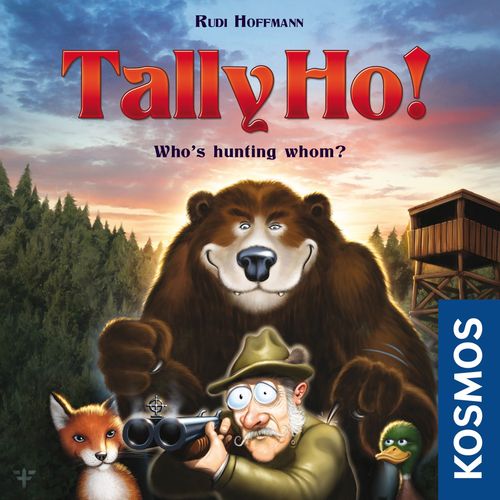
Tally Ho!
Tally Ho! Rulebook
Table of Contents
Table of Contents
Overview
One player takes the role of the hunters and the lumberjacks; the other takes the role of the foxes and the bears. The hunters hunt the foxes and the bears, and the bears hunt the hunters and the lumberjacks. The hunters, bears, and foxes hunt the ducks and pheasants, while the lumberjacks "hunt" the trees. The tiles with all these figures begin the game face down on the board. During the game, the players will turn the tiles face up and move them from space to space on the board.
Goal
The player who bags the most game during the hunt is the winner.
Contents
- 1 board
- 8 tiles with blue background:
- 2 bears and 6 foxes
- 10 tiles with brown background:
- 2 lumberjacks and 8 hunters
- 30 tiles with green background:
- 7 ducks, 8 x pheasants and 15 trees
Preparation
- Place the board on the table between the two players.
- Shuffle the 48 tiles face down and place them face down on the board leaving the middle space on the board empty.
- The players decide who will play blue (bears and foxes) and who will play brown (hunters and lumberjacks).
The blue player begins and then the players alternate turns.
Playing the Game
On a player's turn, he does one of the following:
- turn one face-down tile over
or
- move one face-up tile.
1. Turn One Face Down Tile Over
The player chooses any face down tile and turns it over. When turning a tile over, the player must turn it as shown in the picture below. The orientation of some tiles is important and must not be changed by the players as they are turned over.
2. Move One Face Up Tile
The following rules applies to all moves:
- Brown tiles may only be moved by the brown player.
- Blue tiles may only be moved by the blue player.
- Green duck and pheasant tiles may be moved by either player.
- Green tree tiles may not be moved by either player.
- A tile may only be moved orthogonally and through empty spaces.
- A bear may only be moved one space on a player's turn.
- A lumberjack may only be moved one space on a player's turn.
- A player may not move one of his colored tiles back to the space it was in on the previous turn. A tile may be moved to a previous space that it occupied if there is at least one turn separating its move away from the space and its return.
- When a player turns over a green tile, his opponent may not move that tile on his next turn.
Hunting and Scoring
Players score points in the game by using their colored tiles to remove other tiles from the board. They do this by moving one of their "hunter" tiles to a tile that "hunter" hunts. The following rules govern the removal of tiles:
- A lumberjack may only remove trees.
- A hunter may only remove animals (bears, foxes, pheasants, and ducks), but may only remove an animal that is in front of the hunter. This means that the hunter's rifle is pointing at the animal and only empty spaces separate the two. The player may never turn the hunter so that his rifle points in a direction different from the direction it pointed when it was turned over. The hunter may move to empty spaces in any direction.
- A bear may only remove the hunter and the lumberjack.
- A fox may only remove pheasants, and ducks.
A player is not required to make a move to remove a tile when such a move is offered. When a player removes a tile, he places it face up on his side of the table next to the board.
Game End
When the last face down tile is turned over, each player takes 5 more turns and then the game ends. Players may want to count their turns aloud to track them correctly.
During these last five turns, players may score extra points by removing their own colored tiles from the board. To remove a tile, the player must move the tile, using the normal movement rules, through one of the four exits on the board.
The game ends immediately (before these last five turns are taken) when all tiles have been turned face up and a player has no tiles of his color left on the board.
At the end of the game, each player adds the points for the tiles they have taken during the game:
- bear: 10 points
- fox: 5 points
- lumberjack: 5 points
- hunter: 5 points
- pheasant: 3 points
- duck: 2 points
- tree: 2 points
The players record their points and the number of tiles they took on a piece of paper.
Switch Roles
To ensure that each player has an equal chance at the two roles, the players switch roles and play again. After the second game, the players add their scores from the two games. The player with the most points after two games is the winner. If the players tie, the player who took the most tiles in the two games is the winner.
Tile Reference
| Tile | Number | Points | How Far It Can Move | Hunting Possibilities | The Prey |
|---|---|---|---|---|---|
| Bear | 2 | 10 | 1 | in all directions | hunter, lumberjack |
| Fox | 6 | 5 | no limit | in all directions | pheasant, duck |
| Lumberjack | 2 | 5 | 1 | in all directions | tree (deciduous), tree (conifer) |
| Hunter | 8 | 5 | no limit | only in the shooting direction | bear, fox, pheasant, duck |
The Author
Rudi Hoffmann worked as an illustrator. He has been designing games for the past 35 years. His game ideas are often marked by their simplicity and originality. Tally Ho! is an example of such. Rudi Hoffmann has had 6 games nominated for game of the year in Germany and won that award in 1989 with Cafe International.
- development: TM-Spiele
- graphics: Franz Vohwinkel
- English translation/editing: Jay Tummelson