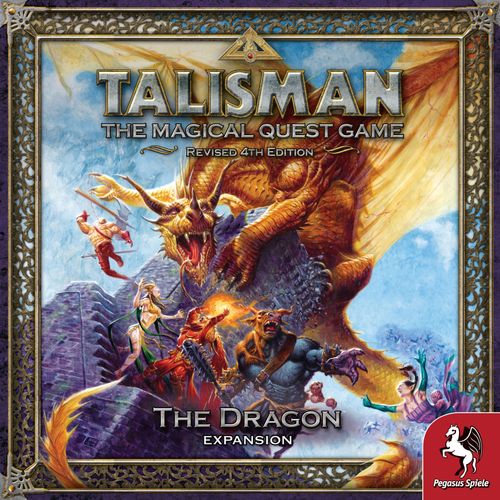
Talisman (Revised 4th Edition): The Dragon Expansion
Talisman (Revised 4th Edition): The Dragon Expansion Rulebook
Table of Contents
Table of Contents
- Object of the Game
- Components
- Component Overview
- Using Only Portions of This Expansion
- Using the Dragon with Other Expansions
- Setup
- Expansion Rules
- Matching Tokens and Cards
- Drawing Dragon Tokens
- Dragon Lore
- Crowning the Dragon King
- Example of Crowning the Dragon King
- Enemy Dragons
- Encountering Dragon Scales
- Claiming Dragon Scales
- Dragon Scales and Multiple Enemies
- Board Overlay
- Confronting the Dragon King
- Alternative Ending Cards
- Other Rules
- Optional Rules
- Helpful Hints
- Character Lore
- Dragon Tower Lore
- Rules Summary
Object of the Game
The object of the game is to reach the Crown of Command in the centre of the board and vanquish the Dragon King (see "Confronting the Dragon King" on page 14).
Components
The Dragon expansion includes the following components:
- This Rulebook
- 1 Double-sided Board Overlay
- 168 Dragon Cards, consisting of:
- 56 Varthrax Cards
- 56 Cadorus Cards
- 56 Grilipus Cards
- 3 Alternative Ending Cards
- 3 Draconic Lord Cards, consisting of:
- 1 Varthrax Draconic Lord Card
- 1 Cadorus Draconic Lord Card
- 1 Grilipus Draconic Lord Card
- 140 Dragon Tokens, consisting of:
- 40 Varthrax Dragon Scales
- 40 Cadorus Dragon Scales
- 40 Grilipus Dragon Scales
- 6 Dragon Strikes
- 6 Dragon Rages
- 8 Dragon Slumbers
- 1 Crown Token
- 19 Sleep Tokens
- 6 Character Cards
- 6 Plastic Character Figures
Component Overview
Below is a brief description of each game component.
Board Overlay — The board overlay is placed on the main game board and replaces the Inner Region with new encounters and victory objectives. The Dragon Realm is featured on one side and the Dragon Tower is featured on the other. Before starting the game, players must decide which side to use.
Dragon Cards — The 168 Dragon Cards are separated into Varthrax, Cadorus, and Grilipus decks. Each deck of 56 cards features new Events, Enemies, Strangers, Objects, Followers, and Places. Dragon Cards are similar to Adventure Cards, but are encountered by characters exploring spaces occupied by one of the Draconic Lords' dragon scales.
Alternative Ending Cards — The use of the three new Alternative Ending Cards is optional, and players must agree whether or not to use them before starting the game (see "Alternative Ending Cards" on page 15).
Draconic Lord Cards — The three Draconic Lords (Varthrax, Cadorus, and Grilipus) represent the contenders for the Crown of Command. When a Draconic Lord seizes control of the Crown, he becomes the Dragon King for a time, until another Draconic Lord usurps him and becomes the next Dragon King.
Dragon Tokens — The 140 dragon tokens represent the Draconic Lords' dominance over the land. When a Draconic Lord has accumulated three dragon scales on his card, he becomes the next Dragon King!
Crown Token — The Crown token is placed on one of the Draconic Lords to indicate the current Dragon King. When another Draconic Lord accumulates three dragon scales, he seizes the Crown and becomes the current Dragon King.
Sleep Tokens — The 19 Sleep tokens may be placed on Dragons during the course of the game by certain encounters and effects. A sleeping Dragon has its fighting capabilities reduced but will wake up at the end of an attack if a character does not defeat it.
Character Cards — The six new character cards work exactly like those in the base game, and offer players an even larger selection of heroes to play.
Character Figures — Each of the new characters has a plastic figure used to represent that hero on the game board.
The Dragon Symbol — Cards in The Dragon expansion are marked with an expansion symbol to differentiate them from the cards in the base game.
Using Only Portions of This Expansion
Overcoming the dangers and perils of the board overlay and vanquishing the Dragon King is the greatest challenge for even the mightiest hero. While The Dragon expansion is intended to be used in its entirety as an epic quest for the Crown of Command, players are welcome to play Talisman using only some of the elements of the expansion in order to speed the game up or reduce the difficulty of the victory condition. The new characters and Alternative Ending Cards may be used without including the new tokens, cards, or board overlay. Players may also use the new Dragon Cards and Draconic Lord Cards without the additional challenge of the board overlay. See the "Optional Rules" section on page 16 for more details.
Using the Dragon with Other Expansions
The Dragon expansion can be used with any Talisman expansion, including boards that offer new Regions to explore such as the Dungeon and Highland. Characters may enter these Regions regardless of what tokens or cards from The Dragon expansion are placed on their entrance spaces.
Setup
When playing with The Dragon expansion, add the following steps after the base game's setup is completed:
- Place Board Overlay: Players must agree which side of the board overlay to use. If players are using The Dragon expansion for the first time, we recommend using the Dragon Realm side until they are more experienced with the game. The board overlay must be placed over the Inner Region on the main game board so the doorways of the Portal of Power on both boards line up correctly.
- Set Up Draconic Lord Cards: Shuffle the three Draconic Lord Cards facedown and place them next to the game board. Reveal one Draconic Lord at random by flipping the card faceup and place the Crown token on the card. Flip the other two Draconic Lord Cards faceup. Then place five life counters on each of the Draconic Lord Cards.
- Set Up Dragon Decks: Separate the Dragon Cards by colour into three decks (the Varthrax deck is red, the Cadorus deck is gold, and the Grilipus deck is green). Shuffle each deck individually and place it facedown beside its matching Draconic Lord Card.
- Set Up Dragon Tokens: Place all of the dragon tokens facedown next to the game board and randomize them. Players may prefer to place them in the box lid or a bowl instead. This forms a pool of dragon tokens.
- Place Sleep Tokens: Place all of the sleep tokens next to the game board. This forms a pool of sleep tokens.
After these steps have been carried out, the game is ready to begin!
(The rulebook's setup example diagram, which shows the placement of the board overlay and the Draconic Lord Cards, is not reproduced here.)
Expansion Rules
Three Draconic Lords are vying for control of the Crown of Command. When a dragon seizes control of the Crown, he becomes the Dragon King and claims dominance over areas on the board, represented by one of his dragon scales being placed on a space. The reign of the Dragon King is short-lived, however, and only lasts until one of the rival Draconic Lords gathers enough power to usurp the Crown and become the new Dragon King. Characters exploring spaces with dragon scales may face challenges from Dragon Cards instead of encountering the space normally.
These rules are used in addition to those in the main Talisman game when playing with The Dragon expansion.
Matching Tokens and Cards
Each dragon scale and Dragon Card matches one of the three Draconic Lords:
- Varthrax dragon scales and Varthrax Cards match the Draconic Lord Varthrax.
- Cadorus dragon scales and Cadorus Cards match the Draconic Lord Cadorus.
- Grilipus dragon scales and Grilipus Cards match the Draconic Lord Grilipus.
Drawing Dragon Tokens
At the start of each player's turn, he must draw one dragon token at random from the pool and resolve its effect. After the effect of the dragon token is resolved, the player continues his turn as normal. The effects of the various dragon tokens fall into two different types: special effects and dragon scales.
Special Effects
These tokens are always discarded after their effects have been resolved.
Dragon Strike — The character who drew the token immediately draws two additional dragon tokens from the pool and resolves them in the order in which they were drawn. If additional Dragon Strikes are drawn, the character must continue to draw additional dragon tokens. After the Dragon Strike is resolved, it is discarded.
Dragon Rage — The character who drew the token suffers the Dragon Rage of the current Dragon King (see "Dragon Rage" on page 15). After the Dragon Rage is resolved, it is discarded.
Dragon Slumber — The character who drew the token places a sleep token on one Dragon of his choice in any Region. If there are no Dragons on the board, he may place the token on any Enemy of his choice. If there are no Enemies on the board, the Dragon Slumber has no effect. After the Dragon Slumber is resolved, it is discarded.
When a character encounters an Enemy with a sleep token on it, the Enemy's Strength and Craft are both reduced by 3 points, to a minimum of 1 (see "Sleep Tokens" on page 15).
Dragon Scales
When a dragon scale is first drawn, it is placed on the matching Draconic Lord Card. The number of dragon scales on a Draconic Lord indicates how close he is to becoming the next Dragon King (see "Crowning the Dragon King" on page 8).
When a dragon scale is placed on the game board, characters may have to draw Dragon Cards when they encounter it on the space (see "Encountering Dragon Scales" on page 10).
When a dragon scale is placed in a character's play area, the character gains a bonus to his attack score for each dragon scale that matches his opponent (see "Claiming Dragon Scales" on page 11).
The effects of dragon scales vary depending on whether they are placed on a Draconic Lord, the game board, or a character's play area.
Dragon Lore
From storm-darkened skies, three Draconic Lords have descended upon the Firelands, their ancestral home, in an attempt to claim the Crown of Command. While all three dragons are mighty and fearsome, each is unique in his abilities and temperaments. The legends of these mythic creatures paint a terrifying picture.
Varthrax — An enormous dragon who possesses unthinkable strength and a keen tactical mind. Those who serve Varthrax thrive on physical combat and typically wield powerful weaponry. This Draconic Lord uses his influence to pit dishonoured knights and power-hungry warlords against those who would oppose his rule, particularly the noble knights who dwell within the Castle. Varthrax usually favours honourable victory in fair combat, but when given over to fits of rage, he lashes out violently, destroying anything and everything around him.
Cadorus — A cunning and calculating dragon with a vast hoard of gold that he uses to enact his complex schemes. Those who serve Cadorus excel in amassing great wealth and exerting political and economic influence. He holds especially strong sway among merchants and nobles who use their fortunes to starve and oppress the simple country folk of the land. Cadorus particularly despises the humble farmers who dwell within the Village, whose simple rural lives and agricultural strength defy the dragon's ability to bribe or starve them. Cadorus usually favours guile and subterfuge, but when given over to fits of rage, his boundless greed drives him to claim as much wealth as he can with no regard to subtlety.
Grilipus — A mysterious dragon who has mastered the magical art of leeching power from all living things around him. Those who serve Grilipus use spells and rituals to bend the forces of nature to serve their master's will. He is particularly adept at manipulating druids, rangers, and others who are tied to the natural elements. Grilipus finds the priests who dwell within the Temple intolerable and seeks to wipe them out for their worship of spirits that dwell within the sky, not the land. Grilipus is usually protective of the environment from which he draws his power, but when given over to fits of rage, his corrupt nature reaches out and poisons everything around him with death and decay.
Crowning the Dragon King
When a character draws a dragon scale, it is placed on the matching Draconic Lord Card. When the third dragon scale is placed on a Draconic Lord, he is immediately crowned the new Dragon King and the Crown token is placed on his card as a reminder of his status.
The character then takes one dragon scale from the Dragon King's card and places it on the character's space. If the space already has a dragon scale, it is placed in the next space counterclockwise that does not already have a dragon scale. If every space in the Region already has a dragon scale, the dragon scale is discarded and the character must suffer the Dragon Rage of the Dragon King instead (see "Dragon Rage" on page 15). The two remaining dragon scales on the Dragon King's card are discarded, and the character continues his turn as normal.
In this manner, the Dragon King changes throughout the game and spawns Varthrax, Cadorus, and Grilipus dragon scales on board spaces.
Important: Characters in the Inner Region do not place a dragon scale on their space; all three dragon scales on the Dragon King's card are discarded instead.
Example of Crowning the Dragon King
The Conjurer draws a Varthrax dragon scale at the start of her turn. The dragon scale is placed on the Draconic Lord Varthrax, which brings his total to three dragon scales.
This results in Varthrax being crowned the new Dragon King! The Crown token is placed on Varthrax, then the Conjurer takes one dragon scale from Varthrax and places it on her space. The remaining two dragon scales on Varthrax are discarded and the Conjurer continues her turn.
Enemy Dragons
Some cards and special abilities only affect Dragons.
The term "Dragon" refers to any Enemy with the word "Dragon" in the card type box. Cards and special abilities that only affect Dragons do not affect Draconic Lords or creatures in the Inner Region.
Encountering Dragon Scales
During the course of the game, dragon scales are placed on the board when Draconic Lords are crowned the Dragon King and as a result of various cards. If a character lands in a space that has a dragon scale, he may either encounter the space, a character in the space, or the dragon scale in the space.
Exception: When a character lands on a space with a dragon scale that matches the current Dragon King, that dragon scale must be encountered.
If a character encounters the dragon scale, he must draw one card from the deck that matches the dragon scale, even if there are already one or more cards in the space. The character must resolve all of the cards in the space following the normal rules (cards must be resolved in order of their encounter number, Enemies with the same encounter number add their Strength and Craft together, etc.). This may result in a character resolving an Adventure Card from the main game before he resolves the newly drawn card if the Dragon Card has a higher encounter number.
When a character encounters a dragon scale, all of the instructions on the space are ignored. In other words, the text on the space has no effect on the character or cards whatsoever. This can dramatically change the Regions, as dragon scales can potentially prevent characters from purchasing items in the Village, praying at the Temple, or healing at the Doctor.
If the Sentinel has a dragon scale that matches the Dragon King, characters may not use the space to cross to the Middle Region, but they may freely cross from the Middle Region to the Outer Region.
If the Portal of Power has a dragon scale that matches the Dragon King, characters may not use the space to cross to the Inner Region, but they may freely cross from the Inner Region to the Middle Region.
Example of Encountering a Dragon Scale
The Fire Wizard lands on the Ruins, which contains a Grilipus dragon scale. Grilipus is not the Dragon King, so the Fire Wizard may choose to encounter the space or the dragon scale.
The Fire Wizard decides to encounter the dragon scale and draws one Grilipus Card from the top of the deck and places it on the space.
Even though the Ruins has instructions to draw two cards, the Fire Wizard must ignore all of the instructions on the space when he encounters the dragon scale.
The Fire Wizard attacks the Carrion Drake and resolves the psychic combat normally.
Claiming Dragon Scales
If a character kills an Enemy from a Dragon Card, in addition to taking the Enemy as a trophy, he may claim the dragon scale on his space and place it in his play area. Dragon scales have two powerful effects:
- If a character encounters an Enemy or Draconic Lord, each dragon scale the character has that matches his opponent adds one point to his attack score.
- If a character is about to suffer a Draconic Lord's Dragon Rage (see "Dragon Rage" on page 15), he may discard one of his dragon scales that matches the Draconic Lord to cancel the Dragon Rage and not suffer any of the effects.
Characters may gain any number of dragon scales during the game. Dragon scales are not considered Objects, Spells, or Followers. Therefore, they cannot be ditched, stolen, sold, or traded. If a character is killed, all of his dragon scales are inherited by the player's new character.
Example of Claiming a Dragon Scale
The Minotaur lands on the Tavern with the Conjurer and a Varthrax dragon scale. Varthrax is the Dragon King, so the Minotaur must encounter the dragon scale; he may not encounter the Tavern or Conjurer instead. The Minotaur draws one Varthrax Card from the top of the deck and places it on the space.
The Minotaur attacks the Fire Drake and defeats it in battle. The Minotaur then claims the dragon scale because he killed an Enemy from a Dragon Card. The dragon scale is removed from the space and placed in the Minotaur's play area. The Minotaur also takes the Fire Drake as a trophy.
Example of Using Dragon Scales
The Conjurer lands on the Ruins, which contains a Carrion Drake and a Grilipus dragon scale. Grilipus is not the Dragon King, so the Conjurer may choose to encounter the space or the dragon scale. The Conjurer decides to encounter the space, and the Ruins instructs her to draw two cards. Since there is already a card on the space, the Conjurer only draws one Adventure Card to bring the total to two cards.
The card is another Enemy with the same encounter number, so the Carrion Drake and Shadow will fight as one during the psychic combat. The Conjurer has two dragon scales that match the Carrion Drake, so she adds 2 to her attack score. The Conjurer kills the Carrion Drake, so she claims the dragon scale on the space and places it in her play area.
Dragon Scales and Multiple Enemies
If a character resolves a battle or psychic combat with more than one Enemy at the same time, each dragon scale that matches an Enemy adds one point to his attack score.
Example: A character attacks two Enemies from the Varthrax deck with the same encounter number. The character has three dragon scales that match Varthrax, so he adds a total of six points to his attack score.
Example: A character attacks two Enemies with the same encounter number. One Enemy is from the Varthrax deck and the other Enemy is from the Cadorus deck. The character has one dragon scale that matches Varthrax and two dragon scales that match Cadorus, so he adds a total of three points to his attack score.
Board Overlay
The board overlay features the Dragon Realm on one side and the Dragon Tower on the other. Before starting the game, players must agree which side is to be used. The board overlay forms a new Inner Region and replaces the encounters and victory objectives from the main game board.
The Dragon Realm has a similar layout to the Inner Region from the main game board, but the challenges on each space grow even more dangerous as the number of dragon scales on the Draconic Lord Cards increases.
The Dragon Tower has a single path that leads to the Crown of Command, and characters move along the spiralling staircase by drawing cards from the Dragon King's deck.
Entering the Inner Region
The Dragon Realm and Dragon Tower can be entered by passing through the Portal of Power, which must be opened before it can be traversed. The instructions on the Portal of Power describe the rules for movement in the Inner Region.
Turning Back
A character in the Inner Region may decide to turn back and move back towards the Plain of Peril instead of moving towards the Crown of Command. A character who has turned back only moves one space per turn and ignores the instructions on all of the spaces on his return to the Plain of Peril. Once a character has declared his intention to turn back, he cannot change his mind, and he must go all the way back to the Plain of Peril. Once there, however, the character may move toward the Crown of Command or leave the Inner Region through the Portal of Power. A character wishing to pass through the Portal of Power from the Inner Region to the Middle Region does not need to open it. The character simply moves from the Plain of Peril to the Portal of Power.
Encounters in the Inner Region
None of the creatures, Enemies, or Draconic Lords in the Inner Region can be affected by any Spell, nor may they be evaded. A character may only encounter another character on the Plain of Peril and Valley of Fire. Characters in the Inner Region may be targeted by Spells and other effects unless the card specifically states otherwise.
If a card effect requires a character in the Inner Region to place a dragon scale in his Region, the scale is discarded instead.
Conquering the Dragon Realm
The die is not rolled for movement in the Dragon Realm. Instead, a character moves one space forward in the direction indicated by the arrow on the space. The instructions on each space in the Inner Region must be completed before a character can move on toward the Crown of Command. Conquering the Dragon Realm follows the same rules for traversing the Inner Region from the main game board, except some space instructions are changed and the challenges grow even more dangerous as the number of dragon scales on the Draconic Lord Cards increases.
Any effects or special abilities that refer to the Mines also apply to the Dragonstone Mines. Any effects or special abilities that refer to the Crypt also apply to the Dragonbone Crypt.
When a character reaches the Crown of Command, he must confront the Dragon King (see "Confronting the Dragon King" on page 14).
Ascending the Dragon Tower
The die is not rolled for movement in the Dragon Tower. Instead, a character draws the number of cards from the Dragon King's deck instructed by his space and encounters them. Note that characters draw Dragon Cards at the start of their turn to determine how many spaces they move; characters do not draw cards when they land on the space.
Example of Moving in the Dragon Tower
The Dragon Hunter begins his turn on the Plain of Peril. The space instructs him to draw one card which will determine whether he moves any additional spaces this turn. Varthrax is the Dragon King, so the Dragon Slayer must draw one Varthrax Card from the top of the deck and encounter it.
The Dragon Slayer encounters a Fire Drake and kills it, so he will move an additional space this turn. The Dragon Slayer moves forward two spaces and ends his turn.
If the Dragon Slayer were defeated by the Fire Drake, he would only move forward one space and the Dragon Card would be discarded at the end of his turn.
Encountering Dragon Cards in the Dragon Tower
Encountering Dragon Cards in the Dragon Tower follows all of the normal rules (cards must be resolved in order of their encounter number, Enemies with the same encounter number add their Strength and Craft together, etc.), except creatures cannot be affected by any Spell, nor may they be evaded. Characters may use dragon scales as normal. If a character is defeated or is instructed to miss his turn, he may not encounter any of the remaining cards on the space.
After a character has finished resolving the Dragon Cards he encounters, he moves one space forward towards the Crown of Command, plus one additional space for each Enemy he killed during his turn. If a character is defeated on a stairway, he must move one space back towards the Portal of Power as indicated on the space's instructions.
After the character ends his turn, all cards and tokens in the Dragon Tower are discarded.
When a character reaches the Crown of Command, he must confront the Dragon King (see "Confronting the Dragon King" on page 14).
Dragon Tower Clarifications
If a character on a stairway kills an Enemy but is defeated by another card during his turn, he must still move one space back towards the Portal of Power instead of moving forward.
If a character on a stairway has a stand-off, he moves forward normally.
If a card is placed on the Dragon Tower at the start of a character's turn, such as by a Spell or if the character ditches a Follower or Object, he still draws the number of cards indicated on the Dragon Tower's space. Characters must always draw the number of cards indicated on the Dragon Tower's space regardless of how many cards were already placed on the space.
If a character is forced to move clockwise, he moves following the direction indicated by the arrows on each space.
If a character is forced to move counterclockwise, he moves against the direction indicated by the arrows on each space.
Confronting the Dragon King
In order to confront the Dragon King, characters must overcome the dangers of the Inner Region and travel to the Crown of Command in the centre of the board overlay. When a character enters the Crown of Command, he immediately attacks the Dragon King. The character must choose whether to attack the Dragon King using Strength or Craft. Each time he defeats the Dragon King, he must remove one of the Dragon King's lives and immediately attack him again.
The character who removes the last life on the Dragon King wins the game!
If a character confronting the Dragon King has a stand-off or is defeated, his turn ends and he must attack the Dragon King at the start of his next turn. If the character is defeated, in addition to losing a life, he suffers the effects of the Dragon Rage listed on the Dragon King's card. If the character is killed and there are no other characters on the Crown of Command, the Dragon King heals all his lives.
When a character is on the Crown of Command, he does not move and must continue to attack the Dragon King; he may not turn back and move towards the Plain of Peril.
If three dragon scales are placed on a Draconic Lord while any characters are on the Crown of Command, one dragon scale from the Draconic Lord's card is placed on a space and the two remaining dragon scales on the card are discarded as normal. However, the Crown token is not moved to the Draconic Lord. In other words, the Dragon King does not change while a character is on the Crown of Command.
Once any character has reached the Crown of Command and confronted the Dragon King, any character who is killed automatically loses the game. Note that this rule stays in effect for the rest of the game.
Alternative Ending Cards
The use of Alternative Ending Cards is optional, and players must agree whether or not to use them before starting the game. Alternative Ending Cards allow players to use the cards and tokens from this expansion in new ways. However, players cannot play with The Dragon expansion in its entirety and Alternative Ending Cards at the same time.
Setup
The Alternative Ending Cards should be shuffled at the start of the game and one card, drawn at random, is placed faceup on the Crown of Command at the centre of the game board.
Encountering Alternative Endings
Alternative Ending Cards replace the base game's victory conditions, offering players new ways to win the game. When using the Alternative Ending Cards, characters on the Crown of Command must encounter the Alternative Ending Card and follow the rules printed on the card – they cannot cast the Command Spell or encounter other characters on the Crown of Command.
All other rules regarding the Inner Region still apply when playing with Alternative Ending Cards:
- None of the creatures in the Inner Region (nor any of the Alternative Ending Cards) can be affected by any Spell. They also cannot be evaded.
- Characters on the Crown of Command cannot move and must remain on that space unless the Alternative Ending Card specifically states otherwise.
- Once any character has reached the Crown of Command, any character who is killed automatically loses the game.
Alternative Ending Cards generally only affect characters on the Crown of Command. However, instructions that have a star icon at the start of their text affect all characters, no matter what Region they are in, including characters on the Crown of Command.
Other Rules
This section clarifies rules regarding the new components for The Dragon expansion.
Dragon Rage
Each of the three Draconic Lords features a Dragon Rage effect: Varthrax forces characters to discard a Follower, Cadorus forces characters to discard an Object, and Grilipus forces characters to discard a Spell.
If a character does not have the required card to discard, he loses one life instead. If a character has a dragon scale that matches the Draconic Lord, he may discard the dragon scale to cancel the Dragon Rage and not suffer any of the effects (see "Claiming Dragon Scales" on page 11).
Sleep Tokens
Characters may have the opportunity to place sleep tokens on Enemies during the course of the game. When a character encounters an Enemy with a sleep token on it, the Enemy's Strength and Craft are both reduced by 3 points, to a minimum of 1.
An Enemy can only have one sleep token placed on it at a time. For example, two sleep tokens cannot be placed on an Enemy to reduce its Strength by 6 points.
If a character encounters a sleeping Enemy, its sleep token is returned to the pool at the end of the turn, regardless of whether the Enemy was killed or the character was defeated. Killing a sleeping Enemy does not reduce its points as a trophy – the Enemy is worth the full value printed on its card.
Drawing from the Dragon King's Deck
When characters are instructed to draw cards from the Dragon King's deck, the cards must be drawn from the deck that matches the Draconic Lord who is the current Dragon King.
Breath Attacks
Some Dragons make a breath attack before the character's attack is resolved. If a character suffers the effects of a breath attack, he must still resolve the battle or psychic combat unless specifically stated otherwise.
If a character has a Spell or ability that is used when he is about to engage in battle or psychic combat, it is implemented before the breath attack is resolved.
If a character evades the Dragon, he does not resolve the Dragon's breath attack.
Special Abilities Involving Dragon Cards
Special abilities and effects that apply to Adventure Cards also apply to Dragon Cards but only after they have been drawn and placed on the board.
Example: The Prophetess's special ability states that whenever she draws Adventure Cards, she may discard one card of her choice and draw one more card to replace it. The Prophetess may not use her ability when she draws Dragon Cards.
Example: A character lands on a space with a Dragon Card and casts the Destruction Spell. The Spell's effect allows him to remove any faceup Adventure Card from the board and place it on the discard pile. The character may cast Destruction on the Dragon Card because it has already been drawn and placed on the board.
Discarding Dragon Tokens
When dragon tokens are discarded, they are removed from the game and returned to the box. If every dragon token is taken from the pool, return all of the dragon tokens that were removed from the game (including any discarded dragon scales) back to the pool facedown and randomize them to form a new pool.
Discarding Cards
If an effect such as suffering the Dragon Rage of the Dragon King forces a character to discard Objects, Followers, or Spells, the character chooses which card to discard unless the effect specifically states otherwise.
Running out of Cards
If a deck of Dragon Cards is exhausted, all of the discarded cards from the deck are shuffled and placed facedown beside its matching Draconic Lord Card to form a new deck.
Missing Turns
If a character misses his turn, he does not draw a dragon token on the turn that he loses.
Optional Rules
These are rules that players can include to add new experiences to the game. If players want to use any of the rules discussed here, they should make sure that everyone understands and agrees to the rules before the game begins.
Wrath of the Dragon King
This variant makes dragon scales on spaces even more dangerous to encounter.
If a Draconic Lord is crowned when he is already the current Dragon King, the following effects are applied to every space that has a dragon scale that matches the Dragon King:
- All characters on the space suffer the Dragon Rage of the Dragon King.
- All cards on the space are discarded, including any Adventure, Dragon, Spell, and Purchase Cards as well as cards from any other decks. Any dragon scales on the board remain.
The wrath of the Dragon King is implemented after the Draconic Lord is crowned, but before the character places a dragon scale on his space.
Challenge for the Crown
This variant creates the most challenging victory conditions characters can face. The added peril and dangers characters must overcome on their path to the Crown of Command also increases the length of the game significantly. When playing with this variant, we recommend that players use the "Starting Bonus" and "Strength and Craft" alternative rules for faster play on page 21 of the main game's rulebook.
The Dragon expansion is played following all of the normal rules, except the Dragon Tower board overlay is placed next to the main game board instead of being placed over the Inner Region.
In order to win the game, characters must first journey to the centre of the Inner Region on the main game board. When a character enters the Crown of Command on the main game board, he immediately moves to the Plain of Peril on the Dragon Tower. Only when a character enters the Crown of Command on the Dragon Tower can he confront the Dragon King and win the game by vanquishing him.
If an encounter moves a character to a location in the Inner Region, the character must move to the indicated space on the main game board; he may not move to the indicated space on the Dragon Tower. For example, if a character encounters the Great Portal and is able to move to the Plain of Peril, he must move to the Plain of Peril on the main game board.
Dragon Spawn
This variant gives characters the opportunity to encounter dragon scales earlier in the game.
After the game setup is complete, the character who will take the first turn reveals a random dragon token from the pool until a dragon scale is drawn; any Dragon Strike, Dragon Rage, or Dragon Slumber tokens that were drawn are kept faceup next to the pool. The character rolls a die and places the dragon scale that many spaces away clockwise from his start space following the normal rules for placing dragon scales: If the space already has a dragon scale, it is placed in the next space counterclockwise that does not already have a dragon scale. The character then draws another dragon token, rolls a die, and places the dragon scale that many spaces away counterclockwise from his start space.
The next character continues the process of drawing a dragon token and placing the dragon scale clockwise and counterclockwise from his start space until each character has placed two dragon scales on the board. Any Dragon Strike, Dragon Rage, or Dragon Slumber tokens that were drawn are now returned to the pool facedown and randomized. After these steps have been carried out, the game is ready to begin!
Helpful Hints
Each deck of Dragon Cards features different challenges and rewards. As players discover the themes of each deck, they will learn which encounters are best suited for their character.
When a dragon scale that matches the Dragon King is on a space, all of the instructions on the space are ignored. Characters can use this to their advantage and have encounters on spaces that they would normally avoid, such as the Deserts in the Middle Region. Characters should also be aware when dragon scales may nullify vital spaces, such as the Healer in the Village.
If a space has a dragon scale and an Adventure Card has already been placed on the space, courageous characters may choose to encounter the dragon scale instead of the space. This allows the character to draw a Dragon Card as well as encounter the Adventure Card that is already on the space. Encountering multiple cards during a turn is a powerful advantage which is similar to gaining an extra turn.
If a space has a dragon scale and an Enemy has already been placed on the space, cautious characters may choose to encounter the space instead of the dragon scale (as long as the dragon scale does not match the Dragon King). Avoiding the dragon scale prevents unexpected dangers from being placed on the space, such as drawing another Enemy.
Collecting dragon scales from each of the three Draconic Lords will help protect against unexpected Dragon Rage attacks.
The effects of some Dragon Cards become more powerful depending on which Draconic Lord is the Dragon King. Encountering dragon scales that match the current Dragon King may become even more dangerous than normal.
Character Lore
Dragon Hunter — A fierce fortune-seeker who has perfected the dangerous art of tracking and slaying dragons to claim their hoards and collect rewards from terrified villagers.
Fire Wizard — A volatile and frightening master of pyromancy who is torn by the constant struggle between his rational pursuits and the all-consuming rage that burns inside of him.
Dragon Rider — A fearless and insightful traveller who, through discipline and bravery, has uncovered the mysteries of taming dragons, turning them from ferocious enemies to loyal companions.
Conjurer — A deft and nimble practitioner of the magical arts who uses her miraculous sleight-of-hand to entertain and delight those she encounters.
Dragon Priestess — A domineering and power-hungry matriarch of the Dragon Cults who can perform ancient rituals and sacrifices to gain boons from the dragons she worships.
Minotaur — A brutish creature of unrestrained violence who charges forward to crush anything in his path with no regard to the devastation that he brings.
Dragon Tower Lore
At the very heart of the realm lies a volcanic wasteland known as the Firelands. Long ago, a great tower stood in the centre of the Firelands from which the Dragon King ruled. The Dragon King was both strong and wise, and while none dared trespass within his domain, dragonkind never presumed to expand their borders beyond the Firelands.
But one day a mighty wizard challenged the Dragon King for the right to enter the sacred Valley of Fire, the birthplace of dragonkind. The Dragon King burned with rage at the wizard's insolence and attacked him with the ferocity of flame and fang. An epic battle ensued, and while the wizard was a master of the arcane arts, he was no match for the Dragon King. The wizard realised that no spell in his arsenal could kill the Dragon King, but there was magic powerful enough to banish him. The wizard performed his ritual and opened a portal between the realm of dragons and a horrible black void. The tower was pulled apart as stone after stone disappeared into the void, and although he struggled fiercely, the Dragon King ultimately disappeared into the void as well. With their king gone, the remaining Draconic Lords fled to the extreme corners of the world, fearful of the wizard's wrath should they ever return.
Seeing that the Dragon Tower had been reduced to a shattered husk, the wizard travelled to the Valley of Fire, where he used its searing eldritch heat to craft the Crown of Command, the most powerful artefact ever created. Empowered by the Crown, he ruled over the land for many, many years until the end of his life.
Since then, secret Dragon Cults have formed, praying that the Draconic Lords will someday return and grant the cultists power and influence in exchange for their worship. These cults tell of a prophecy in which one day a new Dragon King will arise, ruling the entire realm from a new Dragon Tower and adorned with the Crown of their enemy. After years of labouring in secret, the Dragon Cults' patience was finally rewarded. They found three of the Draconic Lords – Varthrax, Cadorus, and Grilipus – who had gone into hiding many years ago. The cultists told the Draconic Lords that the wizard who drove them off was dead and that the Firelands were ready to be reclaimed.
To each of the Draconic Lords, this was at last an opportunity to not just return to their ancestral home, but to claim the Crown of Command. With the awesome power of the Crown, a Draconic Lord could establish himself as the undisputed new Dragon King, ruling over his brethren and subjugating all other living things to his will. Believing no other dragon to be worthy of the title, each Draconic Lord now struggles to establish dominance by rebuilding the Dragon Tower.
Once the tower is complete and one of the Draconic Lords acquires the Crown of Command, the Dragon Cults' prophecy may well come to pass. A new era of dragons will begin, and all living things will bow to the sovereign rule of the new Dragon King!
Rules Summary
The rules summary contains the basic rules players need to play The Dragon expansion.
Matching Tokens and Cards
- Varthrax dragon scales and Varthrax Cards match the Draconic Lord Varthrax.
- Cadorus dragon scales and Cadorus Cards match the Draconic Lord Cadorus.
- Grilipus dragon scales and Grilipus Cards match the Draconic Lord Grilipus.
Drawing Dragon Tokens
At the start of each player's turn, he must draw one dragon token at random from the pool and resolve its effect. After the effect of the dragon token is resolved, the player continues his turn as normal.
Dragon Token Descriptions
- Varthrax Dragon Scale — Place the token faceup on the Draconic Lord Varthrax. This may result in Varthrax becoming the Dragon King.
- Cadorus Dragon Scale — Place the token faceup on the Draconic Lord Cadorus. This may result in Cadorus becoming the Dragon King.
- Grilipus Dragon Scale — Place the token faceup on the Draconic Lord Grilipus. This may result in Grilipus becoming the Dragon King.
- Dragon Strike — The character who drew the token immediately draws two additional dragon tokens from the pool and resolves them in the order in which they were drawn. If additional Dragon Strikes are drawn, the character must continue to draw additional dragon tokens. After the Dragon Strike is resolved, it is discarded.
- Dragon Rage — The character who drew the token suffers the Dragon Rage of the current Dragon King (see "Dragon Rage" on page 15). After the Dragon Rage is resolved, it is discarded.
- Dragon Slumber — The character who drew the token places a sleep token on one Dragon of his choice in any Region. If there are no Dragons on the board, he may place the token on any Enemy of his choice. If there are no Enemies on the board, the Dragon Slumber has no effect. After the Dragon Slumber is resolved, it is discarded.
When a character encounters an Enemy with a sleep token on it, the Enemy's Strength and Craft are both reduced by 3 points, to a minimum of 1.
Dragon Scales
The effects of dragon scales vary depending on whether they are placed on a Draconic Lord, the game board, or a character's play area.
When a dragon scale is first drawn, it is placed on the matching Draconic Lord Card. The number of dragon scales on a Draconic Lord indicates how close he is to becoming the next Dragon King (see "Crowning the Dragon King" on page 8).
When a dragon scale is placed on the game board, characters may have to draw Dragon Cards when they encounter it on the space (see "Encountering Dragon Scales" on page 10).
When a dragon scale is placed in a character's play area, the character gains a bonus to his attack score for each dragon scale that matches his opponent (see "Claiming Dragon Scales" on page 11).