TaleSpin: The Card Game
TaleSpin: The Card Game Rulebook
Table of Contents
Table of Contents
Game Setup
Remove the four Player cards, the twelve Location cards and the two extra Cargo cards from the deck. (The extra Cargo cards have a Shere Khan logo in the upper left corner.) Each player selects a Player card: either Baloo, Don Karnage, Kit Cloudkicker or Molly Cunningham. Build the Location Ring by arranging the 12 Location cards in order like the face of a clock. Each player should choose a character token (like a coin, action figure or small model plane) and place it on one of the four N/E/S/W Locations: 12, 3, 6 or 9. Make sure your characters start exactly opposite each other.
These rules are written for a two-player game. See page 13 for rules for playing with three or four players.
Starting locations
- Don Karnage: 12 - Iron Vulture (or 9 - Cape Suzette)
- Kit Cloudkicker: 3 - Louie's (or 12 - Iron Vulture)
- Baloo: 6 - Higher for Hire (or 3 - Louie's)
- Molly Cunningham: 9 - Cape Suzette (or 6 - Higher for Hire)
Players vs. Passengers
There are two cards for each of the game's main characters: Baloo, Kit, Molly and Don Karnage. The Player version to represent you, and the Passenger version to be included in the deck. Whichever characters are not used should be shuffled back into the deck. For example: if the players are using Baloo and Kit, shuffle the Passenger versions of Molly and Don Karnage into the deck.
Card Types
Action cards
These cards are played during Step 2 of your turn. Some may be played on your opponent's turn; these cards will say on them when they can be played. Some may have a cost associated with them, such as "Discard a card from your hand to do X." Once you have determined that you can play an Action card, do whatever it says.
If an Action card has a tiki symbol on it, then you may only play that card once during your turn.
Location cards
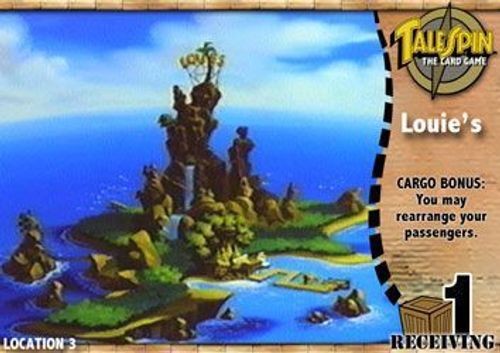
The Location cards form the game's Location Ring, arranged like the face on a clock according to the number in the lower left corner. Each Location has a RECEIVING score, which is the minimum number of SHIPPING you need to play cargo there.
Some Locations have a Cargo Bonus effect. This is a special effect that is resolved only if you play cargo at that Location. You can get an idea how good the Bonus is by the RECEIVING score.
Cargo cards
These cards are the only true cargo in the game. They are played during Step 3 of your turn.
Artifact cards
Artifacts are played on your turn to any Player's cargo hold, during Step 2. Artifacts are not considered "bluffs" when revealed as open cargo. Artifact effects apply only to the Player that controls them, not necessarily the Player who played them.
Character cards
Characters are either Players, Passengers or Pilots. If the rules or card text references a "character," you can assume it means any of the three types. All three types have keywords which indicate sub-classes of characters and make some characters viable targets for certain cards and effects. Each character has a color classification - blue or red - indicated by the big icon in the lower right half of the card. Blue characters have a star icon. Red characters have the pirate symbol.
Players
These cards represent you in the game world and cannot be discarded. Each Player has a base level in the three stats: SHIPPING, RANGE and PILOT. The stats indicate the Player's natural skill in the three areas. SHIPPING deals with the ability to cargo; a Player's SHIPPING must meet or beat the given Location's RECEIVING score to play cargo at that Location. RANGE shows how many Locations - counting from your current Location and going in either direction - that your Player can start a dogfight. Your PILOT skill is your character's overall prowess and translates to the number of bonus cards you draw at the beginning of a dogfight.
Players have a die effect table on them, showing the possible results of a six-sided die roll. Die effects are rolled during Step 3 of your turn. Players also have a unique maneuver that is used when they start dogfights.
Passengers
Passenger cards add effects and abilities to your Player character. They generally contain bonus versions of the three stats, meaning that they add their value to your Player's total. Passengers also have a die effect table.
Passengers are played during Step 2 of your turn phase, and are always played to the table immediately behind either your Player card or your last played Passenger. This forms a Passenger priority chain that determines the order in which to apply die effects. Passengers may not be re-ordered unless a game effect allows it. Many effects will force the discard of your last Passenger in the chain, so it is important to protect your most useful Passengers by finding ways to shift them to the beginning of your chain.
Each player has a maximum of four Passengers. To take on a new Passenger after you have reached your max, you must play the new Passenger at the end of the chain and then immediately discard any other Passenger in your chain.
Remember, you may not re-arrange your Passengers in the chain unless a card effect allows you to do so. However, if Passenger #2 is discarded, the remaining Passengers immediately shift up and fill the empty space.
Playing passengers
Example #1: Molly wants to play Wildcat as a new Passenger. He goes to the end of the chain.
Example #2: Now Molly wants to play Gibber, but she already has the maximum number of Passengers. Gibber goes to the end of the chain, and Molly must immediately discard one of her existing Passengers. We suggest tossing the Monkey Workers. Once they are gone, Baloo, Wildcat and Gibber may move directly behind Torque to tighten the line.
Molly's Passenger chain now looks like this (see the chain diagram on the printed page).
Pilots
Pilot cards are played during Step 2 of your turn. A Pilot card starts a dogfight against any opponent, regardless of the opponent's Location. Your Player's RANGE does not apply to dogfights initiated by a Pilot card. Pilot cards have a PILOT numerical skill and may contain a Reward. Rewards are collected if you win the dogfight. See the section on dogfights to see how to play a Pilot card.
Some Pilots have effects that change the rules of the dogfight they started. These effects are only active for the duration of this dogfight.
To help distinguish between Passenger cards and Pilot cards, check the keywords below the card artwork. Also, Pilots have a darker card background. Passengers may have any (or none) of the stats; Pilots only have the PILOT stat.
Maneuvers
All cards have a maneuver displayed on the right hand side. Maneuvers are used when your characters meet in thrilling aerial dogfights. Each maneuver has a name and a number. The numerical value goes from 1 to 13. If an additional effect lowers or raises that number, it can never go lower than 1 or higher than 13. In dogfights, the higher number wins, and identical numbers favor the defender.
Most maneuvers have dogfight effects on them, Damage and Draw. These are the results of the dogfight and they are tallied only by a winning attacker. The Damage icon allows the attacker to wreck the defender's cargo. The Draw icon lets the attacker draw a card from the draw pile. Note that even though each number from 1 to 13 has a name assigned to it ("Strafe," "Cloud Cover," etc.), not all maneuvers with the same name will have identical dogfight effects.
Maneuvers have their values displayed on both sides of the card, so you can easily align the sides of two cards and quickly see if one card beats another. The right hand side indicates the maneuver's attacking value and the left side shows the defensive value. In all cases but one, the values are the same on both sides. The exception is the Lucky Shot. When used as an attack, it is a 1. On defense it has a special effect, so watch your maneuvers carefully.
When a card is played as a dogfight maneuver, the rest of the card - including any card text, keywords or stats - is completely ignored.
Your Turn
Summary:
- Draw 1 card, or draw until you have 5 cards in hand.
- Play cards from hand.
- Roll the die once and follow effects on your Player and Passengers in chain order.
- All players discard down to 7 cards if necessary.
1. Draw
At the beginning of your turn, draw 1 card. If you have less than 5 cards in your hand, continue to draw cards to bring your hand up to 5.
Note (printed sidebar): the max hand size is 10. Once you have 10 cards in hand, you can't draw any additional cards, even Pilot bonus cards!
2. Play
You may perform actions in the Play phase in any order. You may:
- Play a Passenger card to your chain
- Play a Pilot card to start a dogfight
- Start a dogfight using your Player's RANGE
- Play an Action card from your hand that says "play on your turn" or similar
- Play an Artifact card to any Player's cargo hold
You may play as many Passengers, Artifacts and Actions as you like, but there can be only one dogfight per turn. All players have a maximum hand size of 10. Once a player has 10 cards in hand, he or she may not draw additional cards, even when instructed to do so by a card or effect.
3. Roll
Roll a six sided die and apply character effects in order. Start with your Player character and follow the instructions according to your roll. For Player characters, the result is most often a "move X Locations, then play cargo" effect. This means you move your token around the Location ring in either direction, then play a card as cargo if possible. X can not equal 0. See the section on playing cargo for details.
Then continue to your first Passenger if you have one. Follow the effects on that character and continue on down your priority chain. If an effect discards a Passenger, discard them when you come to them in the chain... not before and not after. If an effect shuffles a Passenger's position in the priority chain - say, Move to Last Position - then do that immediately, but you do not follow the effect again should you come back to that character later in the chain. Keep in mind: it pays to peek ahead to see what abilities your Passengers can perform!
Rolling the die
Example: Molly has rolled a 3. First, look at Molly's card: move up to 3 spaces and play cargo...
After completing that move/play effect, Molly must work her way down the passenger chain. First up is Torque, who discards himself, so the remaining passengers can all shift up one. A 3 for Baloo is "no effect." Wildcat makes all players draw 1 card (do it in turn order, beginning with Molly.) Last is Gibber, who says "move to first position." Move Baloo and Wildcat down one to make room for Gibber at the head of the line. Now step 3 of Molly's turn is complete.
At the end of her turn, Molly's passenger chain should look like this (see the chain diagram on the printed page).
4. Discard
All players must discard down to seven cards in hand. If you have five played cargo on the table, you win! You must completely end your turn to check for victory, just in case one of your Passengers would ruin it for you.
Playing Cargo
You only play cargo as instructed by the die roll effect on your Player card. You may not always be able to play cargo every turn, depending on the Locations within your movement range and the total SHIPPING score of your team.
To play cargo, your current SHIPPING must meet or beat the RECEIVING score of your current Location. So a player with a total SHIPPING of 3 could play cargo at any Location with a RECEIVING of 3 or lower.
Once you have determined that you can play cargo, you select ANY card from your hand and play it facedown into your "cargo hold." This card is now "packed cargo." Note that you can play ANY card as packed cargo, not just the special Cargo cards. Packed cargo counts towards your win, so it's a good idea to use whatever cards you have available to bluff your way to a full hold.
Some Locations have a Cargo Bonus. This is a special effect that is resolved only if you play cargo at that Location. Always apply the Cargo Bonus after you play your cargo, before continuing with the rest of the die effects in your chain.
Your cargo cannot be mixed up or moved once it is on the table (unless a game effect allows you to do so.) You can tighten up your lineup of packed cargo if one in the middle disappears, however.
Since cargo is your route to winning, you can expect to have your opponents do whatever they can to wreck it. There are two ways to affect your opponents' packed cargo. You can open the cargo, and you can damage the cargo. Lots of card effects will let you open cargo, but damage only results from a dogfight (See the section on dogfighting.)
Calculating your shipping
Example: Your shipping is the total amount of your Player and all your Passengers in the chain. In this example, Kit moves to the Khan Industries Location, which has a RECEIVING of 6. Kit has a SHIPPING of 2, but his Passenger Rebecca has a SHIPPING of 4, so together they have just enough shipping to play cargo. If Kit moved there and did not have Rebecca as a Passenger, his total SHIPPING would be 2 and therefore he would be unable to play cargo this turn.
Opening cargo
The effect "open X cargo" allows you to flip over X number of packed cargo on the table (even your own. In fact, it MUST be your own if there is no other packed cargo on the table.) In all cases, if you flip over a packed cargo and it is revealed to be a genuine Cargo card (or an Artifact), then it stays where it is, faceup. The Cargo or Artifact card is now considered "open cargo." However, if the card was not a Cargo or Artifact card - a bluff card of any other type - then it is immediately discarded.
The effect "repack and mix up your cargo" allows you to flip all your open cargo facedown and completely mix up all your cards in the hold. These are separate instructions - although they most often appear as one effect - so if a card allows only a repack, then you may only do the flip over, not the mix up.
The effect "steal cargo" allows you to take an opponent's cargo and place it in your own cargo hold. Stealing cargo is not playing cargo. When you steal cargo, it comes in your hold in the same state in which it was stolen: facedown or faceup. As the new owner of the cargo, you are allowed to peek at it if it is facedown.
Note (printed sidebar): Once you have four cargo (packed or open) in front of you, then the next cargo you play (or steal) must be a genuine Cargo card (not an Artifact) played open (faceup) to win. If you have four packed cargo and do not have a Cargo card in your hand, you CANNOT play OR steal any cargo until you can draw a Cargo card or can steal an open one.
Example (printed sidebar): Kit played an effect that lets him open two cargo. Karnage has four packed cargo in his hold, so Kit chooses to open the two in the middle. One is shown to be a real piece of cargo, so it stays where it is; it remains faceup. The other one is a bluff, so it is discarded right away.
Playing cargo is a bluffing game. You should play cargo every turn, whether it's real or not. The benefit to real Cargo is that it sticks around longer in dogfights, but bluffing will often be the quickest path to a win.
Dogfights
A dogfight is initiated by either a Pilot card or a Player card (Player dogfights must be within the RANGE stat of the Player character. Remember that a Player's RANGE is equal to the RANGE of the Player plus any relevant bonuses from Passengers.) That Player is the attacker, and the chosen opponent is the defender. In the dogfight, the attacker plays three maneuvers one at a time. For each attacking maneuver, the defender must match or beat it with a maneuver of his or her own. The dogfight ends when the defender can't (or chooses not to) block the attacking maneuver, or when the defender successfully blocks the attacker's final maneuver. If the attacker wins the dogfight, he or she gets to perform any Pilot reward actions and carry out any dogfight effects. If the defender wins, he or she receives a "bounty": the choice of any card played as a maneuver.
Once the attacker starts a dogfight, the defender has the choice to defend; if the defender opts out, the attacker has won the dogfight and gets to apply any rewards or effects.
Finding your range
Example: In this example, the player is at the Location with the black dot. A range of 2 puts all the red dot Locations within his or her range. This player can start a dogfight at any of these five Locations.
If the defender accepts, each participant draws cards according to their individual PILOT skills. The attacker always draws first, according to the PILOT skill of the card that started the dogfight, either a Pilot card or the total PILOT skill of his or her Player and Passengers (if the dogfight has been started by the Player's RANGE.) For the defender, the amount of cards drawn will always be the total PILOT skill of the Player card and any Passengers with pluses to PILOT.
Once both participants have drawn their PILOT bonus cards, the attacker begins the dogfight with the first attacking maneuver. The attacker's first maneuver is not a card from his or her hand, however... it's the one printed on the Pilot card or Player card, depending on how the dogfight was started. The Pilot card should be placed in the center of the table to display the first maneuver.
The defender must either play a maneuver from his or her hand or concede the dogfight. If the defender chooses to play a defensive maneuver, the numerical value must meet or beat the attacking maneuver's value. The blocking maneuver should be placed on the table side by side with the attacking maneuver so it is obvious to all that the attack has been stopped. If the defender has no maneuvers in hand that can block the attacking maneuver - or he or she simply chooses not to defend against it - then the attacker has won the dogfight.
Note (printed sidebar): When arranged side by side, the red streak visually indicates which maneuver is greater.
Dogfighting
Example: Don Karnage, fearless Air Pirate, wants to attack Baloo. Baloo is within Karnage's RANGE, so he opts to initiate a dogfight himself. Karnage uses his built-in "Pirate Attack" maneuver, which has a value of 6 and a double damage effect. If Baloo would choose not to defend against the attack, he would have to take the double damage. However, Baloo is a great pilot and thinks he has a good chance to successfully defend. So Baloo accepts and both Players draw extra cards to their hand, based on their respective PILOT skills. Karnage, as the attacker, draws first: 2 cards. Then Baloo draws his 3 cards.
Karnage points out his first maneuver: the 6 built into his Player card, then Baloo gets to play a defensive maneuver from his hand. He plays a card with a maneuver of 8, beating the 6. Karnage's next maneuver is a 3 with another double damage effect on it. Baloo blocks this one with a 4. But he won't be able to handle Karnage's final maneuver: a 10. Baloo has no cards in his hand that can meet or beat a 10, so he is forced to concede. Don Karnage wins the dogfight and Baloo must suffer four damage. Ouch!
If the attacking maneuver is blocked, then the attacker must play a second maneuver. The defender again has the option of blocking or conceding. If the defender successfully blocks this maneuver, then the attacker must play a third maneuver.
If the defender can block all three attacking maneuvers, the defender wins the dogfight. If the attacker runs out of cards before playing all three attacking maneuvers, the defender wins the dogfight.
Note (printed sidebar): If the defender accepts the dogfight, draws PILOT bonus cards, but then concedes before playing any defensive maneuvers, the defender must suffer an additional Damage effect as well as whatever results from the attacker winning the dogfight.
Note (printed sidebar): The attacker draws pilot bonus cards according to one of the following, depending on how the dogfight was started: the PILOT stat of the Pilot card used to start the dogfight, or the total PILOT stat of the Player card plus any bonuses from Passengers. The defender always draws according to the total PILOT stat of the Player card plus Passenger bonuses.
Rewards, damage, draw and bounties
If the attacker wins, first resolve the reward listed on the attacking card (if any; Pilots usually have rewards, but Players do not.) Then total the Damage and Draw effects on the attacking maneuvers. Resolve the Damage first and then the Draws.
For each Damage effect, the attacker has three choices:
- Select one of the defender's packed cargo and open it.
- Select one of the defender's open cargo and discard it.
- Force the defender to discard one card. The defender gets to choose which card.
For each Draw effect, the attacker draws one card from the deck.
These effects are carried out one at a time and treated as separate events, so a total effect of 2 Damage would allow the attacker to open one packed cargo and then discard that same card if it turns out to be real Cargo.
If the defender wins, he or she gets to claim a bounty on the attacker. This means the defender may select any one of the maneuver cards on the table from this dogfight and put it into his hand... except any Player cards. (Similarly, if either player has a card/effect to draw from the played maneuvers, Player cards are not eligible.)
After the dogfight is over and all possible effects are resolved, discard all maneuvers still on the table (except for Player cards; if a Player card was used to start this dogfight, return that card to that player.)
Additional
Card text always outranks any "absolutes" mentioned in this rulebook. For example, the card "Double Check" lets you play cargo instantly, during Step 2 of your turn.
Multiple Players can be on the same Location.
If you are ever told to search the draw pile for a card, always shuffle the deck when you are done.
There are many action cards that can be played during a dogfight, even if it is not your turn. These cards will specify when they can be played. See the Dogfight Timing Table for a detailed explanation of the dogfight sequence.
The player whose turn it is always gets to play cards first in the event that several players want to play cards simultaneously. In fact, whenever anything happens simultaneously - say, multiple players are all told to draw a card - always start with the player whose turn it is, and then continue around in turn order. The only exception is when dogfighting... the attacker always plays first, followed by the defender, followed by any other players in turn order from the attacker.
For a longer game, play to seven cargo instead of five.
Don't forget that ALL PLAYERS must discard down to seven cards at the end of each player's turn.
If an effect would cause you to draw cards over the hand limit of 10, just draw up to 10 and stop.
When a card effect tells you to open cargo, you must do it to the full extent unless there are no legal targets. If you play a card that says "open two cargo" then you must open two cargo, even if one of them is yours. If there is no packed cargo, or only one packed cargo, then you can't play the card. If an effect says "open one cargo" and the only available packed cargo is your own, then you must open your own. If an effect specifies "open one of an opponent's cargo," then only opponent cargo is a legal target.
Cards with an "X" in the top right corner are from the first expansion set. These cards introduce more complex ways to play, so beginning players may wish to remove them from the deck at first.
Changes for three and four player games
For a three or four player game, use any three or four Player cards and remove the Passenger versions of those characters as appropriate. Set up the character tokens according to the first suggested starting Locations: Don Karnage on 12, Kit on 3, Baloo on 6, and Molly on 9. Shuffle in the two extra Cargo cards; they have a Shere Khan logo on the shipping crate icon.
Play to four cargo for the win. This means that reaching three cargo is now the point where you can no longer play facedown cargo.
Specific card clarifications
The card "Death Trap" merely says that the player doesn't get to roll the die, so that player may still use "Prototype Jet Engine."
When played on defense, the Lucky Shot maneuver says "beats 4-13, opponent immediately draws a card." The Lucky Shot has no numerical value on defense, and so cannot be increased or decreased by effects such as "Strafing Run" or Covington's dogfight effect. A "U-Turn" makes no difference to the play of a Lucky Shot on defense because it will still beat any Maneuver of value 4 to 13.
For additional card clarifications and errata, visit www.fourhman.com/talespin.
Dogfight Timing Table
Attacker announces dogfight by playing a Pilot card or using his Player's RANGE. Attacker chooses a legal opponent. Attacker may play any cards that say "Play when you start a dogfight." Defender may play any cards that say "Play when opponent starts a dogfight with you." Defender chooses whether or not to defend the dogfight. If defender chooses not to defend, skip to Attacker Wins. Attacker may play any cards that say "Play before drawing PILOT cards." Defender may play any cards that say "Play before drawing PILOT cards." Attacker draws cards according to his PILOT skill. Defender draws cards according to his PILOT skill. Attacker may play any cards that say "Play after drawing PILOT cards." Defender may play any cards that say "Play after drawing PILOT cards." Attacker points out his first maneuver, the one listed on the Pilot or Player card. Defender may play any cards that say "Play instead of playing a maneuver."
- or Defender plays a maneuver from his hand that meets or beats the first attacking maneuver, or announces that he can't (or won't) play a maneuver. If defender concedes, skip ahead to Attacker Wins. Attacker may play any cards that say "Play instead of playing a maneuver."
- or Attacker plays his second maneuver, a card from his hand. Defender may play any cards that say "Play instead of playing a maneuver."
- or Defender plays a maneuver from his hand that meets or beats the second attacking maneuver, or announces that he can't (or won't) play a maneuver. If defender concedes, skip ahead to Attacker Wins. Attacker may play any cards that say "Play instead of playing a maneuver."
- or Attacker plays his third maneuver, a card from his hand. Defender may play any cards that say "Play instead of playing a maneuver."
- or Defender plays a maneuver from his hand that meets or beats the third attacking maneuver, or announces that he can't (or won't) play a maneuver. If defender concedes, skip ahead to Attacker Wins. If defender plays a maneuver that meets or beats the third attacking maneuver, skip ahead to Defender Wins.
Attacker wins
- Attacker may play any cards that say "Play when you win a dogfight."
- Defender may play any cards that say "Play when you lose a dogfight."
- Attacker resolves the reward on the Pilot card that started the dogfight (if any.)
- Attacker totals up the Damage effects on his played maneuvers and applies them one at a time. If the defender chose to defend but did not play any maneuvers, the defender suffers one additional Damage.
- Attacker totals up the Draw effects on his played maneuvers and draws that many cards.
- Attacker may play any cards that say "Play when a dogfight ends."
- Defender may play any cards that say "Play when a dogfight ends."
- Any other players may play cards that say "Play when a dogfight ends" in turn order from the attacker.
- Dogfight ends.
- All played maneuver cards are discarded, except for Player cards.
Defender wins
- Attacker may play any cards that say "Play when you lose a dogfight."
- Defender may play any cards that say "Play when you win a dogfight."
- Defender takes one played maneuver (except a Player card) to his hand.
- Attacker may play any cards that say "Play when a dogfight ends."
- Defender may play any cards that say "Play when a dogfight ends."
- Any other players may play cards that say "Play when a dogfight ends" in turn order from the attacker.
- Dogfight ends.
- All played maneuver cards are discarded, except for Player cards.
Solitaire
In TaleSpin Solitaire, you play as Baloo against Shere Khan himself! Set up the deck with the passenger versions of Don Karnage, Kit and Molly. Do not include the passenger Baloo or the two extra cargo cards. Start Baloo at Higher for Hire. Draw a hand of five cards. Your goal is five cargo. If the deck runs out of cards, you lose.
On your turn, draw one card, then play the top card of the deck as facedown cargo for Khan. No peeking! Play as normal - except that you can only play blue characters and Artifacts. All other cards are only useful as maneuvers.
All red characters you draw to your hand (even as PILOT bonus cards) must immediately cover a Location. Start covering Locations at Khan Industries and continue placing red characters clockwise. You may not play cargo at Locations covered in this way, but you may still move there.
You must win a dogfight against Khan on your turn to play cargo on your die roll. Khan is always within your range, so you can always attack with Baloo even if you do not hold a blue Pilot. To dogfight with Khan, play all your maneuvers at once. Then draw three cards from the deck as Khan's maneuvers. If any one of Khan's maneuvers beats your single highest maneuver, Khan wins and you may not play cargo this turn. If none do, you have won the dogfight and may resolve any rewards, damages and draws. If Khan gets a Lucky Shot, it always trumps any other high maneuver values, so you get to draw the card. As an additional dogfight damage effect, you may discard the newest red character on the Location ring.
Khan wins at the END of any turn in which he has five cargo (Khan's final cargo is played facedown) or all twelve Locations are covered by a red character. Khan also wins if at any point you run out of cards to draw from the deck. You win if you have five cargo (your final cargo must be real!) at the end of any turn.
Changes From Last Edition
- All players must discard down to seven cards at the end of every turn, not just their own turn.
- All players have a maximum hand size of 10.
- Artifacts are not considered bluffs and now remain in play after revealed. This gives you two ways to play artifacts... as packed cargo or by replacing existing open cargo.
- Solitaire rules and Shere Khan solitaire card added.
- Minor clarifications and changes made to several cards.
Glossary
Bounty
If the defender wins a dogfight, he or she may select any played maneuver and put it in his or her hand.
Cargo bonus
Some Locations have a Cargo Bonus effect on them that is triggered only if you play cargo at that Location. The Bonus is always resolved immediately after playing cargo, before continuing with the rest of the chain.
Cargo hold
The area on the table where you play your cargo cards.
Chain
The specific order of Passengers in a row behind your Player character.
Damage effect
Damage effects are attached to maneuvers. Damage is totaled at the end of a dogfight in which the attacker was successful. For each Damage result, the attacker may choose to open 1 played cargo, discard 1 open cargo, or discard 1 card from defender's hand (defender's choice of which card to drop.)
Die roll effect
At the end of your turn, you roll a six-sided die and follow the priority chain on your Player and Passengers. Each character is checked for effects only once, so if a die roll effect moves a Passenger to the last position of the chain, you do not follow the effect a second time when you come to that character again.
Draw effect
Draw effects are attached to maneuvers. Draw effects are totaled at the end of a dogfight in which the attacker was successful. For each Draw result, the attacker draws one card.
Keywords
Keywords are special words listed on Players, Passengers, Pilots and Artifacts. Other cards may use keywords as triggers to play game effects.
Maneuver
Every card has a dogfight maneuver on it: a value from 1 to 13. The numerical value can not go below 1 or above 13.
Open cargo
The instruction "open cargo" allows you to choose any played facedown cargo and flip it over, even your own. If the card is a Cargo or Artifact card, it remains faceup and is now considered "open cargo." If the exposed card is a bluff - neither Cargo nor Artifact - it is discarded.
Packed cargo
Any card played facedown to the cargo hold is considered "packed cargo."
Passengers
Passenger cards are characters that form a chain behind your Player character. Many add to your Player's stats. They contain effects that are activated during Step 3 of your turn.
Pilots
A Pilot card starts a dogfight against any opponent anywhere on the Location Ring. Pilot cards have a PILOT numerical skill and may contain a Dogfight Effect and/or Reward. A Pilot card's first maneuver in a dogfight is the one printed on the card.
PILOT skill
Your Player's PILOT skill shows how many cards you may draw at the beginning of a dogfight. Your PILOT value can be altered by your Passengers.
Play cargo
Play a card from your hand facedown into your cargo hold. These cards may not be moved or rearranged unless a game effect allows you to do so. These cards are all considered "played cargo." In most cases, Players only play cargo as indicated by the die roll at the end of their turn.
RANGE skill
Once during your turn, you may start a dogfight using your Player character as the attacker if there is an opponent within your RANGE (or within your current location.) RANGE is plus or minus X locations from the one you're in. Your first attack maneuver is the one printed on your Player card. Your RANGE can be altered by your Passengers.
RECEIVING
The numerical value on a Location that indicates the minimum SHIPPING required to play cargo there.
Reward
Rewards are on Pilot cards. If the Pilot card starts a dogfight and wins it, that player may claim the reward listed.
SHIPPING skill
Your Player's SHIPPING determines if you can play cargo at your current location. To play cargo, you need to meet or beat the RECEIVING score at the location. Your SHIPPING value can be altered by your Passengers.