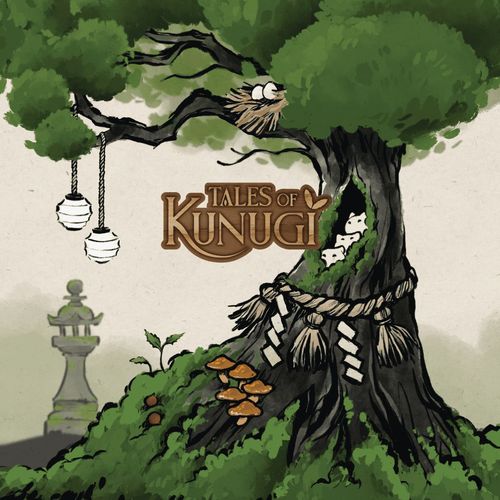
Tales of Kunugi
Tales of Kunugi Rulebook
Table of Contents
Table of Contents
Game Material
- Counter token x2
- Objective leaf x11 (printed as "Objective leave x11")
- Donguris token x50 (each Donguris token is an acorn)
- Square token "decoration token" x8
- Round token "twig token" x15
- A trunk on its base, with a red shrine gate (torii) and a decorative stone lantern
- 12 decorations of each type:
- 12 lanterns
- 12 nests
- 12 leaves
- 12 shimenawas (sacred ropes)
- 15 twigs:
- 5 small twigs
- 5 medium twigs
- 3 large twigs
- 2 very large twigs
Game Setup
- Set up the base in the centre of the table and place the trunk with the torii and lantern on it. Place the counter tokens on the year and season tracks on the sides of the bottom of the box.
- Separate the twigs according to the 4 shapes and make piles of them. Separate the decorations according to type (regardless of size) and make piles. These piles are the reserves.
- Place both the twig pile and decoration pile tokens face down. Make a pile with the Donguris (acorn) tokens.
- Distribute the right number of team objectives and personal objectives according to the number of players.
| Number of players | 2p | 3p | 4p |
|---|---|---|---|
| Common (team) objective number | 1 | 2 | 1 |
| Personal objective number | 2 | 1 | 1 |
For your first game, we advise you to use the goals marked with one paw as personal goals. Use the goals marked with two paws for team goals.
Unison Mode Rules
Players have 5 years to place twigs and decorations. At the end of these 5 years, the players evaluate their success according to the objectives distributed at the start of the game.
A game year is made up of 4 seasons, starting with winter:
- Winter: prepare the twigs and decorations to be used during the year.
- Spring: add twigs to the trunk and branches to make the Kunugi grow.
- Summer: decorate the Kunugi (the tree) - it's festival season!
- Autumn: harvest the Donguris (acorns) to unleash your Kodama powers and use your special actions!
Remember to use the 2 counter tokens to keep track of the current year and season on the sides of the box.
Winter
During the winter, the team creates together the twig and decoration piles. The twig pile consists of 4 pieces (except in the last year, when there are only 3 pieces).
To build up the twig pile, the team randomly reveals a number of "twig" tokens according to the table below and then places the corresponding twigs from the twig reserve into the twig pile. (See page 9 for branch sizes and tokens.) This token is then removed from the game and cannot be returned.
The decoration pile contains 5 pieces.
To make up the decoration pile, the team randomly reveals a number of "decoration" tokens according to the table below and then places the corresponding decorations from the decoration reserve into the decoration pile. The size of the decorations is up to the team to choose. If the type of decoration is no longer available, another token must be revealed.
The tokens revealed are then turned face down for the next year.
| Year 1 | Year 2 | Year 3 | Year 4 | Year 5 | |
|---|---|---|---|---|---|
| # of twig tokens revealed | 4 | 3 | 3 | 3 | 2 |
| # of decoration tokens revealed | 5 | 4 | 4 | 4 | 4 |
Once the piles have been made, the team moves on to the next season.
Spring
Each pose is made with ONLY one hand. Players may move around the table. Any decoration falling from the tree is returned to the corresponding reserve, not to the pile prepared during the winter. Any fallen twig is removed from the game.
Without mentioning their objectives and with no set order of play, the team must place 3 twigs. A player wishing to place a twig takes the twig he/she wishes and places it on the tree. The twig that is not placed during the season remains in the twig pile and can be placed on the following year.
Players can place more than one twig if they wish.
The Kunugi tree drops a Donguri (acorn) for each player who does not place a twig.
The Donguris fall and are placed in front of the player on the base of the trunk. They can be harvested in autumn. From then on, you can use them whenever you like.
Once the three twigs have been placed, the team moves on to the next season.
Summer
Without mentioning their objectives and with no set order of play, the team places 4 out of the 5 decorations from the decoration pile. A player wishing to place one of the decorations takes it and places it into the tree. Each player must place at least one decoration.
The decoration not placed during this season remains in the decoration pile and can be placed on the following year.
Donguris: the Kunugi drops Donguris depending on the twig that has just been decorated (see branch length on page 10). The Donguris that fall are placed on the base in front of the player and will be harvested during the next autumn. They are personal and can't be shared between players.
| Donguris dropped | A twig without decoration | A twig with at least a decoration |
|---|---|---|
| A twig in position 1 or 2 in the branch | 1 Donguri | None (ø) |
| A twig in position 3 or higher in the branch | 2 Donguris | 1 Donguri |
When a decoration is placed on several twigs, consider only the twig that yields the most Donguris.
Example: One Donguri falls for the player who placed the leaf. The player has placed the leaf on an undecorated twig which is only the first twig on the branch.
Example: 2 Donguris fall for the player who placed the nest. The player has placed the nest on a twig that had no decoration and was in 3rd position on the branch.
Autumn
Players harvest Donguris that have fallen during the spring and summer. Players can spend Donguris at any time to perform a bonus action (see the torii game help and box sides). A player can spend:
- 1 Donguri to immediately put back a decoration that has just fallen. It can be placed wherever the player wants.
- 2 Donguris to put a new decoration of the player's choice from the reserve wherever the player wants.
These decorations cannot be used to earn new Donguri.
These Donguris can be spent at the end of the 5th and final year, after the decorations have been placed and before the victory points are counted. Players cannot give Donguris to each other.
Twigs
A twig is a piece of wood with several notches. Several twigs will form branches over the years.
Twig sizes (shown on the twig tokens, with their symbols):
- Very large twig - Kodama symbol
- Large twig - Bird symbol
- Medium twig - Mushroom symbol
- Small twig - Leaf symbol
Rules for Twig Installation
The notch of the twig must be inserted into the notches of other twigs or the trunk.
If the notch of the twig is in a notch of the trunk, the installation is valid.
Branches
A branch is a succession of twigs extending from the trunk. The length of a branch is measured from the trunk. It is determined by the greatest number of distinct twigs in succession making up the branch.
A twig is considered to be in the last position on a branch when no twig is placed after it. A branch can have several last twigs.
Example: the branch in the example has a length of 4. Its twigs are numbered 1 (nearest the trunk) to 4 (furthest out).
Decorations
Nests are placed horizontally, with the eggs visible, on at least one other object in the tree (trunk, twigs, decorations, except on another nest).
Lanterns are hung by their hooks, with the bulb pointing downwards. The hook must support the lantern and can be placed on any other object (branches, trunk or decorations) on the tree.
Shimenawas are placed between two distinct objects (branches, trunk or decoration). The ends of the Shimenawa rope determine which branches and/or decorations are in contact with the Shimenawa. Two Shimenawas are considered in sequence when they rest on the same object or directly on top of each other.
The size of a Shimenawa during the winter, or after the use of Donguris, is left to the choice of the team and the player.
Leaves are placed in the notches of the trunk or a twig. Its notch must be used.
The choice of leaf size during the winter, or after the use of Donguris, is left to the choice of the team and the player.
Objectives
The objectives are divided into 3 sections (Easy, Medium and Hard). Each section is independent and gives victory points at the end of the game if the conditions are met. Each section can only be cleared once.
A decoration placed solely on top of one or more other decorations does not count towards the twig or trunk objectives. It only counts towards the objectives for decorations on other decorations.
Each objective card shows three conditions, each worth victory points as marked by the leaf icons under it: the left condition is worth 1 point, the middle condition 2 points and the right condition 1 point.
End of the Game
The game ends at the end of the 5th year and after the players who wish to use their Donguris have used them. It's time to contemplate your Kunugi and assess its splendour.
The team observes the conditions of each personal and team objective. Each section gives points for the team without taking into account actions taken individually during the game. Unspent Donguris do not earn victory points apart from the Harvester objective.
The team adds up the victory points for each objective. The total sum gives the tree a value between 0 and 20.
| Victory points | Result |
|---|---|
| 6 or less | Dead tree |
| Between 7 and 11 | Young sapling |
| Between 12 and 15 | Adult tree |
| Between 16 and 17 | Majestic tree |
| Between 18 and 19 | Secular Tree |
| 20 | Kami of the forest |
Solo Mode
The player will grow this tree by following the rules of Unison mode, with a few exceptions concerning objectives and Donguri (acorn) gains.
Setting Up the Game
- Set up the game as described for the Unison mode.
- Remove the Harvester objective card from the game for this mode.
- Place the remaining objectives face down.
The player has 5 years to place twigs and decorations. At the end of these 5 years, the player evaluates the splendour of his Kunugi according to the objectives drawn during the game.
A year in the game is made up of 4 seasons:
- Winter: prepare the branches and decorations to be used throughout the year.
- Spring: add twigs to the trunk and branches to help the Kunugi grow.
- Summer: decorate the Kunugi as it's festival season!
- Autumn: harvest the Donguris (acorns) that will be used to unleash your Kodama powers and use your special actions!
Donguri are used in the same way as in Unison mode.
Revealing an Objective
The player reveals an objective once the twig and decoration piles have been made during the winter. This objective is added to the objective cards already revealed. In total, 5 cards are revealed, allowing the player to determine the value of its tree.
Earning a Donguri
At the end of the spring, the player earns automatically one Donguri.
In addition, the same rules for earning Donguris during summer apply (see page 8).
Victory Points
It's time to contemplate the Kunugi and sum up all the points earned by the 5 objectives and assess the splendour of the tree.
Objective Cards
Each objective card below lists its three conditions, with the victory points for each in brackets.
Easy Objectives
Lighting Tree
- At least 1 lantern is suspended only on a shimenawa (1 pt)
- The tree is decorated with at least 7 lanterns (2 pts)
- At least 4 lanterns are on the last twigs of the branches of the tree (1 pt)
Green Tree
- At least 1 leaf is located in a notch of the trunk (1 pt)
- The tree is decorated with at least 7 leaves (2 pts)
- At least 4 leaves are on the last twigs of the branches of the tree (1 pt)
Singing Tree
- At least 1 nest rests only on a decoration of another type (1 pt)
- The tree is decorated with at least 7 nests (2 pts)
- At least 4 nests rest on the last twigs of the branches of the tree (1 pt)
Hallowed Tree
- At least 1 shimenawa rests only on decorations (1 pt)
- The tree is decorated with at least 7 shimenawas (2 pts)
- At least 2 shimenawas are on the last twigs of the branches of the tree (1 pt)
Medium Objectives
Sylvan Exposition
- The trunk is decorated by the 4 types of ornaments (1 pt)
- The tree is decorated by at least 4 ornaments of each type (2 pts)
- At least 1 twig is decorated by the 4 types of ornaments (1 pt)
Revered Tree
- A twig is decorated by at least 2 pairs of shimenawa+lantern (1 pt)
- The tree is decorated by at least 5 pairs of shimenawa+lantern (2 pts)
- At least 3 twigs are decorated by a pair of shimenawa+lantern (1 pt)
Natural Tree
- A twig is decorated by at least 2 pairs of nest+leaf (1 pt)
- The tree is decorated by at least 5 pairs of nest+leaf (2 pts)
- At least 3 twigs are decorated by a pair of nest+leaf (1 pt)
Hard Objectives
Museum Tree
- The tree is decorated by 12 ornaments of the same type (1 pt)
- The tree is decorated by at least 20 ornaments (2 pts)
- Every twig is decorated (1 pt)
Sanctuary Tree
- A shimenawa sequence makes a closing loop around the trunk (1 pt)
- The tree is decorated by a sequence of 5+ distinct shimenawas (2 pts)
- The tree is decorated by 2 distinct sequences of shimenawas (1 pt)
Harvester
- The team has at least 12 acorns when counting victory points (1 pt)
- A player has at least 9 acorns when counting victory points (2 pts)
- Every player has at least 1 acorn when counting victory points (1 pt)
Colossus Tree
- Every notch in the trunk is utilised by twigs or leaves (1 pt)
- The tree has at least 4 branches of length 3+ (2 pts)
- At least one branch is of length 5+ (1 pt)