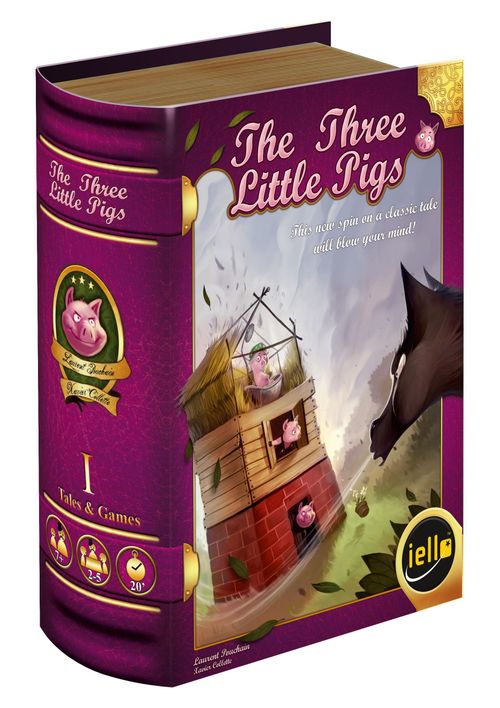
Tales & Games: The Three Little Pigs
Tales & Games: The Three Little Pigs Rulebook
Table of Contents
Table of Contents
Goal of the Game
Build the strongest and most valuable houses out of straw, wood, and brick before the wolf blows them down.
Contents
- 36 House tiles, comprising 12 straw, 12 wood, and 12 brick. Each building material has 4 door, 4 window, and 4 roof tiles.
- 5 special dice, 3 of which include one wolf face.
- 1 breath spinner.
- 6 award cards used in the variant (see end of rulebook).
Setup
- Set the 36 House tiles in the center of the table, in three columns (straw, wood, brick). Each column has three rows: a door stack, a window stack, and a roof stack. Shuffle each stack before starting the game.
- Place the dice and breath spinner near the players.
Playing the Game
The last player to have seen pigs (or wolves) is designated first player of the game. Then everyone will take turns in a clockwise direction. When it is your turn, roll the dice, then use their results to build one or more houses.
Roll the Dice!
- You are allowed a maximum of 3 rolls.
- First, roll the five dice, and set aside those of interest.
- For the following two rolls, you can reroll all your dice, or only those that do not suit you (you can even reroll the ones you set aside).
- Once a wolf face appears on a die, set it aside. You cannot reroll it this turn.
You are not required to reroll your dice. You may decide to end your turn after the first or second roll; however, you must stop after your third roll, or as soon as you have rolled two or more wolf faces (see The Wolf is Coming!).
Build!
At the end of your turn, use the door, window, and roof symbols you rolled to purchase one or more House tiles:
- 2 identical symbols (2 doors, 2 windows, or 2 roofs) allow you to buy, respectively, a door, a window, or a roof of straw.
- 3 identical symbols (3 doors, 3 windows, or 3 roofs) allow you to buy, respectively, a door, a window, or a roof of straw or wood.
- 4 identical symbols (4 doors, 4 windows, or 4 roofs) allow you to buy, respectively, a door, a window, or a roof of straw, wood, or brick.
If the dice permit, you must always buy at least one House tile. You are also welcome to buy two different tiles during your turn.
Place any house you purchased in front of you, according to the following rules:
- Building a house always starts with a door or a window.
- When it's not the bottom piece of the building, a window always goes above a door or window.
- A roof always goes above a door or window.
- Straw, wood, and brick can be mixed in the same house.
- A house may have several windows, but only one door and one roof. It is possible to add a door under a window, as long as the house has no roof.
- Once a house gets a roof, it is considered complete, even if it has no door. A completed house cannot receive more pieces!
- Building several houses side by side is allowed, even if the former are not completed.
Example: if a straw door needs to be placed and one house already has a brick roof (complete, so no door can be added), a second house already has a door (a door cannot go under another door), and a third house has only a window in brick, the straw door must be placed under that middle house's window. The straw door could also be used to start a new house instead.
The pig heads present on the House tiles indicate not only the cost of constructing that tile, but also the number of points it's worth at the end of the game.
The Wolf Is Coming!
If you get two or more wolf faces, the wolf is coming! You can no longer roll the dice and can no longer buy House tiles. Instead, you must blow on an opponent's house:
- Choose an opponent, and designate the house you want to blow on (it doesn't matter whether the house is completed yet).
- Take the breath spinner and flick the needle so that it makes at least one full turn of the wheel. For players that are blowhards, it is highly recommended to blow on one end of the needle, instead of flicking it! Train!
- The tip of the needle indicates the type of material that's blown away (straw, wood, or brick). All tiles in the targeted house that match this material are removed from the game.
Afterward, if only the roof of the house remains, it collapses and is also removed from the game.
If no opponent has a house to blow on, your turn just ends.
End of the Game
- With 2 players, the game ends when 2 stacks of House tiles are exhausted.
- With 3 players, the game ends when 3 stacks of House tiles are exhausted.
- With 4 players, the game ends when 4 stacks of House tiles are exhausted.
- With 5 players, the game ends when 5 stacks of House tiles are exhausted.
Count the Points!
At the end of the game, each player counts her victory points as follows:
- Houses that have no roof are discarded and do not earn any points.
- For completed houses, each tile earns points: 2 points for a straw tile, 3 points for a wood tile, 4 points for a brick tile.
- Add up the points for your House tiles. Then add 1 bonus point for each flowerpot you have, and 1 bonus point for each house you have completed.
- The player with the most victory points wins. In case of a tie, the player who built the most houses wins. If there is still a tie, the tied players share the victory.
Variant for Veteran Pigs
At the beginning of the game, place the six award cards so that they are visible to all players.
Some awards can be earned during the game (+2); others will be awarded at the end (+3). They are all cumulative.
At the end of the game, the players count their victory points as in the normal rules. But this time, they do not earn bonus points for flowerpots or completed homes. Instead, they add points for award cards they have earned. Whoever has the highest total score wins. In case of a tie, the player who built the most houses wins. If there is still a tie, the tied players share the victory.
The Awards
The six award cards are unnamed scrolls, each showing a point value (+2 or +3) and an icon for what it rewards:
- Flowerpot card (+3): given at the end of the game to the player who has the most flowerpots. In case of a tie between several players, nobody receives this award.
- Three-house card (+3): given at the end of the game to the player who has the most completed houses (regardless of both their number of floors, and whether they have a door). In case of a tie between several players, nobody receives this award.
- Tall house card (+3): given at the end of the game to the player who has the tallest house. It must have at least a roof and a door. In case of a tie between several players, nobody receives this award.
- Straw, wood, and brick house cards (+2 each): these three awards are won by the player who first completes a house entirely of straw, entirely of wood, or entirely of brick, comprising at least a door, a window, and a roof. You get to keep this card, even if the house gets blown down.