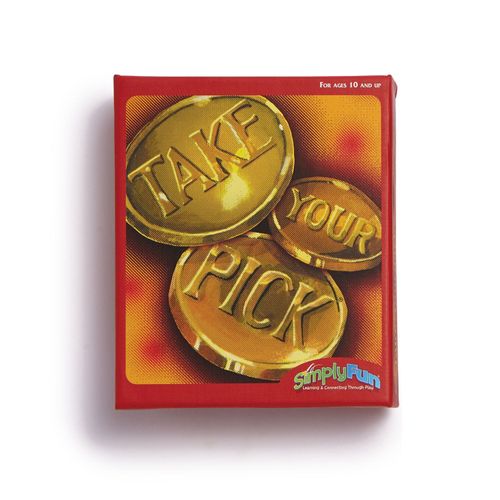
Take Your Pick
Take Your Pick Rulebook
Table of Contents
Table of Contents
Object
How well do you know the other players? Not as well as you might think! In this fun and unruly game, you will try to guess what the other players will pick between two words or phrases. The more you guess correctly, the more points you score. Be the player with the most points at the end of the game and win!
Setup
Randomly pick someone to be the first person as the "Subject." The Subject starts the first round by shuffling the deck and dealing three cards to each of the other players, but not themselves.
Players should note that each card has two words or phrases printed at each end. One end of the card has one of the words/phrases highlighted and the other end highlights the other one.
Example: One card has "In or Out" printed on each end. If you turn the card one way, "In" is highlighted and if you turn it around, you'll see that "Out" is highlighted.
Playing the Game
Now, all the players must arrange the cards in their hands. To understand how to best arrange them, you'll need to know what will happen next. Each player is going to read the words/phrases on their cards to the Subject. The Subject will pick one of the two words/phrases on the cards in response to the question, "Which of these two words/phrases describes me the most?"
Example: One of Jose's cards has "Serious or Silly?" printed on it. Jose will read the card to Tracey, the Subject, who will need to state which of the two words is most like her. Before Tracey answers, Jose needs to decide first which word he believes describes Tracey the best and turns the card with that highlighted phrase on the top.
But there's more! Each card is worth 1 point. The cards will be read to the Subject in the order you choose. For every correct guess, you get 1 point. If you read the first card to the Subject and you get that card wrong, for example, your turn is over and you do not read the remaining cards or score any points. So, it's important to put the cards you're most sure of getting correct first in your hand and the ones you're least sure of last, in order to secure the most points every round!
Testing the Subject
Once players have finished arranging their cards, it's time to analyze the Subject. Starting with the player to the left of the Subject, the player reads the words exactly as they appear on the card. Nothing else can be said that might sway the Subject one way or another! With great introspection and consideration, the Subject will think "Which of those two words or phrases best describes me?" Eventually the Subject will choose one of the two. He or she must honestly state his or her choice back to the player who read the card. At that time, that player lays his or her card face up on the table so that everyone can see if the correct word/phrase was chosen (the choice will be highlighted at the top of the card). If the guess was correct, the card should be kept on the table in front of the player. This card is worth 1 point. If the guess was incorrect, the player's turn is over and that card, and all remaining unplayed cards in his or her hand, are discarded to a pile in the center of the table.
Now the next player, in clockwise order, has the chance to read his or her cards to the Subject using the same rules as described before. This is continued, with each player reading one card at a time to the Subject. If a guess is wrong, the player's turn ends immediately!
Scoring
After each player has read his or her cards to the Subject, players count up the points they earned from correct guesses. All cards that count can be moved to a player's score pile that will accumulate throughout the game.
The Subject can also score points each round. He or she gets the number of points equal to the highest score of the other players in the current round. The Subject can keep track of his or her points by taking cards from the discard pile or draw pile as needed. This will help to keep the Subject honest in his or her answers!
Example: Tom is the Subject. Mike, Kendra and Kim are the players. Mike is wrong on his first card, so he discards his cards to the discard pile. Kendra is right on the first 2, but is wrong on the third one, Kim gets all 3 correct! So, Mike earns 0 points, Kendra earns 2 and Kim earns 3. Finally, Tom also scores 3 points, since he gets the same number of points as the player with the most points. Tom takes 3 cards from the discard pile (or draw pile) and places them in front of him in his score pile.
Additional Rounds
The next round is played in similar fashion with the player to the left of the Subject becoming the new Subject dealing 3 cards to each player and play continues as before. Cards need not be shuffled, unless the available draw cards are depleted.
Game End
The game ends when each player has been the Subject one time. At the end of the game, the player with the most cards in his or her score pile wins. In the case of a tie, all tied players win. Congratulate the winners for their keen insight!
Optional Rules for Large Groups
This streamlined variation is recommended for groups with six or more players. Groups of any size looking for a quicker game will find it fun as well.
The Subject starts by dealing all other players just one card each. Those players "set" their cards just as they would in the regular game, hoping to predict the item from the card that the Subject will choose.
In this version, both the reader and the Subject can score a point each time a card is read. Starting with the player to the left of the Subject, each will take a turn reading his or her card, prompting a response from the Subject. When the reader successfully predicts the Subject's response, he keeps the card as a point and the Subject draws a card from the deck to keep for a point as well. If the response was not predicted correctly, no points are scored.
Play until each player has been the Subject an agreed upon number of times. The player or players with the most points at the end of the game win!
Tips
It won't take players long to realize that the simple question "Which is most me?" isn't always easy to answer! If a Subject is having a particularly hard time answering, remind him the exact wording of the question he's supposed to be answering: "Which describes you the most?"
Choices are difficult to make sometimes as different people see different sides of our lives and our personalities. Bob's wife and Bob's boss may very well choose differently between "Serious or Silly?" when Bob's the Subject. Is it fair for Bob to consider who's asking the question when he answers? Certainly! Just don't be surprised if you find out some people know you better than you thought they did!