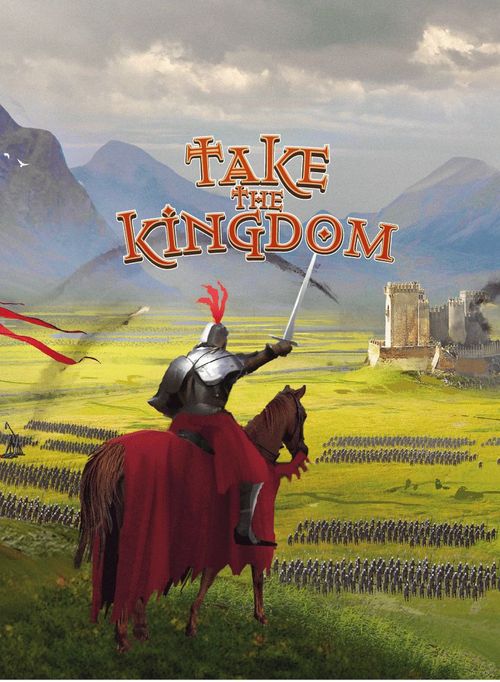
Take The Kingdom
Take The Kingdom Rulebook
Table of Contents
Table of Contents
Game Contents
108 cards, rulebook
Characters
In Take the Kingdom you play as one of six Nobles, each of whom has fought, schemed and negotiated to get where they are. Each of the Nobles has a unique advantage, and a number – this number determines the first player as well as settling ties. The player with the highest numbered Noble goes first. If, at the end of the game, two or more players have the same Kingdom defensive score, the player with the highest Noble score is the winner.
- Baron Charles de Mangonel (1): start game with Gold in hand; Cannons count as -5
- Lord Simon de Longbow (2): tops up hand to six cards on each turn, as long as you have Land
- Graf Egbert of Brunswick (3): starts game with Village in addition to 12 defence pts; Traps always real
- Maria de Cordoba (4): Pikemen count as -2
- Lord Baligant (5): Can play Penalty cards against other players, affecting their next turn
- Anne, Viscountess of Narbonne (6): Starts game with Dawn Raid in hand.
Multiplayer Setup
Kingdom building phase
- Each player chooses a yellow character card and a dark green Castle card. Put any spare characters and Castles back in the box;
- Separate out all the Green Defend cards – Land, Hills, Moat, Walls, Battlements, Archers and Knights, and place them face up in the centre of the table. Do not use the four Trap cards for setup. Each of the Defend cards has a value from +1 to +5.
- Starting with the youngest player, each player in turn takes one Defend card and adds it to their Kingdom, until they have a total of 12 defensive points including their Castle (so you will add a further 9 points of Defence to your Castle, which scores +3).
- Each player takes one blue Mercy card and places it alongside their Castle. Place any spare Mercy cards back in the box.
Shuffle all remaining cards into a single pile (the deck) and place this face down within reach of all players, with room for a discard pile alongside.
[The printed example starting kingdom is a picture and is not transcribed.]
Kingdom Defence
Your Kingdom consists of several lines of defence – (1) your Castle, (2) Castle Defences, (3) Land and its Defences. You cannot attack one line of defence until/unless the lines in front of it have been destroyed. A Castle can have up to two additional Defences (eg Moat, Walls, Archers), plus one Trap. A Castle can also have up to five Land cards defending it. Each of those Land cards can itself have up to two additional Defences plus one Trap.
So a Land's Defences need to have been destroyed before you can attack that Land; all Land has to have been removed before you attack a Castle's Defences; and a Castle's Defences must be destroyed before you can attack the Castle. In other words:
Destroy Land Defences >>> Destroy Land >>>
Destroy Land Defences >>> Destroy Land >>> Destroy Castle Defences >>> Destroy Castle
Destroy Land Defences >>> Destroy Land >>>
Note – you can attack an undefended Land even if other Land cards still have Defences.
Gameplay
Your aim is to cause as much damage to enemy Kingdoms as possible while defending your own. If a player's Castle is destroyed, they are out of the game. Once all the deck cards have been used, players continue to play in turn with their hand cards until no more cards can be played – the game then ends. The surviving Kingdom with the most defensive points is the winner – if more than one player is tied, the highest-scoring Noble wins the game.
On your turn, each player tops up their hand to five cards from the deck (or to six if they are playing as Simon de Longbow), and then plays up to three cards. There are four main kinds of cards – Attack, Defend, Action and Penalty. Attack and Defend cards have a points value that indicates how much damage they can cause or sustain. Each card has several icons on it to indicate what kind of card it is and how it can be used. Here are some of the icons you'll come across:
Attack (red) cards – play against an opponent's Kingdom to cause that amount of damage to their Defences. Any Attack cards used, and Defend cards destroyed, are placed on the discard pile. If an Attack is not enough to destroy a defence (for example if a -1 Pikemen is used against a +3 Archers), then tuck the Attack card under the Defend card to show that it has been damaged. If a Castle or Land has more than one Defence, the topmost card will always be attacked first. If your Attack is stronger than the Defence (eg Trebuchet against Land), no 'change' is given. Attacks can only be made against a single Castle or Land card (plus its Defences), but Spread uniquely allows you to share an Attack across multiple Lands.
Defend (green) cards – add to your Kingdom, as per the Kingdom defence rules. Each Castle and Land card can have two further Defend cards on it, plus one Trap. Once placed, Defend cards cannot be removed or rearranged (other than Mercenaries – see below).
There are four Traps in the game, two real and two decoys. Place a Trap under your Castle or Land so opponents cannot see which type it is.
If a Castle or Land is attacked, the Trap is 'sprung' and is placed on the discard pile. But if the Trap is real, the attack is then reversed back onto the attacker, who sustains that amount of damage as if they had been attacked. The Trap owner decides where that damage happens, within the usual lines of defence rules (that is, the damage can only be sustained to the accessible defences).
Mercenaries (green & red) can be used as Attack or Defend cards – either use them to attack an opponent or add them to your Kingdom. Mercenaries can also be used to directly attack from a defensive position as one of your three cards played. So if Mercenaries have already been played onto a Land card, and have not been damaged or eliminated, they can still be used to Attack directly from that Land card. Mercenaries can also be moved freely between your Fort and Land cards – again, moving a card counts as one of your cards played that turn.
Action (blue) cards are marked with a large 'A' icon, and are played to cause an effect that either benefits you or harms your opponents. Deny, Mercy, Sabotage and Gold can be played out of turn, in response to another player's actions. All the other Action cards can only be played on your turn, as one of your three actions per turn.
Penalty (grey) cards – there are three Penalty cards: Famine, Disease and Plague, marked with a skull icon. If you draw one of these (or have it in your starting hand) it affects you immediately, as one of your three cards played that turn, by restricting the other cards you can play on that turn. Famine applies to the whole round, so you could not play Deny, Gold, Mercy or Sabotage on another player's turn, until it has come round to your turn again. You can use a Deny or Mercy card to cancel a Penalty (including Famine), but this will count as another card played on your turn.
Survival mode (optional)
Player elimination tends to only happen towards the end of a game, so no-one should be sat out for long. But if you really don't like player elimination, you can build a Survival Deck for any player that loses their Castle. At the start of the game, take 1 x Village, 1 x Land, 1 x Mercenaries (+/-1), 1 x Mercenaries (+/-2) and put these to one side. If a player loses their Castle they can 'restart' with a Village and Land as their Kingdom and the two Mercenaries cards as their hand. On their turn, this player will only top up to four cards, but will still play up to three cards on their turn.
Solo rules
In solo mode you are playing against two enemy kingdoms to try and be the last or strongest kingdom standing. The cards have the same functions as in the multiplayer game, but the gameplay itself is different.
First, separate out the 54 cards that are marked with the 'solo' icon, and sort them into three decks of 18:
- Attack Deck: the eighteen red Attack cards;
- Defend Deck: the fifteen green Defend cards + the three Red/Green Mercenaries cards;
- Action Deck: the fifteen blue Action cards + the three grey Penalty cards;
Shuffle each of these decks and place them face down alongside each other. From the non-solo cards, find the following: 3 x Castle, 6 x Land, 3 x Moat, 3 x Hills, 6 x character cards.
Choose character cards for each Kingdom according to the required difficulty level (below), and set up starting kingdoms accordingly:
| Level | You | Enemy 1 | Enemy 2 |
|---|---|---|---|
| Easy | Egbert; Castle; Land + Moat; Land + Hills; Village | Baligant; Castle; Land + Moat; Land | Maria; Castle; Land; Land |
| Medium | Simon; Castle; Land + Moat; Land + Hills; Land | Baligant; Castle; Land + Moat; Land + Hills | Maria; Castle; Land + Moat; Land + Hills |
| Difficult | Maria; Castle; Land + Moat; Land + Hills | Egbert; Castle; Land + Moat; Land + Hills; Village | Simon; Castle; Land + Moat; Land |
| Expert | Simon; Castle; Land + Moat; Land | Egbert; Castle; Land + Moat; Land + Hills; Village | Charles; Castle; Land + Moat; Land + Hills |
If using Anne and/or Charles, find the Dawn Raid and Gold cards. Add Dawn Raid to the Attack deck, removing one of the Soldiers cards. Add Gold to the Action deck, removing one of the Deny cards. When these cards are revealed, they must be given to the Noble that can use them.
You will then play 18 short rounds. On each round, deal the top card from each of the three decks. One of these cards will be assigned to you and one to each of your opponents – you decide how cards are allocated. Then, you and your enemies each play their chosen card – you always go first and play continues clockwise.
Enemy rules:
- The two enemy players will always play their Action and Attack cards against you, never each other. If an enemy has more than one way to play a card, they will always choose the way which is more damaging to you, or more beneficial to them.
- If they have a Defend card, they will add it to their kingdom, starting from the front.
- If they have an Attack card, they attack you, and will remove a Land card from your Kingdom if they can.
- If an enemy has a Deny, Gold, Sabotage or Mercy card, they hold this until they can use it, but will use it at the first opportunity. If Gold is played…? [Sic: the printed sentence ends unfinished here; transcribed as printed.]
- Penalty cards apply to that player for that round, and usually means that player cannot act in that round. If a player has Famine, they cannot play any Deny, Gold, Sabotage or Mercy cards in that round.
- You can give a Defend card to an enemy even if they can't place it (eg if their Land and Fort are already fully occupied). You can give an enemy an Action card even if playing it will have no effect.
- If you eliminate one of your enemies, one of the three drawn cards can be discarded in each subsequent round.
Once all 18 rounds have been played, the surviving player (human or enemy) with the most defensive points is the winner.
Notes on specific cards
Mutiny: Mutiny does not follow the normal Kingdom Defence rules, and can be used to remove Knights or Archers even if there are other lines of defence in front of them. It can only remove a single card from play.
Gold: Gold works in a similar way to Deny, blocking any card played against you. But when played, Gold is exchanged for the card being played against you (you effectively 'buy' that card from the other player). The attacker then takes Gold into their hand and can use it at a time of their choosing. As soon as Gold has been used for a third time, it is placed on the discard pile.
Mercy: Mercy can be used in a range of ways, and can either be played directly from your hand (if you have drawn it from the deck) or from your Kingdom. If used as a proxy Land or Fortune card, or to remove a Freeze, it counts as one of your three actions. But it can also be played out of turn in the same way as a Deny card.
Sabotage and Earthquake: these will remove a Trap but not spring it. Sabotage can either be played on your turn, or out of turn to counter a mechanical attack against you.
Deny: You cannot block a Deny card by playing another Deny card against it.
Spread and Morale: Spread is the only card that allows you to Attack across more than one Land or Castle at once, including across more than one player. So Trebuchet + Spread could be played to remove three separate undefended Land cards. Morale doubles the value of an Attack card. Spread and Morale each count as one of your actions played per turn – so Cannon + Spread + Morale makes a devastating multi-directional 8-point attack, but uses all three of your actions that turn.