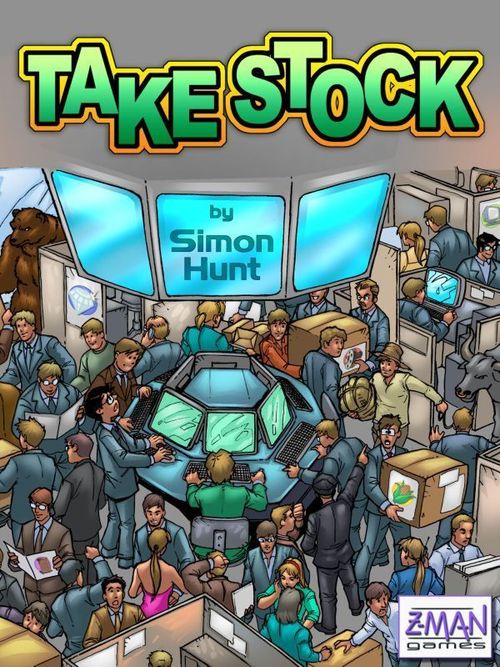
Take Stock
Take Stock Rulebook
Table of Contents
Table of Contents
Game Components
The Cards
There are 60 share cards (numbered 1 - 12 for each stock) representing a stock value if placed in the market, or representing a certificate of 1, 2 or 3 shares if placed in front of the player.
There are 40 market event cards which affect the stock market in various ways: 3 stock splits, 1 stock crash and 1 insider trading for each stock; 4 stock audits; 3 stock freezes; 2 no market changes; 1 market upturn; 1 market downturn; 1 stock option gained; 1 stock option lost; 1 market crash; and 1 market closed.
The Stock Options
There are 30 tokens representing stock options allocated to the players at the beginning of the game.
Preparation
The Stock Options
Give each player 4 stock option tokens, placing the unused tokens back in the box. Players will get an opportunity to exercise their options at the end of each round.
Note: Each player should be careful to make the options last, as the initial allocation of 4 options is for all 4 rounds of the game.
The Stock Shares
Place the 5 stock starter cards (the 1's) face up in a column in the center of the table to form the stock market. The current market value of a stock is represented by the highest value card of the row (initially 1). Thoroughly shuffle the remaining 55 share cards (2-12's) and deal an equal number of cards to each player: 7 cards each for 2 players, 6 cards each for 3 players, 5 cards for 4 players, or 4 cards for 5 or 6 players. Place the remaining cards face down to one side of the stock market to form the shares draw pile.
The Market Events
Remove the market closed event card, and thoroughly shuffle the remaining 39 event cards. Deal 10 cards face down onto the table, place the market closed card face down on top of those cards, then place the remaining event cards face down on top of the market closed card. Place these cards to form the market events draw pile. (This puts the market closed event 11th from the bottom.)
Playing the Game
The player to the left of the dealer begins the round.
On a player's turn he does two actions. The first is to draw a card from the shares draw pile and add it to his hand. If the last card is drawn, thoroughly shuffle the discard pile and form a new draw pile. (In the unlikely event that there are no cards in the discard pile, the round ends immediately.)
For the second action the player must do one of the following:
- Increase a stock price
- Save a certificate and discard a card
- Discard a card and play the market
- Play a previously saved market event card
Increase a Stock Price
The player may choose to add one of the cards from his hand to the corresponding row in the stock market, as long as the value of the card placed is higher than the value of the previous card and the difference between those two cards does not exceed 4. For example, at the beginning of a round, any of the stocks may have their value increased with the corresponding 2, 3, 4, or 5 card being placed on them. The value of the card played becomes the new market value for that stock.
If either an 11 or 12 is played, the market closes and the round ends immediately.
Save a Certificate and Discard a Card
The player may choose to place one of the cards from his hand face up on the table in front of him, upside-down so that the share icons are at the top. This card represents a certificate of shares (with the number of shares being equal to the number of share icons in the shaded box), for the stock represented. This card will stay there for the remainder of the round, and will contribute to the player's score for that round. The player must also discard one other card from his hand (to the shares discard pile) resulting in his hand size being reduced by one.
The "Limit" Rule: A player may only select this action if he has fewer share cards already saved (face up in front of him) than the maximum number of cards (including splits) in a stock row. For example, suppose Oil has two splits, and values 1, 3, and 7 laid out (5 cards total), and that the other four stocks have fewer cards; the player may only save another certificate (share card) if he has less than 5 certificates (share cards) already saved.
Discard a Card and Play the Market
The player may choose to discard a card from his hand (to the shares discard pile) to play the market. Playing the market consists of choosing one of two options:
A. The player may draw and examine the top 2 cards from the market events draw pile. He must then choose one of them to take effect immediately. He places the other card face down on the market events discard pile without revealing it to the other players.
B. The player may draw and examine the top card from the market events draw pile and then place it face down in front of himself without revealing it to the other players. This card may be played on a subsequent turn (see next section).
The player must decide which action to take (A or B) before drawing any cards. In either case, if the market closed event card is drawn, it is shown to all players and the round ends immediately.
Play a Previously Saved Market Event Card
The player may choose to discard a card from his hand (to the shares discard pile) to play one of his previously saved market event cards. The event card effect is resolved as detailed in the next section.
The Market Event Cards
Stock Split
A stock split is placed above the 1 card of the corresponding row in the stock market. Additionally, the highest value share card is removed from the end of the row (unless it is the 1 card) and placed on the shares discard pile. Each split card present for a stock represents a multiplier. One split card equals a x2 multiplier while the second and third split cards equal x3 and x4 multipliers respectively for the stock price.
Note: If the stock is frozen (see below), discard the split card instead.
Example: The price of the stock was 14 (7 x 2) before the second split. The price becomes 15 (5 x 3) after the second split. Note that if the third split is played before another corn value card is played, the stock will be worth 12 (3 x 4) since the corn-5 will be removed.
Stock Crash
A stock crash is placed face down on the market events discard pile. If the value of the corresponding stock is greater than 1, the top half (rounded down) share cards are removed from the end of the row and placed face up on the shares discard pile. Additionally, if there are any stock splits above the row, one is removed and placed face down on the market events discard pile.
Note: If the stock is frozen (see below), the freeze card is discarded first, and the crash is resolved as normal.
Example: The price of the stock was 16 (8 x 2) before the crash. The price becomes 4 after the crash. Note that the gem-5 and gem-6 cards may now be played to increase the stock price, whereas they were unplayable before the crash.
Market Crash
The market crash card is placed face down on the market events discard pile, and all five stocks crash as described above.
Insider Trading
An insider trading card is placed face down on the market events discard pile, and the player then searches through the shares discard pile to retrieve up to 3 cards of the corresponding stock. For each card thus retrieved, the player must discard a card from his hand and place it on the shares discard pile. The retrieved cards are shown to the other players then added to his hand.
Note: During normal play, players are not permitted to examine either discard pile. The shares discard pile may only be picked up and searched after the player has committed to playing the insider trading card.
Stock Audit
A stock audit card is placed face down on the market events discard pile, and the player chooses which of the five (unfrozen) stocks to audit. The player may either remove the highest share card (unless it is a 1) placing it on the shares discard pile, or he may remove one stock split card and place that face down on the market events discard pile.
Note: The player may choose to audit a stock which currently has a price of 1 (no splits), in which case nothing happens.
Stock Freeze
A stock freeze card allows the player to freeze an unfrozen stock, or to thaw a frozen stock. To freeze a stock, the card is placed on the end of the chosen stock row in the stock market. To un-freeze an already frozen stock, the player places both the freeze card from the stock row and the freeze event card just played face down on the market events discard pile.
Note: Stocks that are frozen may not have their prices increased, may not be audited, and may not have splits applied (the split card is discarded).
Market Upturn or Downturn
A market upturn card is placed face down on the market events discard pile and (starting with the active player) every player immediately draws an extra card from the shares draw pile. A market downturn card is placed face down on the market events discard pile and every player immediately discards a card from their hand.
Note: If any player discards his last card, the round ends immediately.
Stock Options Gained or Lost
The stock option gained card is placed face down on the market events discard pile and every player immediately gains a stock option by taking an option token from the supply in the box. The stock option lost card is placed face down on the market events discard pile and every player immediately loses a stock option by returning an option token to the supply in the box (players with no remaining tokens lose nothing).
No Market Change
A no market change card is placed face down on the market events discard pile and nothing else happens.
Market Closed
If the market closed card is drawn, it is shown to all players and the round ends immediately. This card cannot be saved.
Ending the Round
Ending Conditions
The round ends when one of the following conditions is met:
- The market closed event card is drawn
- A value 11 or 12 share card is placed on a row in the stock market
- A player discards the last card from his hand
Exercising Stock Options
After the round has ended, any player who has cards remaining in his hand and who still has unused stock option tokens may choose to exercise some or all of those options: For every option token returned to the supply in the box, a player may add one card from his hand to the certificates saved on the table in front of him. Any cards remaining in his hand afterwards are placed on the shares discard pile.
Note: the "Limit" rule described in the Save a Certificate and Discard a Card section does not apply here.
An Example Hand
In a game played by Shoana, Kris and Dave, the first round ends when Dave draws the market closed event card. Neither Kris nor Dave wants to exercise any options, so they place the cards in their hands onto the discard pile. They will score for the shares they saved throughout the round. Shoana on the other hand, only managed to save a couple of share cards, and decides to exercise two options to boost her score.
If the closing prices are as shown in the example stock market, Shoana scores 60 points for Oil, 32 points for Tech, and 105 points for Corn, giving her a total of 197 points for the round.
Scoring
Once all players who wish to exercise stock options have done so, the round is scored. Multiply the number of shares by the closing price of each corresponding stock and sum the results. Add that result to the total from previous rounds to get the current scores for each player.
Preparing for the Next Round
If the round ended because the market closed card was drawn, gather up all the event cards (including all unplayed saved market event cards) and prepare the market events draw pile as described previously (putting the market closed card 11th from the bottom).
Otherwise, gather up all face up event cards from the stock market (splits/freezes) together with the face-down market events discard pile and place them all face down underneath the market events draw pile without disturbing the rest of the cards. Note that the market closed event card is now closer to the top of the draw pile than before. Any unplayed saved market event cards may be kept face down and used during the new round.
Leave the five stock starter cards (the 1's) in the center of the table and shuffle the remaining 55 share cards (2-12's). The player with the current lowest score deals.
Ending the Game
The game concludes at the end of the 4th round. The player with the highest score is the winner.
Game Play Summary
Setup
Each player receives 4 stock option tokens.
| Number of Players | 2 | 3 | 4 | 5 | 6 |
|---|---|---|---|---|---|
| Number of Cards | 7 | 6 | 5 | 4 | 4 |
Turn Sequence
- Draw a share card.
- Choose one of:
- Increase a stock price: card from hand onto stock market.
- Save a certificate and discard a card (subject to the "Limit" rule): card from hand face up (upside down) on table; card from hand to discard pile.
- Discard a card and play the market: card from hand to discard pile; then either draw two event cards, play one immediately and discard the other face down, or draw one event card and save it face down for a future turn.
- Play a previously saved market event card: card from hand to discard pile; play a saved market event card.
End of Round
The round ends when one of the following conditions occurs:
- The market closed event card is drawn
- A value 11 or 12 share card is placed on a row in the stock market
- A player discards the last card in his hand
Stock options may be exercised. Each option used allows the player to save an additional share certificate (card) from his hand. (Not subject to the "Limit" rule.)
End of Game
The game concludes at the end of the 4th round. The player with the highest score is the winner.
Market Event Summary
- Stock Split (3 per stock): Place split above stock row. Discard highest value card (unless 1). For 1/2/3 split cards, multiplier is x2/x3/x4. (Discard if stock is frozen.)
- Stock Crash (1 per stock): Discard freeze if any. Discard one split if any. Discard half (round down) share cards.
- Market Crash (1): All five stocks crash, as described above.
- Insider Trading (1 per stock): Retrieve up to 3 cards of the matching stock from the shares discard pile. Discard the same number of cards from your hand.
- Stock Audit (4): Choose an unfrozen stock. Either discard highest value card or discard one split.
- Stock Freeze (3): Freeze an unfrozen stock or thaw a frozen stock.
- Stock Option Gained / Lost (1 each): Each player immediately gains / loses one stock option token.
- Market Upturn / Downturn (1 each): Each player immediately draws / discards one share card.
- No Market Change (2): Nothing happens.
- Market Closed (1): If this card is drawn it must be shown to all players and the round ends immediately. It cannot be saved!