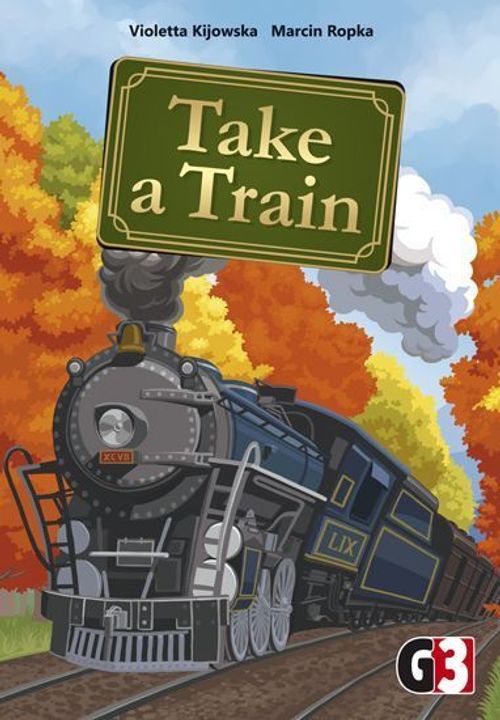
Take a Train
Take a Train Rulebook
Table of Contents
Table of Contents
Components
- 105 cards:
- 18 locomotive cards: 7 steam locomotives, 6 diesel locomotives, 5 electric locomotives
- 87 wagon cards: 25 food wagons, 19 cattle wagons, 15 coal wagons, 11 heating oil wagons, 7 luxury goods wagons, 5 passenger wagons
- 5 special cards
- 155 tokens:
- 6 auction tokens
- 6 sequence tokens
- 18 purpose tokens
- 125 money tokens: 20 worth $ 50, 25 worth $ 100, 35 worth $ 500, 35 worth $ 1,000, 10 worth $ 5,000
- 6 player's screens
Setup
In the game Take a Train there are locomotive cards, wagon cards and special cards.
-
The cards are divided into two decks: wagon cards and locomotive cards. Then they are thoroughly shuffled and put on the table face-down draw piles. Use only a certain number of cards from the locomotive deck, depending on the number of players:
- 2 players – 6 random locomotive cards,
- 3 players – 9 random locomotive cards,
- 4 players – 12 random locomotive cards,
- 5 players – 15 random locomotive cards,
- 6 players – all locomotive cards.
Unused cards are put into the box; they will not be needed until the next round.
-
Purpose and auction tokens are put separately face down, while sequence tokens are put face up. Money tokens serve to create the Bank.
-
Each player receives their player's screen and $ 5,000 from the Bank. The player puts the money behind the screen, so that they are not visible to other players, because throughout the whole game the funds raised by the players are not made public.
-
Each player draws 3 purpose tokens. One can use them at any time during the game. When the player meets the requirements for their token, they do not receive a new one, but only get privileges resulting from the token. The purpose tokens are also hidden from the other players.
-
The player who has last gone on a train goes first. This person becomes the one who starts the auction. In the next round the person sitting on their left becomes the start player.
Locomotive Cards
Each locomotive card shows its power and starting price, its maximum speed, its multiplier, and its type of drive.
There are three different types of locomotives, according to their drives: steam, diesel and electric. This designation is needed to fulfil some purpose tokens.
Locomotive power constitutes the starting price at the auction; the power of the locomotives collected by the players determines the order during the second stage – the attachment of wagons.
The maximum speed allows to settle ties, when several the players collect locomotives of the same power. In the case of a tie, the winner is the person with the fastest locomotive. This factor is also important when it comes to fulfilling some purpose tokens.
The multiplier multiplies the value of the investment. At the end of the round, players add the value of the wagons attached to a given locomotive and multiply it by the multiplier of this locomotive. The resulting amount is their profit which they withdraw from the Bank.
Wagon Cards
Wagons are divided into six types:
- 25 food wagon cards,
- 19 cattle wagon cards,
- 15 coal wagon cards,
- 11 heating oil wagon cards,
- 7 luxury goods wagon cards,
- 5 passenger wagon cards.
Each wagon card has a value from $ 50 to $ 500. Furthermore, in the deck there are five special cards:
- Bin – When this card is revealed, all the faced-up wagon cards are put on the discard pile and the players select new ones. After using the Bin card, it is put back into the box; it won't be needed for the rest of this game.
- Longer stock – In the round in which this card is revealed, the game gets longer until one of the players attaches six wagons (instead of 5) to one of their locomotives. Upon completion of this round, the card is put back into the box; it won't be needed for the rest of this game.
- Multiplier +1 – The player can put this card on the left side of one of their locomotives. Thanks to this, the multiplier of the locomotive increases by 1. This card is not included in the limit of the wagons.
- + $ 600 Bonus – When the player decides to take this card, they receive a bonus of $ 600 from the Bank. This card is put on the discard pile.
- Twin wagon – The player can select this card and attach it to the locomotive, with at least one wagon attached. This card is considered as a copy of the wagon in front of it (closer to the locomotive). You cannot attach it to the locomotive, which does not have any wagons.
Game Play
The game is played for three rounds, each of which consists of two stages.
In the first stage, the players bid locomotive cards. The person starting the auction draws one of six auction tokens to determine the manner of its conduct (pass, blind, double blind, preemption, open, twist – a detailed description of the different types of auctions is included at the end of the game rules).
Stage 1: Auction
Note: Each type of auction is slightly different, the below mentioned rules are common to each.
The players bid locomotives until everyone has three. You can have neither more nor less.
The players cannot borrow money to bid on a locomotive, while bidding, they also cannot offer the amount higher than they have. If the player does not have enough cash to participate in the auction, they do not take part in it.
It can happen that a player will not be able to buy three locomotives. In this case, at the end of the stage they complete the missing locomotives with the unsold cards, but turn them face down. This card constitutes a replacement locomotive. It has the power of 0, it does not have a multiplier, and at the end of the round the profits are counted on the basis of one wagon that is attached to it.
The locomotive power stands for its minimum price (bidding price).
Once all the players have purchased three locomotives, the order of play in the second stage is determined. The players should sum up the power of their locomotives. The person with the highest score will perform the action first. The lower the score, the later the player will perform their action. A tie is settled by checking who has the fastest locomotive. Everyone gets a corresponding sequence token and puts it in front of them, so that it is visible to all the participants.
Example: Tom, Bill and Jane have completed the auction stage and sum up the power of their locomotives to determine the order in the second stage. Tom's locomotives have the power of 1400 and Jane's and Bill's locomotives have 900 each. The first player is Tom, and Bill and Jane determine who of them has a faster locomotive to settle the tie. Jane has a locomotive reaching a speed of 194 km/h, while Bill's fastest locomotive reaches only 150 km/h. Jane becomes the second player, and Bill the third one. One by one, everyone takes appropriate tokens that determine the order in the stage of attaching wagons in the current round.
Stage 2: Attaching Wagons
According to the established order, the players take actions in the second stage. It relies on adding wagon cards to their locomotives. Depending on how many people participate in the game, a different number of cards is taken from the pile of wagon cards.
- 2-3 players – 3 wagon cards,
- 4-5 players – 4 wagon cards,
- 6 players – 5 wagon cards.
Example: Tom has finished the first round, attaching to his locomotive with the multiplier of x3 the last, fifth coal wagon. The total value of the attached wagons is $ 850 (2 x $ 200 and 3 x $ 150). For this locomotive Tom gets $ 2,550 from the Bank (3 x $ 850). This profit will be used to purchase locomotives in the next round. He proceeds similarly with the two other locomotives and the wagons attached to them.
In their turn a player performs one of three possible actions:
- Adding wagon cards
- Replacement of cards
- Passing
Note: You cannot attach wagon cards of various types to one locomotive, and each locomotive must transport a different kind of products (a player cannot have two locomotives carrying the same type of goods).
Adding Wagon Cards
The player chooses one face-up wagon card and attaches it to one of their locomotives. They reveal the top card from the pile of wagon cards and the turn passes to the next person, according to the order indicated by the sequence tokens. When the turn passes to the same player again, they can take the wagon card of the same type and add it to the same locomotive as in the previous turn, or choose another type of wagon and attach it to one of their other locomotives.
Replacing Cards
Before the player selects a card, they can choose to replace one, more or all of the wagon cards. The replaced cards are put on the discard pile. In their place the player draws the same number of new ones from the drawing pile. For such an exchange they must pay the amount indicated by the sequence token. In the case of a two-player game, the second player pays $ 300 instead of $ 500. After the exchange, the player can choose one of the face-up cards and attach it to their locomotive or pass if they do not want to or cannot add any of the wagons.
Passing
If among face-up cards there is no wagon, which the player would like to attach to their locomotive, and they do not want to replace any, they can pass. In the next turn they will be able to draw a card, replace it or pass yet again. But if everyone, one by one, passes, the round is immediately over and the players proceed to summing up the profits.
The round is also over when one of the players attaches the fifth wagon to one of their locomotives, and if in a given round the card Longer stock was put face up – after adding the sixth wagon card.
Summing Up the Profits
Each player adds up the value of the wagons attached to the locomotive, then the obtained score is multiplied by the multiplier of the locomotive. The result constitutes a profit for that locomotive. The player gets the appropriate amount from the Bank. This process is repeated for each of the locomotives. The earned money supplies the player's account.
Note: If a player had a replacement locomotive in their stock, they do not sum up the value of the wagons attached to it. They select only one wagon attached to this locomotive and collect an amount of money equal to its value from the Bank.
Set Up for the Next Round
All 18 locomotive cards are shuffled and the appropriate number of cards is drawn from them a new deck for the next round. Then the person who begins the auction draws an auction token to determine a new auction type (the previous auction token is discarded into the box).
All the wagon cards and special cards (except for Bin and Longer Stock cards, if they have been used in the previous round) are shuffled and form a face-down draw pile, which constitutes the deck of wagons. The players give back their sequence tokens to the common pool.
After the third round, this stage is omitted because the game is over and the winner is determined.
End of the Game
After three rounds the game is over. All players add up the money they have earned. The winner is the player who earned the most. In case of a tie, the winner is the player who has fulfilled more purpose tokens. If this also fails to settle a tie, the players share their victory.
Auction Types
The auction token is drawn at the beginning of each round to determine the way of handling the auction.
If, during any of the auctions, two or more players bid the same amount, the person beginning the auction picks the winner out of the tied players (they can point to themselves).
Pass
- The person beginning the auction takes the top three cards from the deck of locomotives and indicates which of them will be auctioned.
- The person beginning the auction gives the bidding price, which must be at least as much as the value of the locomotive power.
- The other players, one by one, according to the clockwise direction, join the bidding.
- You can beat the previous offer by offering a higher amount.
- You can say pass, which means that a player withdraws from the auction of this locomotive and will not be able to take part in it again.
- The auction continues until all players, except one, pass. The winner is the player who offered the highest amount.
- The player who has won the auction takes the locomotive they have won, puts it in front of them and pays the Bank the amount for which they have auctioned the locomotive.
- The remaining two locomotive cards are put aside (but not into the box – with these put aside while preparing the deck of locomotives).
- The player sitting on the left of the person who has begun the auction becomes a new person starting the bidding and reveals three new cards from the deck. The auction goes on in the same way as described in the points 1-7.
- The player who has accumulated three locomotives is no longer involved in the bidding, either as a bidder or as a person beginning the auction.
- The auction continues until each player accumulates three locomotives. If they no longer have anybody to bid with, they can buy one locomotive at its minimum price, and if they still do not have three locomotives, they draw one locomotive card and form a replacement locomotive out of it.
- When there are no more cards in the deck of locomotives, one should shuffle the cards set aside during the auction and form a new deck of locomotives out of them.
Blind
- The person beginning the auction reveals three locomotive cards from the prepared deck and indicates the one which will be auctioned.
- All players simultaneously make a purchase in secret from the other players, placing the bid amount in the closed hand.
- Remember that the offer made by the person beginning the bidding must be at least equal to the power of the auctioned locomotive. The other players can offer $ 0.
- At the prearranged signal everyone reveals their bids.
- The player who has offered the highest amount takes the locomotive, puts it in front of them and pays the offered amount to the Bank. The other players hide the offered money behind their screens.
- The remaining two locomotive cards are put aside (but not into the box – with these put aside while preparing the deck of locomotives).
- The player sitting on the left of the person who has begun the auction becomes a new person starting the bid and reveals three new cards from the deck. The auction goes on in the same way as described in the points 1-7.
- The player who has accumulated three locomotives is no longer involved in the bidding, either as a bidder or as a person beginning the auction.
- The auction continues until each player accumulates three locomotives. If they no longer have anybody to bid with, they can buy one locomotive at its minimum price, and if they still do not have three locomotives, they draw one locomotive card and form a replacement locomotive out of it.
- When there are no more cards in the deck of locomotives, one should shuffle the cards set aside during the auction and form a new deck of locomotives out of them.
Double Blind
This auction takes place in the same way as Blind, with the only difference that after revealing the offered amount the players make a second offer in secret from others. At the prearranged signal everyone reveals their bids and sums up the first and second amount. The player who offers most in both bids wins the auction. He takes a locomotive, puts it in front of them and pays the offered amount to the Bank. The other players hide the offered money behind their screens. All other rules remain the same.
Example: Tom, Bill and Jane start bidding locomotives with the multiplier of x4, suggested by Tom as the person beginning the auction. Everyone chooses the amount and puts the right number of money tokens in their closed hands in secret from each other. Tom, as the person beginning the auction, must offer a minimum of $ 900, but due to the high value of the locomotive, he decides to offer as much as $ 2,400, thinking that this will discourage his opponents to raise their bids. At a prearranged signal the players reveal their bids. Tom has offered $ 2,400, Jane $ 1,000 and Bill $ 50, hoping that he can outsmart his opponents. The players put the offered amounts in front of the screens and make their choices how much they are willing to add. Tom adds nothing, thinking that no one will beat him, Jane also adds nothing, giving up to participate in the further auction, while Bill has revealed $ 2,500 in his hand. The results are as follows: Tom $ 2,400 ($ 2,400 + $ 0), Jane $ 1,000 ($ 1,000 + $ 0) and Bill $ 2,550 ($ 50 + $ 2,500). Bill becomes a happy owner of the locomotive, so he pays his full amount to the Bank and the other players put the offered money behind their screens.
Preemption
- The person beginning the auction takes as many cards as there are players in the game from the prepared deck of locomotives and puts them face-down in the center of the table.
- All players simultaneously make a preemption offer in secret from the other players, placing the bid amount in their closed hands.
- At the prearranged signal everyone reveals their bids. One is allowed to offer $ 0.
- The player, who has offered the most, will get to pick the locomotive first, and the one who has offered the lowest amount – will go last. Then they reveal the locomotive cards.
- The first player selects a locomotive, pays the sum of the bid amount and the locomotive's power to the Bank and puts the locomotive in front of them. The other players buy their locomotives in the same manner until everyone makes the purchase.
- The next player beginning the bid (the player sitting on the left of the previous person to begin the auction) puts as many locomotive cards as there are players face-down on the table and proceeds in the way described in the points 2-6.
- The auction continues until each player has three locomotives in front of them.
Open
- The person beginning the auction draws one locomotive card, which will be auctioned.
- The player offers the starting price (at least as much as the power of the locomotive).
- Anyone can now increase the amount. The order does not matter. One can join the auction at any time.
- The player who has currently offered the highest amount counts slowly to three. If at that time no one beats their offer, they win the bid. The player puts the auctioned locomotive in front of them and pays the Bank the offered amount.
- The player sitting on the left of the person who has begun the auction becomes a new person starting the bid and reveals a locomotive card for bidding. The auction goes on in the same way as described in the points 2-5.
- The player who has accumulated three locomotives is no longer involved in the bidding, either as a bidder or as a person beginning the auction.
- The auction continues until each player has three locomotives in front of them.
Twist
- Each player receives three cards from the deck of locomotives.
- The players select one of them and place face-down in front of them, while two other cards are passed to the player on the left.
- Everyone chooses one card from the two received from the player sitting on the right and puts it face-down in front of them and the other card is passed to the player on the left.
- The last received card is immediately put face down next to the two previously chosen locomotives.
- Each player sums up the power values of the selected locomotives and multiplies it by the highest multiplier of the owned locomotives, and pays the total amount to the Bank.
- It can happen that a player cannot afford to purchase the selected locomotives. In this case, they turn one of them face down, thus changing it into a replacement locomotive.
Example: Jane has chosen 3 locomotives: steam with the multiplier of x1 and the power of 100, electric with the multiplier x4 and the power of 700 and diesel with the multiplier of x2 and the power of 300. She must pay as much as $ 4,400 (the sum of the power of the locomotives $ 1100 x the highest multiplier x4). Fortunately, the collected funds have allowed her to purchase such expensive locomotives.
This method is not a classic auction, because it is rather based on the calculation of financial risk.
Purpose Tokens
- If you have fulfilled two of your purpose tokens, discard this token and collect a bonus of $ 1,000 from the Bank.
- If at any time during the game you have taken one of the special cards (+1 Multiplier, +$ 600 Bonus or Twin wagon), discard this token and collect a bonus of $ 600 from the Bank.
- If at any time during the game you have attached three wagons to each of your locomotives, discard this token and collect a bonus of $ 800 from the Bank.
- If at any time during the game you have been the first player, discard this token and collect a bonus of $ 300 from the Bank.
- If at any time during the game you have been the last player, discard this token and collect a bonus of $ 1,000 from the Bank.
- If at any time during the game you have attached the total number of 10 wagons to your locomotives, discard this token and collect a bonus of $ 800 from the Bank.
- If at any time during the game you have attached 4 food wagons to one of your locomotives, discard this token and collect a bonus of $ 1,000 from the Bank.
- If at any time during the game you have attached 4 cattle wagons to one of your locomotives, discard this token and collect a bonus of $ 800 from the Bank.
- If at any time during the game you have attached 3 coal wagons to one of your locomotives, discard this token and collect a bonus of $ 800 from the Bank.
- If at any time during the game you have attached 3 heating oil wagons to one of your locomotives, discard this token and collect a bonus of $ 600 from the Bank.
- If at any time during the game you have attached 2 luxury goods wagons to one of your locomotives, discard this token and collect a bonus of $ 400 from the Bank.
- If at any time during the game you have attached 2 passenger wagons to one of your locomotives, discard this token and collect a bonus of $ 300 from the Bank.
- If at any time during the game you have 3 diesel locomotives, discard this token and collect a bonus of $ 800 from the Bank.
- If at any time during the game you have 3 steam locomotives, discard this token and collect a bonus of $ 1,500 from the Bank.