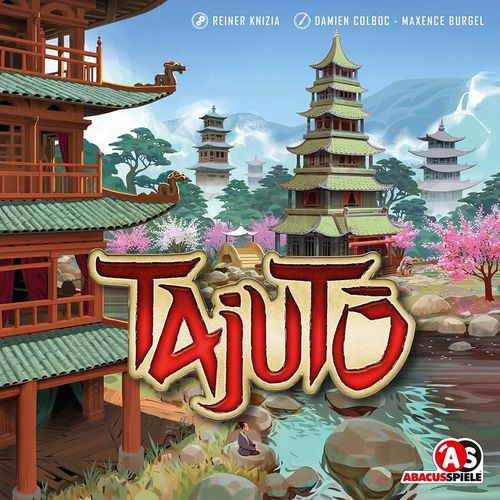
Tajuto
Tajuto Rulebook
Table of Contents
Table of Contents
Contents
- 1 Gameboard
- A. 8 Pagodas (each in a different color, each made of 6 floors) B. 1 large Cloth Bag
- A. 4 Monk Meeples (1 in each player color) B. 12 Action Tiles (3 in each player color)
- 32 Offering Cubes (4 for each Pagoda)
- A. 15 Wisdom Tiles B. 4 Transcendence Tiles (2 Markets and 2 Shrines) C. 6 Additional Action Tiles (3 pairs, each pair with a lower and higher value)
- 8 Objective Tiles
- 8 Inauguration Tiles (1 for each Pagoda)
1 Rulebook
Setup
- Place the gameboard in the middle of the table.
- Put the 48 Pagoda floors in the bag and shuffle them well.
- Each player chooses a color, places their Monk meeple on the 0 space of the Meditation path, and lines up their 3 Action tiles face up in front of them.
- Each player places a set of 8 Offering cubes (1 for each pagoda) in front of them.
- Fill the dwellings of the upper part of the village with face-up stacks of tiles as follows, sorting each stack by Meditation Point value, with the lowest value on top:
- A. Fill the houses of the top row with Wisdom tiles: stack the three 1-Spirituality tiles in the first space, the 2-Spirituality tiles in the second, 3s in the third, 4s in the fourth, and 5s in the fifth.
- B. Fill the left two houses of the next row with Transcendence tiles: in one space, stack the 2 Market tiles; in the other, the 2 Shrines tiles.
- C. Fill the other three houses of that row with Additional Action tiles, stacked by type.
- Fill the lower part of the village:
- A. Place an Endgame Objective tile in each of the two houses on the left.
- B. Place an Immediate Objective tile in each of the six Zen gardens on the right.
- Set up the Sacred Garden: In the Sacred Garden of the Eight Pagodas, each construction site has a space beside it for an Inauguration tile. Place the matching tile in each space.
Goal of the Game
By participating as mindfully as possible in constructing the pagodas, become the Buddhist Monk with the most Spirituality Points at the end of the game.
Playing the Game
The oldest, and thus wisest, player begins the game, and play continues clockwise until the end of the game is triggered.
A – On Your Turn
On your turn, you must use some or all of your Action tiles to perform actions, and you may also construct pagoda floors and/or claim objectives. You can do all of this in whatever order you like.
You begin the game with a set of 3 basic Action tiles of your color: You can use each of these tiles only once per turn. When you use one, twist it to indicate that it is now unavailable.
Over the course of the game, you may acquire Additional Action tiles, which you can use in addition to (or, if you prefer, instead of) your 3 basic Action tiles. Just like the basic Action tiles, you can only use each of these once per turn. When you use one, twist it to indicate that it is now unavailable.
At the end of your turn, untwist all of your Action and Additional Action tiles, so all of them are available for your next turn.
Action Tile Anatomy: each Action tile shows the Meditation Point cost to buy it, the Meditation Point cost to use it, and its effect.
Each Additional Action tile lets you perform a specific one of the above actions.
Thus, on your turn, you can perform some or all of the following actions one or more times, in any order you like:
1. Draw a Pagoda Floor: Draw a pagoda floor from the bag and place it in front of you. You are welcome to blindly rummage around to try to recognize the floor by its size, but you aren't likely to be able to detect the color this way. So, drawing the floor size you want depends on your tactile recognition, but drawing the color you want depends on luck.
2. Make an Offering: Place 1 of your 8 Offering cubes in the space provided on the current top floor of the same-color pagoda. Each floor of the pagoda can only have one offering. Thus, no further offering can be made at this pagoda until another floor has been built on it.
Your offering earns you Meditation Points (MP): Advance your Monk meeple on the Meditation path a number of steps equal to the number of floors, plus 2 for the offering.
Example: 4 MP (2 MP for 2 floors + 2 MP for your offering).
Note: Once a pagoda is finished, it is inaugurated, and no further offerings can be made there. Thus, you can never make an offering on Floor 6.
B – Action Tile Actions
If a tile has a cost to use it, you must move your Monk meeple back a number of spaces on the Meditation path equal to the cost. Each of your basic Action tiles lets you perform any one of the following three actions:
- Draw a Pagoda Floor
- Make an Offering
- Acquire a Tile
3. Acquire a Tile: You can acquire any tile with a Meditation Point cost in the upper-left corner; this means you cannot acquire Objective tiles (you must earn those). You can acquire either a tile from the upper part of the village (Wisdom, Transcendence, or Additional Action) or an Inauguration tile from the Sacred Garden. These tiles will help you progress more quickly and/or gain Spirituality Points. Acquiring one of these tiles costs Meditation Points, which means you must move your Monk meeple back along the Meditation path a number of steps equal to the cost indicated in the upper-left corner of the chosen tiles.
Note: You can only acquire a tile if you already have sufficient Meditation Points to pay for it. Your Meditation Points can never go below 0.
Inner Spirituality: Your Action tiles will be flipped face down as you use them, and flipped face up at the end of your turn. Your spirituality, on the other hand, is a more private matter: You can keep your tiles worth Spirituality Points (Wisdom, Objectives, Shrine, and Inauguration tiles corresponding to pagodas that are completed) stacked face down in front of you. This way, your opponents cannot see how many Spirituality Points you have accumulated during the game.
On the other hand, your Inauguration tiles corresponding to pagodas that are not yet completed and your Market tiles must remain face up.
C – Other Actions
There are also two actions that do not involve your Action Tiles:
- Construct a Pagoda Floor
- Complete an Objective
1. Construct a pagoda floor
At any moment during your turn, you can construct any number of pagoda floors.
Although as many as 8 pagodas may be under construction in the Sacred Garden, once 4 are completed, the game will end.
Each pagoda is composed of six same-color floors. A pagoda must be built from the ground floor (the largest), which we consider Floor 1, upward in descending sizes to Floor 6 (the smallest).
When Floor 6 of a pagoda has been built, the pagoda is complete. If someone has the Inauguration tile that matches the pagoda, they may stack it face down with their other tiles worth Spirituality Points. If not, immediately remove the tile from the game.
Notes:
- If you have drawn and placed in front of you any pagoda floors that can be built, you absolutely must do so during your turn; however, you can choose the exact moment(s) at which you do so.
- At the end of your turn, if you find that you have several floors you cannot construct (due to their size or color), you must return all but one (of your choice) to the bag. The one you keep stays in front of you for the next round.
Simple Meditation: Participating in constructing a sacred pagoda earns you Meditation Points (MP): Advance your Monk meeple along the Meditation path a number of steps equal to the height of the pagoda after you add your floor. If you construct several floors on the same turn, you advance along the Meditation path after each one.
Example: If, in the same turn, you construct floors 3 and 4 of the same pagoda (or different pagodas), you would score 3 MP + 4 MP = 7 MP.
Intense Meditation: If you construct a floor that directly covers an offering, advance your Monk meeple 2 additional steps along the Meditation path.
Example: 5 MP (3 MP for floor 3 + 2 MP for covering an offering).
2. Complete an objective
On your turn, you can claim one or more Objective tiles, but only if you meet their requirements. Stack the Objective tile face down with your other tiles worth Spirituality Points.
Note: Objective tiles do not cost Meditation Points.
End of the Game
Once the fourth pagoda is completed, the game ends immediately!
The player who completed it claims the Inaugurate the Fourth Pagoda Endgame Objective tile. The player who at this precise moment is furthest along the Meditation path claims the Finish with the Most Meditation Points Endgame Objective tile; if there is a tie for most, nobody takes it.
Ultimately, only your Spirituality counts: Each player flips their tiles worth Spirituality Points (Wisdom, Objective, Shrine, and fulfilled Inauguration tiles) face up then totals the Spirituality Points depicted on them. Remember the bonus from your Shrine tiles!
The player with the most Spirituality Points wins, and Prince Shotoku names them "The Great Guardian of the Sacred Garden of the Eight Pagodas". In case of a tie, the tied players share the victory and honor!
Tile Description
A – Your Starting Tiles: Basic Action Tiles
Each of your basic Action tiles lets you perform any one of the following three actions: Draw a Pagoda Floor, or Make an Offering, or Acquire a Tile.
In order to use a tile with a cost (in Meditation Points) in its upper-right corner, you must have enough Meditation Points to pay the cost: Move your Monk meeple back along the Meditation path the number of steps indicated in the upper-right corner of the tile.
Using tile A doesn't require any MP; tile B costs 4 MP; tile C costs 6 MP.
B – Other Tiles You Can Acquire
1. Additional Action tiles
Each of the Additional Action tiles let you perform one specific action.
As with your basic Action tiles, if the tile has a cost (in Meditation Points) in the upper-right corner, you must have enough Meditation Points to pay the cost: Move your Monk meeple back along the Meditation path the number of steps indicated on the tile.
- Tile D lets you Draw a Pagoda Floor but costs 2 MP.
- Tile E lets you Make an Offering (playing this costs 0 MP).
- Tile F lets you Acquire a Tile (playing this costs 0 MP).
2. Wisdom tiles
Wisdom tiles have no other use than to earn Spirituality Points.
The three tiles in each stack are progressively more expensive for the same Spirituality Points, so get them before your opponents do.
3. Inauguration tiles
Each inauguration tile is essentially a bet that the matching pagoda will be completed before the end of the game.
When a pagoda is completed:
- If someone has already acquired the matching Inauguration tile, they may stack it face down with their other tiles worth Spirituality Points.
- If, however, its inauguration tile is still beside the pagoda, immediately remove the tile from the game; nobody can acquire it.
At the end of the game, for each of your Inauguration tiles:
- If the pagoda is complete, you earn 4 SP.
- If the pagoda is incomplete, you earn 0 SP.
4. Transcendence tiles
Once you acquire a Transcendence tile, its effect is permanent until the end of the game.
Each Market tile costs 10 or 12 Meditation Points to acquire, but reduces the cost of all future tile acquisition by 2 Meditation Points.
If you have two Market tiles, you indeed pay 4 Meditation Points fewer for all future tile acquisitions (if the tile costs less than 4 MP to begin with, you pay 0).
Each Shrine tile increases the Spirituality Point value of each of your Wisdom and Inauguration tiles by 1 Spirituality Point at the end of the game.
However, Inauguration tiles whose pagodas are incomplete still earn 0 Spirituality Points (not 1).
C – Tiles You Earn: Objective Tiles
You claim Objective tiles in the moment you meet their requirements. They serve no other purpose than to grant 1 Spirituality Point.
You can claim each of the 6 Objective tiles on your turn as follows:
- Have 5 or more Spirituality Points on Wisdom tiles.
- Have 10 or more Spirituality Points on Wisdom tiles.
- Have 4 or fewer Offering cubes in front of you.
- Have 0 Offering cubes in front of you.
- Reach at least step 30 on the Meditation path.
- Complete the 1st Pagoda.
The 2 Endgame Objective tiles are awarded as follows:
- Complete the 4th Pagoda (you ended the game).
- Be the single player furthest along the Meditation path at the end of the game. If you are tied for furthest, nobody gets the tile.
Quick Reference
A – On Your Turn
On your turn, you can play one or more Action tiles, construct pagoda floors, and/or claim Objective tiles; all in any order you like.
B – Play an Action Tile
Pay the cost to use it, if there is one. Play an action tile to:
1. Draw a Pagoda Floor: Draw a pagoda floor from the bag and place it in front of you.
2. Make an Offering: Place 1 of your 8 offerings on the current highest floor of the same-color pagoda.
Gain 1 MP per stage + 2 MP for the offering.
3. Acquire a Tile: You can acquire any tile by paying its Meditation cost.
C – Other Actions
There are two other Actions that do not require playing Action tiles:
- Construct a Pagoda Floor
- Claim an Objective
1. Construct a Pagoda Floor
At any time on your turn, you can build as many pagoda floors as the situation allows.
Gain 1 MP per stage + 2 MP if you covered an offering.
When a pagoda's 6th floor is constructed, the pagoda is complete and inaugurated.
Note:
- If you have drawn and placed in front of you any pagoda floors that can be built, you absolutely must do so during your turn; however, you can choose the exact moment(s) at which you do so.
- At the end of your turn, if you find that you have several floors you cannot construct (due to their size or color), you must return all but one (of your choice) to the bag. The one you keep stays in front of you for the next round.
2. Claim an Objective
On your turn, you can claim one or more Objective tiles, but only if you meet their requirements. Stack the Objective tile face down with your other tiles worth Spirituality Points. Claiming objectives is free.
End of the Game
Once the 4th pagoda is completed, the game ends immediately!
The player who completed it claims the Inaugurate the Fourth Pagoda Endgame Objective tile.
The player who at this precise moment is furthest along the Meditation path claims the Finish with the Most Meditation Points Endgame tile; if there is a tie for most, nobody takes it.
Ultimately, only your Spirituality counts: Each player flips their tiles worth Spirituality Points (Wisdom, Objective, Shrine, and fulfilled Inauguration tiles) face up, then totals the Spirituality Points depicted on them. Remember the bonus from your Shrine tiles.
The player with the most Spirituality Points wins, and Prince Shotoku names them the "The Great Guardian of the Sacred Garden of the Eight Pagodas". If there is a tie, the tied players share the victory and the honor.