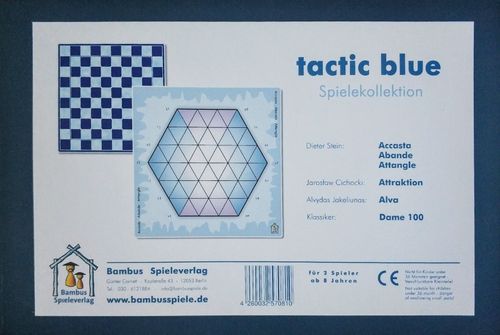
Tactic Blue
Tactic Blue Rulebook
Table of Contents
Accasta
Strategy game for 2 players aged 8 and up.
Accasta is a tactical stacking game. At the start players set up their pieces on their side of the game board and try to occupy the castle on the opposite side. In the process they inevitably cross paths.
Components
- Six-sided game board composed of 37 tiles
- 2 sets of 20 pieces, black and white
Game Board
Accasta is played on a six-sided board. Pieces are placed on the intersections of lines. Nine intersections at either end of the board are marked as player castles.
Playing Pieces
Players choose colors. To start the game all of the pieces are placed on the board. Most of them will be stacked.
White places 3 stacked pieces on each of a1, a2, a3 and a4, 2 pieces on b2, b3 and b4, as well as 1 piece on c3 and c4. Black makes the corresponding placements on his side of the board.
The starting placements.
Basic rule: the top piece on a stack (the "controlling piece") determines which player owns the stack, that is, pieces are free and may move and which are captured.
Goal of the Game
The players try to place 3 or more controlling pieces in the opposing castle.
Playing the Game
White takes the first turn and from then on turns alternate between the players. A player must always perform at least one action whenever he has a turn.
Moving Pieces
Pieces may move 1, 2 or 3 spaces, but always in a straight line. No piece or stacks may ever be jumped over, however it is possible (within certain restrictions explained below) to jump on top of other pieces (regardless of whether owned or opposing).
The controlling piece of the stack at b2 (lower left) may move up to 2 spaces, the singleton piece at f4 (upper right) may move 1 space.
The distance a piece may move corresponds to its height, ignoring opposing pieces in its stack. For example, a singleton piece always moves only 1 space. A piece with one same-color piece somewhere in the stack below it (not necessarily immediately below) is in the second position and moves 1 or 2 spaces. A piece in the third position moves 1, 2 or 3 spaces.
Illustration: The main piece of the white stack at c4 may move up to 3 spaces in a straight line, but not over other pieces (or stacks).
In the course of the game mixed stacks of black and white pieces will come into existence. The determination of the height for purposes of movement range counts only one's own pieces in a stack. For example, a white main piece atop 3 black pieces may only move 1 space.
Jumping
It is possible for pieces to jump on top of other pieces (regardless of whether owned or opposing). However, any move which would result is a stack having more than 3 pieces of the same color is not permitted.
Carrying Pieces
When it moves, a piece may carry along as many other owned and opposing pieces as desired so long as they are stacked under it. Thus a stack can be arbitrarily divided. However, the range of the piece in question is not altered by the number of pieces brought along, but is only determined by its height before the move.
Multiple Moves
If a stack is split and after the controlling piece moves off, the new controlling piece on a stack belongs to the current player, then this piece may also immediately move. It can move in a different direction and take pieces with it and even end on top of another stack, but it may never jump over other pieces or stacks.
In this way a player may make up to three moves in a round. It is never required to make a multiple move; a player may stop after having made at least 1 move.
Illustration: a selection of possible moves for the white stack of three at c4: a) the complete stack moves; b) the top two pieces are separated and move 3 spaces, then the remaining piece moves 1 space; c) 2 moves in the same direction; d) with a stack of 3 up to 3 moves are possible.
Release
Moves which leave an opposing piece in the position of controlling piece are permitted (termed a "release").
In that event the next turn is immediately taken by the opponent. It is not allowed to release an opposing piece which rests on one of the 9 spaces in one's own castle.
Safe Stacks
Basic rule: At all times a stack may only contain at most 3 pieces from any one player. All moves which would result in a stack containing more than 3 pieces of the same color are not allowed.
Illustration: White must split his stack at left if he wants to move on top of the center stack. Similarly, Black must release at least one white piece from his stack at right to be able to stack atop the center stack.
Thus a stack containing 3 pieces of a color may not have any more pieces of this color added. If these pieces are captured, this is known as a safe stack as it is invulnerable.
Thus if a player has captured 3 pieces in a single stack, this stack is unassailable as long as he does not split it. On the other hand, captured pieces can be a hindrance if pieces are to be moved on top of an opposing stack.
End of the Game
The first player able to place 3 (or more) controlling pieces in his opponent's castle wins the game.
Alternatively, a player wins if the opponent is unable to perform a legal turn.
Illustration: White wins with 3 controlling pieces in the opposing castle.
Q&A
- What is the origin of the game's name? From the Italian accatastare, which means "to stack up".
- After a release, is the opponent required to operate from the stack which was just released? No, he may choose any stack he controls.
Notation
The spaces on the six-sided board are clearly marked with coordinates. The horizontal rows are marked, starting from White, with "a" through "g" and the individual spaces numbered left to right. The central space therefore has the coordinate "d4", for example.
Accasta turns may consist of up to 3 moves which all depart from the same space.
A complete turn is notated as follows: Stack location: Total number of pieces moved (a "1" may be omitted) — ending space, further turns, …
When a player stacks on top of one of his own pieces, this can be noted by a "+" rather than a "-" while capturing an opposing piece is noted via an "×".
Sample Game
| Turn | White | Black |
|---|---|---|
| 1 | b4:2-c5 | e4:+e3 |
| 2 | a4:3-b4 | f2:+f3,+e3 |
| 3 | b2:2+c3 | f4:2-e5 |
| 4 | c4:-d4 | e3:+e5,×d4 |
| 5 | b4:×d4,2-c4 | e5:×c4 |
| 6 | c5:×c4,-d5 | e5:-e4 |
| 7 | d4:2×e3,-d3 | e4:-d4 |
| 8 | c4:2×d4 | f3:×e3,2×d5 |
| 9 | c4:×d5 |
White concedes.
Placements after turn 15 (diagram caption): e5:2-c6,×d5.
Strategy Hints
- Keep an eye on the safe stacks! The stacking height restriction should be used to tactical advantage.
- Safe stacks are worthwhile, but they can be more easily blocked by the opponent.
- Notice how the range of pieces changes! If you stack on your own pieces, range increases, but if you place individual pieces on vacant spaces, they decrease.
- If on the first turn you move your three-stack from a1 to d1 (a1: 3-d1) pull, you have already lost. Do you see why? Your opponent answers with g1: 3×d1; this 6-height stack is unstoppable.
Accasta, together with the games Abande and Attangle, comprise the stacking game trilogy by Dieter Stein, invented between 1998 and 2006.
Strictly speaking the above rules describe a variant of the base game called Accasta Pari, which is played with unmarked pieces. In the original game there are three different piece values which provide fixed ranges.
Abande
Strategy game for 2 players aged 8 and up.
Abande is a board game with the feel of a classic – simple rules and an abundance of tactical possibility.
The players try to occupy valuable positions, where it is impossible to lose the opponent's cooperation. At the end points are earned for owned pieces, but only with the help of the opponent.
Components
- Six-sided game board composed of 37 tiles
- 2 sets of 18 pieces, black and white
Game Board
Abande is played on a six-sided board. Pieces are placed on the intersections of lines.
Playing Pieces
Each player selects a color and receives the 18 corresponding pieces. The pieces are laid out openly (these are the pieces "in the hand").
During the game these pieces are stacked up in different ways. A player owns a stack when the topmost piece belongs to him.
Goal of the Game
Players try to score as many points as possible. Each individual piece and each stack of pieces are scored at the end of play.
Playing the Game
In the beginning the board is empty. The player with the black pieces begins by placing one of his pieces on any space on the board. This turn is called "the initiative turn", in contrast to the usual turn.
Afterwards the players alternate turns. There are 3 different possible turn options:
- Placing one's piece on the board.
- Moving an owned piece (or stack) already on the board on top of an adjacent opponent's piece (or stack).
- Passing, i.e. to do nothing, which is only allowed if the player has no more stones in hand. If both players pass consecutively, the game is over.
Illustration: In this example there are 14 spaces where a new piece could be placed.
The "Chain"
At all times all pieces (and stacks) must be connected to one another.
No individual piece and no group of pieces may be isolated (i.e. be without any pieces in any adjacent space).
Placing New Pieces
As long as a player has pieces in hand and is unable or unwilling to move a piece already on the board, he must place a piece on an empty space.
Newly-placed pieces must appear always adjacent to another (regardless of owner) piece (or stack).
Moving Pieces
Instead of placing a new piece, a player can move one of his own pieces (or one of his complete stacks):
- Pieces (or stacks) may move 1 space in one of the 6 possible directions.
- Pieces (or stacks) in moving must capture an opposing piece or stack. They are placed on top of the opposing piece (or stack). They cannot be moved to a vacant space or on top of one's own piece (or stack).
Illustration: Black to move. Besides being able to place a new piece, there are 5 different movement options. The piece in the very center of the board (d4) cannot move because this piece is bound; moving to either c4 or e4 would break the chain.
- Stacks may not grow to more than 3 in height.
- Stacks may never be divided.
- Moving is allowed only after Black has entered his second piece, i.e. Black cannot directly capture White's reply to the initiative turn.
Passing
If a player has no more pieces in hand, he is permitted to pass; the opponent receives a consecutive turn.
It is possible that a player must pass because there no regular turn is possible.
A player who has passed is allowed to take a regular turn again, in the following round.
End of the Game
If both players pass, one immediately after the other, the game ends.
Sleeping Pieces
Before scoring, pieces (or stacks) which are not adjacent to an opposing piece (or stack) are removed from the board, i.e. do not count for scoring. Note that this does not apply to pieces within mixed stacks. Only the tops of the stacks are taken into account when deciding if they are asleep. It is possible that by removing these sleeping pieces that the chain is broken. This does not matter for purposes of scoring.
Scoring
Scoring is performed after the sleeping stones are removed. Players receive:
- 1 point for each individual owned piece
- 2 points for each owned double stack
- 3 points for each owned triple stack
After the sleeping pieces are removed, all the stacks are scored. In this example the contest is a 12:15 victory for Black.
The player who earns more points wins the game. Should both players have the same point total, the result is a tie.
Variant
Abande can also be played on a square grid. Then it is tactical and even a bit more demanding.
The pieces are placed on the 49 (7x7) intersections between spaces in the middle of the board. Pieces also count as connected if they are adjacent along the diagonal. Thus there are at most 8 lines of connection for any one location. All other rules are as in the base game for a six-sided board.
Q&A
- What about triple stacks? Careful attention to the rules shows that triple stacks may never be captured nor moved for the rest of the game.
- Some moves cause the chain to be broken in one location, but everything is still connected elsewhere. Is this allowed? Yes, because all pieces are still always part of one chain. It's just that the connection path has been altered.
Notation
The coordinate system from Accasta (see page 4 of the collection rules) is used for notation.
Sample Game
| Turn | White | Black |
|---|---|---|
| initiative | d4 | |
| 1 | d5 | e4 |
| 2 | c3 | b2 |
| 3 | e3 | c4 |
| 4 | b4 | d3 |
| 5 | d2 | d1 |
| 6 | f4 | c5 |
| 7 | d5-d4 | g4 |
| 8 | d4-c4 | f2 |
White wins 14:13.
Strategy Hints
- Keep the end of game scoring firmly in mind!
- Try to place near several opposing pieces (without vulnerability to being captured of course). This increases the chance that at the end your piece is connected to an opposing one and therefore earns points.
- Take care at the edges and in the corners of the board! Things get tight there very quickly and it's not always possible to defend a position.
- Sometimes situations arise where one should sacrifice a piece (and lose 1 point), but cause the opponent to lose 2 or ever more points.
- Often in the course of the play, there arise "bridges", i.e. pieces which create additional connections. When that happens, new movement possibilities can arise in a completely different part of the board – for the opponent, but also for yourself!
Abande together with the games Accasta and Attangle comprise the stacking game trilogy by Dieter Stein, invented between 1998 and 2006.
Attangle
Strategy game for 2 players aged 8 and up.
Attangle is a board game with very simple rules. Its fine points reveal themselves to the players only after a few playings.
Components
- Six-sided game board composed of 37 tiles
- 100 playing pieces, half black and half white
Game Board
Attangle is played on a six-sided board. Pieces are placed on the intersections of lines.
The coordinates printed on the board permit each space to be named, making it easier to record a playing.
Playing Pieces
Players choose colors.
During the game these pieces are stacked up in different ways. A player owns a stack when the topmost piece (or more precisely: the majority of the pieces in the stack) belongs to him.
Goal of the Game
The players try to create 3 of their own stacks of five.
Playing the Game
In the beginning the board is empty. The player with the white pieces begins by placing one of his pieces on any space on the board. However, on the first turn of the game he may not place in the exact center (space d4) of the board. After that the players alternate turns. It is required to always take a turn. There are two basic turn options:
- Place a piece on the board.
- Capture an opposing piece (or stack) which is already on the board.
Placing Pieces
A new piece may be brought onto the board on any vacant location.
Capturing Opposing Pieces
To capture, a player moves exactly 2 pieces or an individual piece plus 1 stack of three. Each piece or stack moves in a straight line and the two lines meet on an opposing piece or stack.
Illustration: Two individual pieces capture an opposing piece and create a triple stack.
- Pieces (or stacks) may move in any of the 6 directions. Once decided, the direction of movement for this stack may not be changed during the turn.
- It is not allowed to jump over owned or opposing pieces (or stacks).
- Pieces (or stacks) may not move unless in doing so, they capture. They are then placed on top of the opposing piece (or stack). They cannot be moved to a vacant space or on top of one's own piece (or stack).
- The capturing pieces must be moved at the same time, that is, they must come from different directions since they cannot jump over other pieces.
- After the move the active player must have a majority of 1 piece in the new stack, i.e. either it is a triple stack (2:1 ratio) or a quintuple stack (3:2 ratio).
Illustration: Stacks may also capture. Together with an individual stack it creates a stack of five.
Illustration: Triple stacks can be captured by two individual pieces.
Illustration: It is not possible to be captured in this position.
- No stack may exceed 5 pieces in height.
- Once formed, stacks may never be split.
End of the Game
The first player to create his third stack of five wins the game.
Illustration: Black wins with his 3 stacks of 5 at c4, e5 and f3.
Variant
Attangle can also be played on a square grid board (as in Chess).
The pieces are placed on the 64 (8 × 8) spaces in the middle of the board. Pieces move in all 8 possible directions (straight or diagonal). Five stacks of five are required to win the game. All other rules are as in the base game for a six-sided board.
Q&A
- What is the origin of the game's name? From the English words "attack" + "angle": in attacking the pieces describe an angle.
- The instructions state that in moving exactly 2 pieces (or an individual piece plus 1 stack of three) must be moved? Yes, that is correct.
- So stacks can only be 3 or 5 in height? Yes, this is also correct.
- What about the stacks which are five pieces high? These stacks can never be captured or moved for the rest of the game.
- Are quintuple stacks removed from the board when formed? No, they remain there.
- The capturing pieces move at the same time. In what order must I place them on the stack? The order plays no role here. One can stack them in any order.
Notation
The coordinate system from Accasta (see page 4 of the collection rules) is used for notation.
Sample Game
| Turn | White | Black |
|---|---|---|
| 1 | e1 | g3 |
| 2 | d4 | c5 |
| 3 | a4 | c1 |
| 4 | c4 | f5 |
| 5 | e6 | f3 |
| 6 | a1 | f5,c5-e6 |
| 7 | c5 | d6 |
| 8 | d4,c5-d6 | f1 |
| 9 | g1 | e6,f1-e1 |
White wins.
Strategy Hints
- Triple stacks are simultaneously dangerous and in danger; over them lead all the paths to victory.
- Try to keep all of your pieces covered as much as possible.
- Wall off areas of the board and at the same time try to create connected groups of your pieces.
Attangle, together with the games Accasta and Abande, comprise the stacking game trilogy by Dieter Stein, invented between 1998 and 2006.
Attraktion
Strategy game for 2 players aged 8 and up.
Attraktion is a strategy game with the power to attract.
Components
- A square grid game board having 8 × 8 (or 10 × 10) spaces
- 2 × 32 white and black pieces (2 × 50 for the 10 x 10 game board)
Game Board
Attraktion is played on a square game board having 8 × 8 (or 10 × 10) spaces. The smaller board is good for learning how to play the game the first time. Usually, however, the larger board with its 100 spaces should be used. Experts play on still larger boards.
Goal of the Game
Players try to reach a particular winning position: 1 of one's own pieces surrounded by exactly 4 opposing ones on the diagonally adjacent spaces.
Playing the Game
In the beginning the board is empty. Each player selects a color. White takes the first turn.
Each player turn is conducted in 2 phases:
- Placing one's piece on any empty board space.
- Then letting the power of attraction go to work.
The Power of Attraction
Starting from the newly-placed piece and extending outward, move every piece, regardless of owner, in the same row and column one space in the direction of the new piece. However, a piece only moves only if the space which it is to enter is vacant.
End of the Game
After each player's turn the effects of attraction are reviewed to see how many winning positions each player has achieved. A player's move may create winning positions for the opponent as well. A player wins if he has more winning positions than his opponent. In case of a tie, the game is continues.
Alva
Strategy game for 2 players aged 8 and up.
Alva is a new kind of Checkers/Draughts game with simple rules and many varied possible combinations.
Components
- A square grid game board having 9 × 9 spaces
- 2 × 32 white and black pieces
Game Board
Alva is played on a square grid having 81 spaces. Pieces are placed on the intersections of lines, not in the spaces.
Goal of the Game
Players try to capture as many of the opponent's pieces as possible.
Playing the Game
In the beginning the board is empty. Each player selects a color. White takes the first turn.
The player whose turn it is must either
- capture an opposing piece or pieces by jumping over, or if that is not possible,
- bring one of his pieces into play.
Optionally one owned piece may be shifted over one space beforehand.
Jumping
Opposing pieces must be captured via jumping whenever possible. The jump must always be in along a line over a single piece or over an unbroken row of at least 3 opposing pieces and end on a vacant space immediately afterward.
(Note that the pieces to be jumped over are contiguous, not separated by empty spaces as in traditional Checkers/Draughts.)
If further jumps with the same piece are possible, they must be carried out, even if the new jump goes in a different direction.
If at the start of the turn multiple jumps are available, the player is free to select any one of them.
Illustration: Opposing pieces can be jumped and thereby captured.
It is not allowed to jump over exactly 2 opposing pieces.
After each jump the jumped-over opposing pieces are removed and momentarily placed next to the board. If the opponent in his very next turn also captures pieces, he keeps them if the number of captured pieces for each player differs. Otherwise, these pieces must be given back to the player to whom they belong.
After the opponent has completed his turn, pieces which were placed at the edge of the board are now taken in hand. Each one is worth one point at the end of the game.
Moving and Placement
If none of one's pieces can jump, then the player may shift one of them to an orthogonally-adjacent vacant space. Afterwards an owned piece must be placed in any empty space.
Illustration: A piece can be shifted 1 space in any orthogonal direction, i.e. along a line.
Illustration: White sets up a forced capture in order to prepare his own attack. Black is required to capture the new white piece. White now captures 2 pieces and doesn't have to give them back as Black only managed to capture one piece on his last turn.
End of the Game
The game ends when either of the players is unable to take a turn.
Any pieces at the board edge can be claimed. Each captured piece and every opponent piece on a space which touches the edge of the board is counted as 1 point. The player having the higher total wins.
Dame 100
[Checkers 100 / Draughts 100]
Classic strategy game for 2 players aged 8 and up.
Dame 100 is also often known as International Checkers (International Draughts) as it is played according to worldwide convention. Moreover there exist innumerable much older variants in many countries.
Components
- A square grid game board having 10 × 10 spaces
- 2 × 20 white and black pieces
Game Board
The game is played on a square grid board having 10 x 10 spaces. The board is laid out so that the lower left corner as seen by White is dark space. The game is played only on the dark spaces. (To achieve better contrast with the pieces, players can of course agree – contrary to the official rules – to play only on the light spaces.)
In the beginning players set their pieces on the first 4 rows of the board.
The initial set up.
Goal of the Game
Players try to capture the opposing pieces or prevent them from moving.
Playing the Game
Each player selects a color. White takes the first turn.
There are two possible turn options:
- A piece moves 1 space diagonally forward.
Illustration: A piece moves diagonally forward 1 space.
- A piece jumps diagonally forward or backwards over 1 opposing piece and ends on the empty space on the opposite side. When the turn is over, and only then, the captured piece(s) is(are) removed from play.
Jumping may occur either forward or backward.
Multiple Turns
If after a capture a piece could immediately perform another jump, it must do so. The turn does not end and no captured pieces are removed until no more captures are possible for the moving piece.
No piece may be captured – jumped over – more than once in a turn, although the same vacant space may be entered more than once.
Capture Is Required
If one or more opposing pieces can be captured, the player must do so.
In addition, the player must make the move that would capture the most pieces possible in the current turn.
In the case where there are multiple ways to capture the most pieces, the player has the choice of which one to perform.
Kings
When a piece reaches the last row opposite the side on which it started, it becomes a King. This is shown by placing a second piece not in play on top of it.
Note: A piece which during capture reaches the last row, but then moves backwards because it must capture another piece does not become a King.
Kings move forward or backward any number of squares on a diagonal line to an unoccupied square. Kings capture from any distance along a diagonal line by jumping, forward or backward, over an opposing man or king with at least one unoccupied square immediately beyond it. The capturing king then lands on any one of these unoccupied squares (except may not jump over the same opposing piece or king more than once) and continues jumping, if possible, either on the same line, or by making a right angle turn onto another diagonal line.
Kings may never jump over checkers of the same color.
When there is a choice between several moves, the King does not receive any special preference.
Kings are not required to land directly behind a captured piece.
Illegal Moves
If the opponent takes an illegal turn (forgetting, for example, to capture or capturing too few pieces) the player may demand that this turn be re-done.
End of the Game
If a player on his turn cannot take any legal action, he has lost the game.
If the situation arises that neither player can win, the game is a draw.