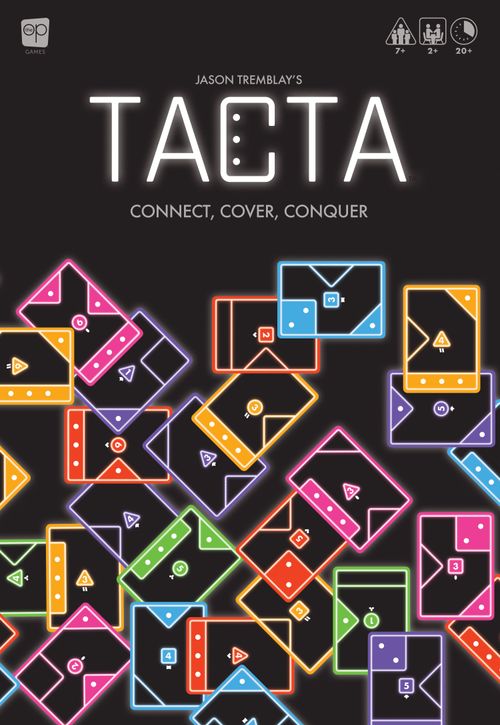
Tacta
TACTA Rulebook
Table of Contents
Table of Contents
Objective
Position and connect your cards to cover your opponent's dots while protecting your own. The player with the most visible dots when the final card is played wins.
Contents
- Starting Card
- 108 Playing Cards (6 colored decks with 18 cards each)
Iconography to support color accessibility: White, Blue, Green, Orange, Pink, Purple, Red.
About the Cards
- Double-Sided — The back is a mirror image of the front.
- Edge Shapes — Hollow and filled triangles, rectangles, and squares.
- Dots — Each dot is an individual point.
- Value & Suit — Total number of dots (Value) in either a circle, square, or triangle (Suit). Note: Suit is only used in alternative ways to play.
- Color-Accessibility Symbol — Symbols to support color accessibility. Used to identify the six card deck colors.
Setup
- Choose a table or play area with a large, flat, open space. The edge of the table marks the boundary—cards cannot go beyond it. If you have a small area, check out Limited Space on page 7.
- Place the Starting Card in the center of the play area.
- Sort the cards in separate decks by color or color-accessibility symbol and select one as your deck. If there are 6 players or fewer, each player should start with 18 cards (one color per player). For larger groups, see Team Up on page 7.
- Shuffle your deck. Keep the cards in a stack in your hand. Never fan or look through your deck. During the game, hold your deck and play either of the two outermost cards.
How to Play
The player with the lowest value on either of their outermost cards starts. If there is a tie, the player with the lowest combined value on their outermost cards begins.
- Choose an outermost card to play.
- Flip or turn the card to connect it to the Starting Card by covering one of the shapes on it. When the shapes match and align, the outline of the card underneath appears to be continuous.
- The play continues clockwise. Players can now cover a matching shape on any card in the play area regardless of color following the Dos and Don'ts below.
DOs
- You can flip or rotate the card's orientation.
- Regardless of whether the edge shape has dots or is hollow, connect or cover any card as long as the shapes align. Shapes with dots can cover blank shapes and blank shapes can cover shapes with dots.
- Gently nudge legally placed cards back into position if they become misaligned during the game. The outline of the card underneath should appear to be continuous.
- If a player notices an illegally placed card, it should be removed from the play area, but only if no other card has been placed on top of it.
- Play a card by connecting or covering a matching shape.
- Connect to only one card per turn. Card edges may touch slightly, but shouldn't overlap shapes or dots.
- If it is your turn and you do NOT have a legal move, you may place a card directly in the play area without touching any other card.
DON'Ts
- Connect or cover shapes that do not align perfectly.
- Connect shapes that do not match.
- Connect shapes that break the outline of the card underneath.
- Remove or nudge any legally placed cards.
- Play on more than one card at a time. This includes connecting or covering more than one matching shape.
- Rearrange a card once you have placed it in the play area.
End of Game
When players place all the cards from their decks, the game ends, and scoring begins.
Scoring
Players count their own dots, then double-check the player to their right to keep things fair.
- If an illegal card is discovered during scoring, simply remove the illegally placed card from the play area. Any visible dots that were connected to that card WILL still count toward the player's score.
- The player with the most visible dots is the winner.
- If players tie at the end of a round, shake hands and share the victory. If a winner must be declared, either play again or declare the player who went out first the winner.
Scoring Example:
- Green: 8 Points
- Red: 7 Points
- Purple: 7 Points
- Blue: 5 Points
- Pink: 5 Points
- Orange: 0 Points
Still having fun?
- As a group, decide how many rounds to play.
- If you want a longer game, set a specific target number. We suggest first to 100 points.
Other Ways to Play
Limited Space
Play this version using one suit each round (the square, circle, or triangle found around the number in the center of your card). Play a total of 3 rounds, then tally your dots from all rounds to determine the winner.
Quick Round
In this version, players follow the basic rules but remove a suit (or two) to shorten the overall playtime. The same scoring rules apply.
Team Up
For larger groups, we recommend the Free Play mode—great for teams of two players per color deck. Shuffle the deck and deal 9 cards to each player, making sure teammates aren't seated next to each other. Refer to Free Play below to get started. If playing by the standard rules, try to keep each turn under 10 seconds to keep the game flowing smoothly.
Free Play
In this version, there are no turns! Countdown from 3-2-1, Go! Simultaneously, any player can place a card on the Starting Card. Play as quickly as possible while adhering to the Dos & Don'ts. Additionally, you cannot play on a card of your own color. Once a player plays their last card, the game ends immediately, and scoring begins.
Sabotage
Play this version with two suits. Choose one suit from your deck and pass to your opponent on the left. Shuffle your new deck, which now includes one suit of your cards and one suit from your opponent. You will play both your cards and your opponent's cards, but the same rules apply: you only score for your own color.
Follow @theopgames for more ways to play!
House Rules
We'd love to hear your House Rules! Email [email protected] to share them. Who knows, they might find their way into an expansion.
Note from the Designer
Years ago I fell into a holiday-food-induced-coma and had a strange, vivid dream: Weaving through a crowded, dusty market, I saw a boisterous crowd jostling over a low table. Curious, I shouldered my way through the crowd and saw them focused, pointing and counting over a mesmerizing sprawl of cards overlapping in angular patterns, covering the table from end-to end.
I woke with my heart racing, knowing what I had to do to make my card game click. The concept of TACTA had formed.
Next came years of crucial encouragement and feedback from my new friends in the game world: Ann Mosconi, Patrick Goepfert, John Heath, Vicki Langer, Danni Palmer, Derrick Reisdorf, Edward Bell, Randall Li, Hunter Johnson, Jen Perry, Tom deBruyn, the mysterious Johann Doe, everyone at BGDL, BMG, Unpub, GCOM, The Op, and all the many play testers. Thank you my brothers Wayne Tremblay and Josh Gould, and to my greatest love, Rebecca Adelman, for your unwavering support. Without you all, TACTA would be just a jumble of cards.
— Jason Tremblay