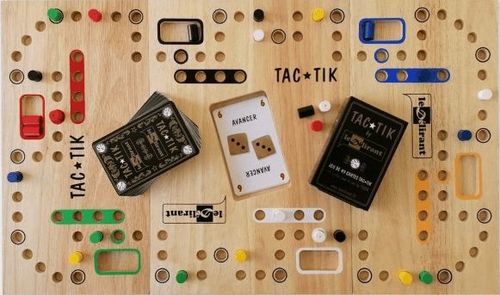
Tac-Tik
Tac-Tik Rulebook
Table of Contents
Table of Contents
Card Functions
Advance 2, 3, 5, 6, 8, 9 and 12. These cards move one peg clockwise by the value shown.
Advance or Start 1 and 10. These cards give the choice of either starting a peg (see THE STAKE) or moving a peg clockwise by the value shown.
Reverse 4. This card moves one peg counter-clockwise by 4 spaces. It may not move a peg directly into its base (see ENTERING ITS BASE).
- It may be used to reverse a stake (see THE STAKE) so that it can enter its base the following turn.
- It may be used on a peg or a stake to eat a peg located 4 spaces behind it.
Swap. This card allows a player to swap one of his pegs, or his own stake (see THE STAKE), with another peg. Both pegs must already be on the board outside the bases.
- Example 1: Swap one of your pegs with:
- a peg of another player;
- another of your own pegs (a way of playing the "excuse").
- Example 2: Swap your own stake, which then becomes a peg, with:
- a peg of another player;
- another of your own pegs (the peg in the starting space may then enter its base the following turn).
Advance 7x1. This card allows a player to move one or several of his pegs by one space each, up to a total of seven spaces, clockwise.
- It eats all the pegs on its path.
- Its value (as for all cards) must be used entirely in all cases.
- The value of this card is never shared between pegs of different colours.
- Example 1: Move several pegs on the board.
- Example 2: Advance one or several pegs into its base to make room for the other pegs (see ENTERING ITS BASE).
The exchange of information during play does not suit the spirit of the game. (And remember... this is only a game!)
Rules for 4 or 6 Players – "In Teams"
(2 or 3 teams of 2 partners – each player has one colour.)
Goal. Be the first team to bring the 4 pegs of both partners into their respective bases.
Setup. For 4 players, the board is made only of the two end sections. For 6 players the whole board (including the central piece) is used. Form the teams of two players as follows: red with yellow, blue with green, and possibly black with white. Each player takes the 4 pegs matching his colour and places them in their cups (alvéole) in front of him.
Play. (a) One player shuffles the 48 cards and deals them one at a time, 4 cards to each player. He then passes the remaining stock to the player on his left, ready for the next deal.
(b) Each player looks at his 4 cards and chooses one, which he passes face down to his partner. This card exchange is compulsory and takes place after every new deal of cards. It is essential for the team, because it may allow the partner to start, eat, enter the base, and so on. Look carefully at the state of the game before giving your card! Do not look at the card received before giving your own.
(c) When the card exchanges are finished, the player to the left of the dealer begins. He plays one card face up in the centre of the board, then moves one of his pegs according to its value.
- Example 1: If the player has no peg on the board, he must, if he can, play a card "1 or 10" which lets him start one and place it visible (see PEG STAKE) on the starting space surrounded by his colour.
- Example 2: If he has no peg on the board and no card to start with, he selects one, throws it face up and passes his turn (see COMPULSORY PLAY).
- Example 3: If the player already has a peg on the board, he may either move it, or start another according to the strategy he chooses.
(d) Then it is the next player (the one on the left) who plays a card, and so on until all the players have played their 4 cards.
(e) Without shuffling, the new dealer takes the remaining stock of cards and deals them one at a time, 4 to each player. Each player again passes a card face down to his partner, then the player to the left of the one who dealt the cards begins… and so on.
(f) When all 48 cards are in the centre of the board, the new dealer gathers them, shuffles them and starts the deal cycle again.
When playing "In Teams". When a player has brought all his own pegs into his base, he plays the following turns together with his partner. (Remember that the "7x1" card is never shared between pegs of different colours.) At this stage, the exchange of cards between partners becomes very important for bringing in the last peg of the team and winning!
Rules for 3 Players – "Individually"
(Each player has 2 colours.)
Goal. Be the first player to bring the 4 pegs of each of his two colours into their respective bases.
Setup. For 3 players, the whole board (including the central piece) is used. One player takes charge of the red and yellow pegs, another takes the blue and green pegs, and the third takes the black and white pegs. Each player places his pegs in their cups (alvéole).
Play. The play for 3 players is the same as for 4 or 6 players, except for (b):
(b) Each player looks at his 4 cards and chooses one, which he passes face down to the player seated on his left (the opponent of an opponent… could that be a partner?). This card exchange is compulsory and takes place after every new deal of cards. Do not look at the card received before giving your own.
When playing "Individually". Each player is free to choose which of his two colours he will play on each turn (but remember that the "7x1" card is never shared between pegs of different colours). A player also has the additional possibility of swapping between his own two stakes.
Rules for 2 Players – "Individually"
(Each player has 2 colours.)
Goal. Be the first player to bring the 4 pegs of each of his two colours into their respective bases.
Setup. For 2 players, the board is made only of the two end sections. One player takes charge of the red and yellow pegs, and the other takes the blue and green pegs. Each player places his pegs in their cups (alvéole).
Play. The play for 2 players is the same as for 4 or 6 players, except for (a) and (b):
(a) Each player receives 6 cards instead of 4 at each deal.
(b) Each player looks at his 6 cards and chooses one, which he passes face down to his opponent. This card exchange is compulsory and takes place after every new deal of cards. Do not look at the card received before giving your own.
When playing "Individually". Each player is free to choose which of his two colours he will play on each turn (but remember that the "7x1" card is never shared between pegs of different colours). A player also has the additional possibility of swapping between his own two stakes.
Note: a simple version of Tac-Tik exists, which allows play for 2 (individually) or for 4 (in 2 teams of 2 partners). The card game, as well as the pegs supplied with Tac-Tik, are also available separately.
General Rules
Compulsory play. To play a card, its value must be used entirely. A player must always play his turn when he can, even if this harms himself (or his partner). If he cannot play a card at all, he throws one away, face up, and passes his turn… politely!
The stake (LE PIEU). When a peg starts, it becomes a "stake" (pieu) and must be placed visible, with its hole showing (partie percée visible), in the starting space surrounded by its colour. It remains a stake as long as it has not been moved or swapped.
A stake cannot:
- enter its base;
- be eaten;
- be overtaken;
- be swapped (except by its owner).
It therefore blocks all the pegs (but does not prevent swapping), including those of its owner which are ready to enter the base or to start. As soon as the player moves or swaps his stake, it becomes an ordinary peg, loses all the characteristics of a stake, and must be turned over with its hole face down (partie percée cachée).
Overtaking (DÉPASSER). A peg may overtake another peg unless the latter is a stake or is inside its base (see ENTERING ITS BASE).
Entering its base (RENTRER DANS SA BASE). A peg enters its base through the starting space with an "Advance" card.
A peg in its base cannot:
- come out again;
- be eaten;
- be overtaken;
- be swapped.
Each peg must therefore, where necessary, be pushed as far as possible so that the others can enter their bases. If the value of the card is greater than the number needed to enter its base, the peg must overtake (see COMPULSORY PLAY).
Eating a peg (MANGER UN PION). To eat a peg, a player must end his movement exactly on that peg, except in the case of the "7x1" card (see CARD FUNCTIONS).
- A peg located in the starting space where a stake starts is also eaten.
- An eaten peg is returned to its cup (alvéole) and must be started again.
The Board
The board is modular and made of three parts, which can be separated ("Désemboîter" on the sheet). The diagram on the sheet labels the following parts:
- Repère points (reference points): all four spaces of each marked group.
- Alvéole (cup): the pegs waiting to be started.
- Base: where a peg enters by way of the starting space.
- Case de démarrage (starting space): the space where a stake is placed.