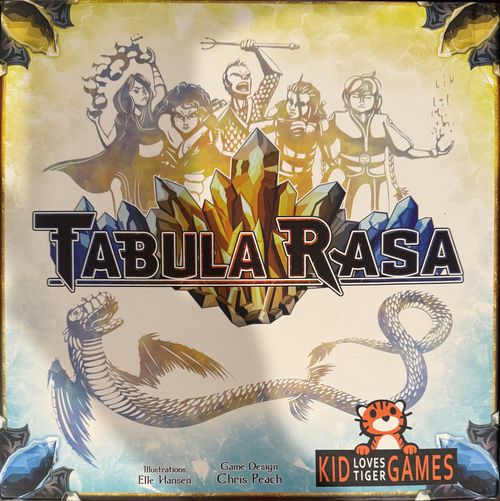
Tabula Rasa
Tabula Rasa Rulebook
Table of Contents
Table of Contents
- Components
- Setup
- A Game Turn
- Movement
- Foe Cubes
- Encounters
- Crystals and their Magics
- Building Crystals
- Exhaust Crystals
- Players Defeated
- Use an Effect listed on your gear
- Gaining Inspiration
- End of Turn
- Quest Cards
- Threat Track
- Foe Cards
- Attacking Engaged Foes
- Threat Deck
- End Game Conditions
- Synergy of Magics
- Location Features
- Glossary
- Last Clarifications
- Reward Token Clarifications
Components
- 1 Game Board
- 1 Rulebook & Glossary
- 6 double sided Hero Cards
- 108 Foe Cards
- 6 Felt Bags and 80 Plastic Cubes in 4 colors
- 36 Champion Gear Cards
- 48 Threat Deck Cards and 30 Threat Adversary Cards
- 130 Acrylic Crystals
- Reward Tokens
- 5 Pool and 5 Discard Tokens
- Player Tokens and 5 Meeples
- Glory Tokens
- Wound and Status Tokens
- 26 Quest Cards
Setup
- Players lace the game board near the center of the play area, on whatever side they choose. Players can sit around the board in whatever order they wish. Depending on the side, see additional setup rules titles Volcanic or Jungle.
- Populate each board space with a foe cube per star it has displayed. Jungle: Place a Platinum Reward in the Temple Region, given to the first player to enter that space. Volcanic: Place no foes in the 4 Star Regions, instead remove 10 Yellow, 5 Red and 2 Purple Cubes before populating the board.
- Populate the Reward Area with the Bronze, Silver, Gold and Platinum Rewards, shuffled up and face down. Then populate the crystal area with 4 Crystals +1 per player. Jungle: If there are not 3 or more colors in the crystal area, each champions draws +1 for setup. Volcanic: If there are not 3 or more colors in the crystal area, put duplicates back and draw again. Editor's note: the Kickstarter rulebook revision update states that Bronze Rewards laid out in this step should be disregarded. The text is transcribed as printed; the Bronze Rewards are still listed here.
- Sort out the Wound, Status and Glory Tokens near the board to create a token bank. This should be accessible to all players throughout the game.
- Choose a Threat to confront by choosing a deck randomly. For your first game, we recommend Malcifer, the Snake Diety. Shuffle the Threat Deck and place it in its board space. Then set the Threat Adversary Cards off to the side of the board for later. You may also shuffle up the boards 3 Adversary Cards and pick one randomly. See below for the board's Threats. Jungle: Malcifer, Shak'Ar or Quetzicotyl. Volcanic: Cerberus, Maggus or Lavvis.
- Separate the 3 different Foe Decks; Weak, Standard and Elite. Place them in their respective spots on the board. You may combine all of the Foes available, but for a balanced and thematic experience, see the Foes below or check the thematic backgrounds. Jungle: Jungle Troll, Naga Warrior, Pit Viper, Shock Spirit, Thunder Bird, Tribe Shaman. Volcanic: Deep Dwarf, Fire Elemental, Golem, Lava Drake, Lava Hounds, Molten Cult.
- Randomly determine someone to be the 1st Player. Starting with them, then proceeding clockwise (this will be referred to as the turn order in the future), each player chooses a Champion, taking their Champion Card and their 3 double-sided gear cards.
You are ready to begin!
A Game Turn
Players take turns in a clockwise order, starting with the first player. After all players have taken their turn, reveal the top card of the Threat Deck. Players continue resolving turns until an "End Game" condition is met.
End Game conditions are described later in this book (page 8).
Your Champion and You
When this book or the reference book use the word "you", it refers to the active player and her/his Champion. The player and Champion are inseparable. The active player is the player currently taking their turn.
2 Crystal Rule
Remember that for ANY Action, any 2 Crystals may be spent as any other color. 2 Red may be spent in place of an Orange, or vice versa. While inefficient, this does mean that your actions themselves are never limited, but your efficiency is sacrificed to gain the actions you want.
Actions
Players have a range of actions available to them, and may perform any actions, any number of times, provided they have the Crystals in their pool to spend on them. Below are the actions players may take, in any order:
- Basic Attack
- Basic Build
- Basic Move
- Activate an Ability
- Use an Effect listed on your gear
All Actions are described in detail in the following Sections.
Basic Attack
Players can generate 1 Attack Strength by spending 2 Crystals of any color. This can be done any number of times.
Attack symbol (a star-burst diamond): this symbol is used to show Attack you generate on your turn. Attack is used to defeat foes.
Note Gaining Attack and "Attacking for X" are functionally the same, but effected by foes differently at times.
Basic Build
Players can build an additional Full Crystal that will cycle into their bag and pool by spending 2 Crystals of any color, then taking a Crystal in the Crystal Area of the board and placing it in their discard.
This can be done any number of times during your turn if there are Crystals in the board's Crystal Area and you have the Crystals to spend on the action.
Basic Move
Players can generate 1 Movement by spending 2 Crystals of any color. This can be done any number of times.
Movement symbol (a footprint): this symbol is used to show Movement you generate on your turn. Movement is used to move from space to space on the board.
Activate an Ability
Each Champion has abilities listed on their Champion Card. Some begin the game unlocked, while the bottom 4 begin the game "locked" from use, until they gain an inspiration to unlock them.
Example abilities shown on a Champion Card:
- Spirit Shot (cost: 1 Purple crystal). Attack for 1. If you [the printed text omits a word here] a foe, regain 1 Health. Orange crystal: Attack for +2.
- Deadly Trap (cost: 1 Red crystal). Destroy up to 2 foes. Gain no Bounty Quest Progress and no Loot. Gain 1 VP for each foe.
- Summon Companion (cost: 1 Blue crystal). Gain 2 Focus, or Gain 2 Protection, or Build 1.
When you activate an ability, perform the actions described in the text area in the exact order they are listed. Abilities may be used any number of times each turn, provided you can pay the cost to activate it.
Note Remember the 2 Crystal Rule when activating Abilities.
Use Effects on Legacy gear
Champions may stumble upon pieces of gear during their quests. Some pieces of gear have triggers, some have abilities you can use at any time. they follow the same rules that abilities and actions do.
These effects only cost Crystals if specified. Though Champions don't start with any Legacy gear, when they find it, it begins on the Basic side, shown to the right.
Example, Dais's Ranger Boots: "At the start of your turn, you may gain 1 Movement or draw 1."
Note Gear will specify how often they may be used by saying "When" or "Once per turn".
Movement
During a player's turn, they might gain Movement, allowing them to navigate the board.
In each space, players will encounter cubes that represent random encounters with different threats. When entering a space, players encounter 1 random foe of each type from the Foe Decks.
Example: The Black Player would be engaging a Standard foe, then moving and engaging an Elite foe as well. First they would move, then draw 1 random Standard foe. After the appearance effects, then moving and drawing a random Elite foe.
Foe Cubes
While foes in Tabula Rasa are generated from the card stacks on the side of the board, the strength of the foes you encounter is determined by the cubes in each space you enter. The strengths are:
- Yellow cube: Weak Foe
- Red cube: Standard Foe
- Purple cube: Elite Foe
Encounters
When you draw and encounter a foe, place the card in front of your Champion Card from left to right. A Champion can only encounter a maximum of 5 foes. If a player would draw a 6th, one foe is discarded, dealing the Champion damage equal to its attack value beforehand.
Crystals and their Magics
When you spend Crystals from your Pool during your turn, place them on your Champion Card's illustration. These are considered "played" Crystals. They remain there until the end of your turn, then move to the discard.
Building Crystals
During your turn you may use an ability, basic action or have an effect from your gear that allows you to build a new Crystal. If you do, select a Crystal you want to build in the Crystal Area on the board, and add that Crystal to your discard.
Exhaust Crystals
Exhaust Crystals are a sign of you being tired from combat to the point where your magics are far less effective. These cannot be used for any type of action, but can be destroyed and discarded.
Players Defeated
When you reach 0 Health, you are returned to the starting space at 10 Health. Add 3 Exhaust Crystals to your bag. Place all of your Crystals from your Pool and Discard into your bag, then redraw. You must skip your next turn. After that continue you continue to play like normal.
Use an Effect listed on your gear
When you reveal the gear symbol upon gaining a reward, you may flip over one of your gear pieces to its advanced side. If you have no gear pieces, you may now add one near your Champion Card, gaining its ability.
Gaining Inspiration
When you reveal the inspiration symbol upon gaining a reward, you may remove any blue cube from one of your abilities. You now have access to that ability. If you have no more abilities to gain, you gain 1 Glory.
End of Turn
When players have spent all of their Crystals, have no more abilities they can or would choose to use, their turn is over. When resolving the end of turn for a player, all of your "played" Crystals move to your Discard area.
You then resolve, from left to right, the foes you are engaged with, attack you, dealing damage to you equal to their attack values and any active modifiers.
Then, draw 6 Crystals from your bag into your Pool. If you do not have the amount you need to draw, place all the Crystals from your Discard into your bag, mix them up, then draw the remaining number your need into your Pool.
After that, refill the Crystal Area on the board and the next player in turn order (clockwise) may take their turn.
Quest Cards
Each Quest Card has its own fulfillment requirements listed in the text area. When a player begins fulfilling the requirements, they place a Quest Token in their player color on that space, advancing that token each time they perform the requirement or condition listed on the card.
Example: a "Collect 4 Pieces of Legacy Gear" quest card, with a "First to Complete" reward of 5 and a "Completed" reward of 3.
Each Player has their own Quest Tokens to track progress. When the token reaches the final displayed number, it is completed. Gain the rewards shown, if you were the first to complete it, you gain a bonus!
Threat Track
Sometimes, foes or the Threat Deck cards will specify advancing this track. When the track meets the 17th space (unless specified elsewhere), the game's end is triggered. If the Threat Deck card doesn't advance the Threat Track, advance it by 1 before the first player takes their turn.
Foe Cards
Foe cards represent the mobs of foes pouring into and out of these Seals. Eliminating these is the main way players accumulate rewards. When you draw a Foe Card, you engage that foe.
The Foe card diagram labels its parts: Attack Value, Health Value, Name, Special Text, and Reward Type.
Attacking Engaged Foes
You may also be generating Attack during your turn. Attack is used to defeat foes you are engaged with. To Attack a foe, spend attack you have generated.
When you use attack that is equal to the Health displayed on the foe's card, it is defeated and you may collect your reward. If you generate attack, but not enough to defeat your foe(s), you may place Wound Tokens on your foes cards.
Note Some foes have effects when fought, defeated etc. Be sure to check for these effects.
Threat Deck
After all players take their turn, flip over the top card of the Threat Deck. There are 3 effects listed on the card. Apply the effect based on where the first player currently is. If they are in a 1-Star space, apply the 1-Star effect.
End Game Conditions
The game's final encounter with the real threat of each Seal can be triggered in a number of ways:
- The Threat Track reaches 17
- 3 Quests have been fulfilled (see number of quests on page 5 of this book to know how many should be in play for each player.)
- There are no Foe Cubes on the Board
After one of these conditions has been met, players will encounter the Threat Deck Adversary cards. Taking their turns in player order. Each player has a chance to fight them and contribute to the battle, though each is treated as its own encounter. After this, players gain the rewards and add up their Glory total. The most Glory Wins!
Synergy of Magics
Certain abilities in game will look like the following:
- Orange crystal: Gain +2 Attack this turn.
This synergy allows you to apply the text after it if you have spent a crystal of that color earlier this turn. This synergy can apply to any color of crystal, including the Wild Crystal.
Example: The ability above gives a 2 Attack bonus when triggered. Meaning that if you had spent an Orange Crystal on an ability or action earlier this turn, this would generate an additional 2 attack for you to spend this turn.
Location Features
Jungle Board
When populating the board with Foe Cubes, populate the spaces from the most stars to least.
When entering the 4 Star Space, players may Build 1 for free.
Volcanic Board
When populating the board with Foe Cubes, do not populate the 4 Star areas. Instead, players encounter 1 of each foe strength.
When you draw 3 or more Exhaust, advance the Threat Track by 2.
Glossary
This section is here to give detailed information and clarification about all gameplay topics and terms.
Abilities
Each player has access to a number of different triggered effects known as Abilities. Abilities are triggered by using Crystals.
- A Champion has access to 6 Abilities on their Champion Card, 2 starting Abilities and 4 unlockable Abilities.
- Some Champion has access to Gear that may also provide Abilities.
Actions
Each player has access to a number of Actions they may take on their turn. Any number of Actions can be performed provided the player has the Crystals to spend on them.
- A Champion has access to 3 Basic Actions such as, Gain 1 Attack, Build 1 Crystal and gain 1 Movement.
- Activating an Ability is considered an Action.
- Activating a Gear Ability or effect is considered an Action.
- A Champion can perform the same action as many times as they can pay for it.
Active Player
The Active Player is the Player whose is currently taking their turn.
Adjacent
Adjacent is in reference to your champions location. Adjacent is always checked orthogonally, not diagonally.
Appearance (Keyword)
Appearance is a keyword foes have that give them an instant effect when engaging a champion.
- Appearance effects happen a single time.
Attack
Attack is a resource generated by different Actions and Abilities that can be spent for the most part, to defeat a Foe.
- Generating attack and attacking for X is functionally the same thing.
Bag
Bag refers to the component players place their Crystals. your turn.
Build
Build is an action where a player gains a Crystal from the Board Crystal Pool.
- The Board Crystal Pool is not refilled until the end of your turn.
Champion
Champion refers to the avatar a player takes in the game of Tabula Rasa. When referring to a player/champion, they are one in the same. Each Champion has their own Card and their own gear tokens.
Component Limitations
The quantity of components are limited, not unlimited, as follows:
- Players are not limited by the number of vp tokens, magic tokens, or wound tokens in the game. If the token bank area is empty, make substitutions as you need.
- Players are limited by the number of Crystals in the game. If they should run out, refill what you can in the Board Crystal Pool.
- Players aren't limited by the number of Foe Cards or Foe Cubes. Should any run out at any time during the game, shuffle the Foe Cards back into their respective decks or put the cubes back into its respective bag and continue play.
- Players aren't limited by the number of reward tokens. Should any type of reward not be available, shuffle the reward tokens of that type and create a new stack to draw from.
Defeat (Keyword)
A keyword that has a following effect when this foe/champion is defeated.
Defeated
When a champion or foe takes Wounds equal to their health value, they are defeated.
- When a champion is defeated, they are immediately returned to the starting position, at 10 health. They place 3 Exhaust Crystals into the bag, skip their next turn, and then resume normal play. Editor's note: the printed page has a stray fragment, "them gains any Defeat effects and any rewards listed.", running on from the end of this bullet. It duplicates the wording of the next bullet and is omitted here.
- When a champion is defeated, they discard all the foes they were engaged with, gaining no rewards for any of them.
- When a foe is defeated, the champion who defeated them gains any Defeat effects and any rewards listed.
- When a foe is defeated they are discarded to their decks respective discard pile.
Discard
Discarding can refer to one of two things:
- Discard can be in reference to the Token space in which a player's crystals go at the end of their turn.
- Discard can be in reference to the act of moving a crystal from their bag or pool to the Token space in which a player's crystals go.
Draw
When a champion is told to draw, it could refer to a number of things:
- A champion may be forced/allowed to draw crystals from their bag.
- A champion may be asked to draw a card from the respective card decks, Threat Deck, Foe Decks etc.
- If no source is specified, draw from your bag.
Engage
When the word "engage" is used, it is in reference to the act of drawing a foe card, then placing it in front of your champion.
Empty Crystal
Any crystal without color or magic.
- Exhaust Crystals are not empty crystals.
- Clear Crystals are considered empty crystals.
Exhaust
Exhaust is a Crystal that enters a champions discard, pool or bag and clogs it up. Exhaust Crystals cannot be used for any abilities or basic actions.
First Player
The first player is randomly decided at the beginning of the game. One popular way to do this is argue loudly about who should be allowed to go first.
- The first player is the one who draws and resolves the Threat Card.
Focus
Focus is a status a champion can have that allows them to draw an additional Crystal the next time they draw Crystals to their pool.
- Focus Tokens are put back in the token bank near the board.
Foe(s)
When the word "foe" is used, it refers to the different enemies champions encounter in a seal. Foes have the following attributes:
- Foes have an Attack value. If they are not defeated, foes deal Wounds equal to their attack value against the champion they are engaged with.
- Foes have a Health value. If they have Wounds equal to their Health value at any time, they are considered defeated, then discarded.
- Foes have a basic text area. This area is used to describe keywords or special attributes a foe has.
- Foes have a Reward Section. This section shows what the champion gains by defeating this foe.
- Foes come in 3 different grades. Weak, Standard and Elite.
Full Crystal
Full Crystals are any colored Crystal.
- Exhaust Crystals are not colored crystals.
- Empty/Clear crystals are not colored crystals.
Gain(s)
When a player "gains" something, they take that component and place it near their champion.
- When a champion gains a Reward token, they take it from the Reward Area.
- When a champion gains VP, they gain it from the VP bank near the board.
Guard (Keyword)
Guard is a keyword that effects the foes a champion can assign Attack they generate. A foe with Guard MUST be assigned damage before any other can.
Heal
When a champion or foe heals, the champion or foe removes Wound tokens equal to the amount healed.
- Gear or abilities that allow for a higher maximum health are written as +X Health, where X is the amount it increases.
Health
Champions, foes and Threat adversaries all have health. If any of them ever have Wound tokens equal to their Health, they are considered defeated.
Injured
Injured is a game state. If a champion or foe has 1 or more Wound tokens, they are considered "Injured".
- Injured has no effect on its own, but abilities and keywords may trigger with this state.
Movement
Champions generate movement during the game. It allows them to move space to space on the board.
- Champions may not hold movement from one turn to the next.
- Aside from movement, champions also must fulfill requirements, if any, in between the spaces.
Once per Turn
The wording "Once per Turn" means that a champion, foe or threat cannot use or perform this more than once per turn.
Played
Played refers to having played or spent a crystal of that color during your turn.
Pool
A players Pool is the space they place the crystals available to them during this or the next active turn.
Protection
Protection is a status a champion or foe can have that shields them from taking Wound tokens. When getting attacked, first remove the Protection tokens.
- Protection tokens are removed and returned to the token bank near the board.
- Protection is always removed before gaining Wound tokens.
- Champions may only have a maximum of 5 Protection at a time.
Quests
Quests are cards champions can advance and complete to gain specific rewards and trigger the end of the game.
- Champions may be working to complete any number of quests at once.
- Quests have a 1st position that gives a bonus to the first champion to finish the quest.
- Quests have a completed position that rewards ALL players who have completed them at the end of the game.
Rage
Rage is a status a champion or foe can have that gives them 1 additional Attack for each Rage token they have.
- At the end of the current turn, Rage tokens you or your foes have are returned to the token bank.
Respawn
Respawn is the act of pulling more foe cubes from their respective bag, then placing them on spaces of the board.
Reveal
Reveal is the act of showing a component.
- Champions may be called upon to reveal a crystal from their bag.
- Champions may be called upon to reveal the top card of a foe deck or Reward token pile.
Rewards
Rewards are tokens that give any number of things to a player.
Round(s)
A "Round" in Tabula Rasa is completed when each player, in turn order, takes their turn.
At the end of a round, the first player draws and resolves the Threat Deck card.
Shatter Icon
Shatter is the act of destroying a Crystal and removing it from the game.
- Shatter effects require a specific place in which a Shatter effect takes place.
Spend
Spend or spending refers to the act of using Crystals in your Pool.
- Spent Crystals are not placed in your discard, but rather on your champion illustration until the end of your turn.
Threat Card
Threats in Tabula Rasa, are represented by a deck of cards and its influence on the seal you are playing, as well as adversary cards you confront at the games end.
Threat Track
The Threat track is a track that when the end is reached, the game ends.
Turn Order
Whenever a player needs to resolve an effect that affects all players, it is done in turn order.
- Turn Order starts with the "First Player" and works clockwise from the first player around the table.
Turns
A champion's turn consists of spending their Crystals to perform Abilities and Actions. After a champion spends all of their available Crystals or using all of their available actions the game advances to the next players turn.
VP
VP refers to Victory points. The player with the most VP wins at the end of the game.
Last Clarifications
Attacking Adjacent Foes allows you to attack foes engaged by adjacent Champions, or random cubes in spaces. If you attack an enemy that isn't engaged, draw a random card from that foes difficulty deck, and attack it. If at the end of your turn it isn't defeated, discard it. Note, this does not count as Engagin[g] the foe for Bounty Quests, nor does the foes Appearance effects count. Editor's note: the printed word is "Engagin" with the final letter cut off; it is shown in brackets as the intended word.
Exhaust Crystals are treated like any other Crystal when gained.
Wealth and Rare Gems are only truly valuable when their Quests are in play. Though Wealth gives Glory as well.
Reward Token Clarifications
In this scetion, we reference the rewards of the Bronze Reward Tokens, but the effects are the same, just greater as the level of rewards gets higher.
- Magic Staff (token shows "Regain 1 Health"): This Reward allows a player to regain 1 Health.
- Thunder Emblem (token shows a Glory value): This Reward gives a player Glory. This example shows 2, but regardless of the value shown, the Reward itself is the same.
- Magic Staff (token shows "Silence 1 Foe"): This Reward allows a player to silence 1 foe that they are engaged to.
- Voodoo Doll (token shows a Shatter icon): This Reward allows a player to shatter a Crystal in their discard, used area or pool.
- Money Cache (token shows "Gain 1 Wealth"): This Reward gives a player Glory. This examplle shows 1, but regardless of the value shown, the Reward itself is the same. This also pertains to a Quest that may/may not be in play.
- Spark of Courage (token shows "Draw 2"): This Reward allows a player to draw 2 immediately.
- Rare Gems (token shows "Gain 1 Rare Gem"): This Reward pertains to a Quest that may/may not be in play.
- Found Gear (token shows "Gain 1 Legacy Gear"): This Reward allows a player to unlock or improve a piece of their Legacy Gear.
- Inspiration (token shows "Gain 1 Ability"): This Reward unlocks a new Ability.