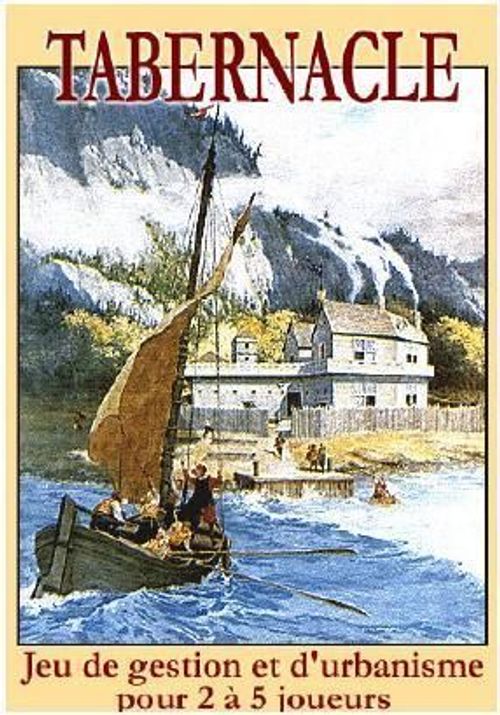
Tabernacle
Tabernacle Rulebook
Table of Contents
Table of Contents
Game Play
The game will be completed when all the districts are encircled, i.e. when all the roads are built. The player having the most points will win the game. There are 4 manners of earn points:
- The construction of a building or a road: one gains the value of the building in points, and 1 point by road.
- Majority on a district: when a district is encircled by roads, one determines the leader of the district, which will earn the sum of the values of the buildings present in the district, in points.
- Trade with the Indians: The buildings "commerce" can be used to gain points of victory.
- The monopoly on the types of buildings (end of part): bonuses are allotted to the leaders of each type of building. There are 9 types of buildings, and 5 buildings in each type. A tenth bonus is allotted to the player which has the most Indians.
Materiel
- 1 game board (see at the end of the rules).
- 49 large tiles, representing the buildings. The buildings have various values, and various functions.
- 57 small tiles prospections. The players must adapt to geology.
- 10 Indian tokens.
- 20 tokens colonists of 5 colors (4 per player).
- 100 tokens of property of 5 colors (20 per player).
- 40 tokens WOOD, 60 tokens STONE, 80 tokens GOLD.
- 1 marker of first player.
Preparation
- The game board is laid out with the center of the table.
- The reserves of wood, stones and gold are placed at with dimensions of the plate.
- Each Player takes 10 gold coins, 5 wood and 3 stones, which will constitute its starting capital, also 4 colonists and the markers of property of the color that it has chosen.
- Each Player place one of its colonists on the score track which surrounds the game board, on the 0. It will be moved according to the marked points. Each one is equipped in addition with 2 tokens colonists. The fourth is not used immediately.
- The tiles "prospection" are laid out randomly face down on the board, but never on a road. They must cover all the hexes that can be built on.
- The 10 tiles "Indian" are placed on the roads, on the hexes marked with a feather.
- The 4 basic buildings (recognizable with their red back) are placed in group on the chart.
- For the first game, you can use the district located at the end of the peninsula, but there are 2 other possible departures. These buildings must be immediately surrounded with 3 roads. All the tiles prospection of the districts which touch these 3 roads are immediately turned over. The other districts remain as they are.
- The 45 buildings remaining are mixed and placed in piles, face down. Draws 5 of them randomly, and places them on the 5 places of the display unit, on the board, above the modulators (-2 to +6).
Lastly, one proceeds to a bidding "fists closed" to begin the part, and one starts it again at zero as long as nobody wins. The invested sums are lost for all players. The wining player gets the marker of first player.
Turn of Play
1 turn = 1 month.
Each player lays out at the beginning a month 2 colonists, who represent that many points of action. When it's a player's turn, the player uses a colonist, by placing it on the board, for:
- To acquire a building or raw materials.
- To build a building.
- To build a road.
- To use a trade.
CAUTION: It is not possible to place more than 2 colonists (whatever they are) on the same hex during a turn of play. That is valid for the construction, or use of buildings.
When all the players alternatively placed all their colonists, each player picks up its colonists. The first player of the turn gives the marker of first player to the player to his left, which becomes the first player of the next month.
Acquisition of Buildings
The players place, at the beginning of the game, a Old Port [Vieux Port] to make purchases, and the 3 Counters, where they will be able to be supplied, simply by posing a colonist on the corresponding building.
The 3 counters are used to gain raw materials. Their use earns 3 units of gold, wood, or stone.
Using the port makes it possible to buy the buildings laid out on the display unit. Those cost their value (from 1 to 6), affected by the modulator shown below [the building], in gold coins. When a building is bought, the buildings are shifted, maintaining their order, so as to free up the +6 site, where a new building, taken randomly for the face down piles, is placed.
The bought buildings are placed in front of the purchaser, who will then have then to build. A player cannot buy any more buildings if there are 3 of them in front of them. It is possible to resell a building with the port (a colonist must go there for that), by putting back the building on the site "/2" of the display unit. The player then earns half its value.
Closing / Reopening of the Basic Buildings
The counters, as well as the old port, "will be gradually replaced" by the buildings of the players. For example, the gold counter will close, when a player builds a gold mine. The player will then turn over the gold counter tile. A turned over building cannot be used any more. The stone counter will be replaced by the quarry, the counter of wood, by the sawmills, and finally the old port by one or more other ports.
The new production buildings are identical to the counters, with the difference that they belong to a player, who will levy a tax on their use. Thus, the player using the gold mine of another player will have to pay 1 gold to him out of the 3 produced. The tax will be 1 wood for the production of 3 units of wood in an sawmill owned by another player, and it will be 1 stone for the use of a quarry. The owner gains 3 units each time he uses his building. Of course, it is possible to have several buildings of the same type in use at the same time (note that the construction of a sawmill, for example, does not involve the closing of the other sawmills...
Lastly, the use of a port owned by another player to reach the purchases costs 1 gold, paid to the owner.
The "deactivated" buildings could "be possibly reactivated" at the time of the independence of the districts, which will involve the closing of the production buildings which are part of them.
Construction of Buildings
A certain number of hexes are dedicated to construction of the roads, and do not contain a prospection token. One cannot build buildings there. All the other hexes can potentially accommodate a building.
CAUTION: Constructions are not possible on the a road, or another building. The construction of a building costs, at least, its wood value.
Prospections: The production buildings can be built only on certain sites. The gold mine must be built on a prospection tile "seam of gold" [Filon D'Or], and not elsewhere. The sawmills can be built only on forests [Foret], and the quarry on the mountains [Montagne]. The port, can be built on any prospection tile, but should be at the edge of water.
All the other buildings can be built on any prospection tile, including the seams of gold, the forests or the mountains.
Certain prospection tiles involve obstacles (Hill [Colline], Sand [Sable], and Marsh [Marais]): Construction +1, +2, or +3 wood. Construction on these tiles will cost the sum indicated (out of wood), plus the cost of the building.
Lastly, certain prospection tiles offer a bonus, for any construction: To build on a treasure [Tresor] brings back 7 golds and to build at the edge of a lake [Lac] brings back 5 additional victory points.
To finish construction, the player marks the value of the building in victory points, and places a property marker of his color on the new building, which will have replaced the prospection tile on the board. The colonist used for construction remains on this building (which becomes operational immediately), until the end of the turn.
Construction of Roads
To build roads makes it possible to reach new prospection tiles, and/or to encircle the districts.
The same colonist can build one or two roads out of two adjacent road sites, if one of these two sites is adjacent to an already built road. The player then places his stones on the boxes, as well as a colonist, and marks 1 or 2 victory points. He does not place a property marker.
If one builds a road on a box which contains an Indian token, one gains this token. To accumulate Indians will make it possible to gain a bonus at the end of the game, and that will also make it possible to use the Trading Post buildings (see further information below).
In addition, when a road touches a undiscovered district, all the prospection tiles which constitute it are turned over.
When a district is entirely encircled by roads, the district becomes "independent", and it is "deactivated". No one will be able to build there any more, nor to use any building. This could cause the reopening of the basic buildings (counters or old port). For example if the last gold mine forms part of an independent district, the gold counter will be turned over, and again be operational. But as long as there remains an active gold mine, one does not reopen the counter.
In all cases, it is necessary to proceed to the calculation of the district:
The leader of the district will be that which has the most building points in the district (sum of the values of the buildings).
CAUTION: Certain buildings have 2 values: a purchase and construction cost, and a building point value. For the calculation of the district, it is of course the second value which counts.
The leader gains all the points of the district, plus 1 point per remaining prospection tile in the district. The second will gain half of the points of the first, and the third a quarter (rounded down). In the event of a tie, the players concerned gain the points which they should have gained if they were not tied, divided by 2.
EXAMPLE: When the last stone surrounding this district is placed, the calculation of the district is made:
- The yellow (6) marks 15 points.
- The green (5) marks 7 points.
- The red (3) marks 3 points.
The port and the mine could not be used any more. No one will be able to build in this district any more.
The 9 Types of Buildings
(the figure between parens represents the value of the building)
- The gold counter [Comptoir D'Or]: Allows to collect 3 golds. The Gold mine [Mine D'Or] (3) also, but 1 gold is transferred with the owner.
- The stone counter [Comptoir De Pierre]: Allows to collect 3 stones. The Quarry [Carriere] (3) also, but 1 stone is transferred with the owner.
- The wood counter [Comptoir De Bois]: Allows to collect 3 woods. The Sawmill [Scierie] (3) also, but 1 wood is transferred with the owner.
- The old port [Vieux Port] makes it possible to reach the purchases of building. The ports (3) also, but 1 gold must be versed to the owner.
- The Tannery [Tannerie] (1): It cannot be built next to another building, except another tannery. One will not be able to build another building next to a tannery, except another tannery.
- Trading Post [Commerce] (2): These buildings can be "used", like production buildings, by placing a colonist above. The player then gains as many victory points as he has Indian tokens. It is possible to use a Trading Post owned by another player: 2 golds should then be paid to him.
CAUTION: The player loses one "Indian" tile, each time a Trading Post is used. This tile is removed from play.
- The Tabernacle (4/6): This building is useful to control districts, because it costs only 4 golds to purchase, 4 woods to construct, but earns 6 victory points.
- The Watchtower [Mirador] (5/1): Allows a player to destroy a building. Indeed, it can be built on an existing building (not in an "independent" district), and remove it from the board. The destroyed building will not even count for the monopolies at the end of the game. The price of the watchtower is 5 golds, and it is necessary to spend 5 wood to build it. But it earns only one victory point after it's built.
CAUTION: It is not permitted to build a watchtower on a hex adjacent to another watchtower. Thus, the watchtower is used "to attack", but also to defend...
- The Cabin [Cabane] (6/3): Allows its owner to place an additional colonist on each turn. This benefit, not cumulative, will be cancelled when the cabin forms part of an "independent" district. The cabin costs 6, but earns only 3.
End of Game: The Monopolies
Once all the districts are independent, the players proceed to the calculation of the monopolies.
There are 9 types of buildings: Gold mines, Sawmills, Careers, Ports, Tannery, Tabernacles, Cabins, Watchtower and Trading Posts.
For each of the 9 types of buildings, one determines which player has built the most. (the buildings in hand do not count). The leader of a type of building gains 7 additional points. The second gains 3 points. The third gains 1 point. In the event of tie, the players gain the sum of the points which it should have gained, divided by two (ex: 2 players at the lead gain 5 points).
Lastly, the players allot a tenth bonus (in the same manner) for the players which have the most Indians.
The player who has the greatest number of victory points wins the game.