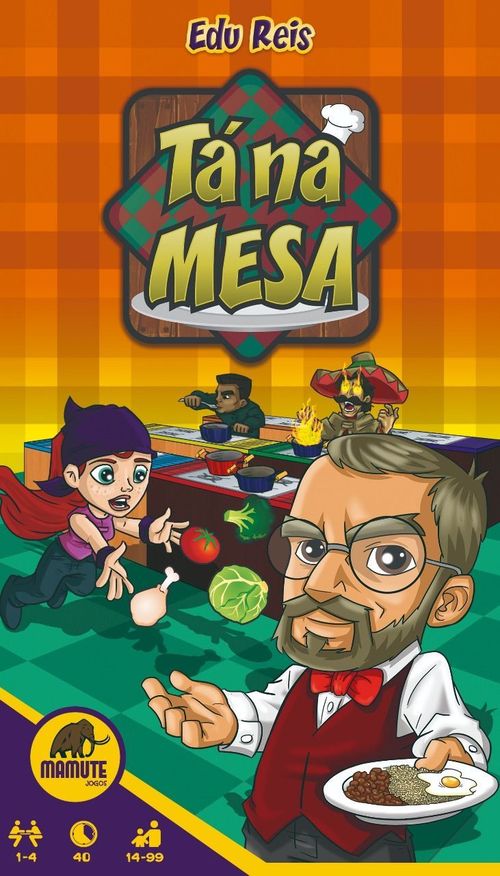
Tá na Mesa
Tá na Mesa Rulebook
Table of Contents
Table of Contents
Components
- 4 player counters (bancadas)
- 8 character cards
- 1 starting player marker (chef's hat)
- 50 ingredient cards
- 25 recipe tiles
- 12 spice tokens
- 1 vegetarian prize marker
- 1 box
- This manual
- 1 scoring board and sum track
- 8 coloured scoring and sum markers
Setup (Preparação)
Each player chooses a character and a player counter (bancada, where the stove sits). Players sit around the table and join their cook card to the counter, fitting the values printed on their respective sides. The scoring board is placed near everyone, along with the piles of ingredient cards, recipe tiles and spice tokens.
Each round, two recipes per participating player are drawn at random and placed in the centre of the table (4 for two players, 6 for three and 8 for four).
The ingredient cards are shuffled into a draw pile. Who starts? The player who was the last to prepare or serve a meal (even if it is a mere sandwich) is the first player, and turn order then proceeds clockwise.
There are 3 to 4 rounds in total, depending on the number of players. It is important that each player is the starting player the same number of times as the others. Therefore, with 2 or 4 players there are 4 rounds, and with 3 players there are only three rounds.
Collect Ingredients (Coletar ingredientes)
First, each player receives one ingredient card at random.
Two cards are turned face up from the top of the draw pile, one on each side of the pile. Then, starting with the starting player of the round (commonly called the Chef of the turn), each player may choose between taking one of the face-up cards or the top card of the draw pile without knowing what it is, depending on what they already hold in their hand, according to their strategy.
Whenever a face-up card is taken, a new card must be turned face up for the next player. This phase ends after 3 rounds of collection (in short, each player receives 4 cards per round if we count the card received at the start).
(The parenthetical sentence above is printed in red in the source manual, as a recap.)
Preparation (Preparo)
Starting with the first player, each player trades three of their ingredient cards for one of the recipes laid out in the centre of the table. If an ingredient needed for the combination is missing, the player may use an ingredient symbol present on their own counter, or on another player's counter by paying that player any card from their hand. If the player opts to use one of the symbols on their own counter, the card paid must be discarded. If the required ingredient is not present on any counter, the player may discard 2 cards to gain the right to use the missing ingredient with a value of 1.
Each ingredient card has, besides a class (yellow grains, green vegetables, blue derivatives, red meats and orange chicken), a number. This value refers to the quality of the ingredient: the higher the number printed on the card, the higher the quality of that ingredient.
Then, after the player trades their ingredients for one of the available recipes, they place a marker of their colour on the sum track. This value is the sum of the numbers on the ingredient cards plus the values of any ingredient symbols used from their respective counters.
The cards used are then discarded, and the recipe is placed beside the counter of the player who prepared it, but it does not yet go to the stove. All players do the same, following clockwise order.
At the end of this phase, the unused recipes are discarded and the sums of all players are compared. The player with the highest sum (who made a recipe with the highest-quality ingredients) receives a bonus of Three points. In exchange, the player with the lowest sum must discard one of their cards from hand (if for some unlikely reason the player with the lowest sum has no card to discard, nothing happens).
In case of a tie for the highest sum, each tied player receives 1 point, regardless of how many are tied. If there is a tie for the lowest sum, nobody needs to discard a card. In a two-player game there is no discard for the lowest sum. At no time may more than one recipe be prepared in the same round.
Attention (Atenção)
Once an ingredient from a counter is used, that ingredient cannot be used by the same player in the same round, even if they could discard/pay two of their cards. Therefore, the player must use the second ingredient from another counter.
Ingredients that are free for players cannot be bought by others.
A player cannot refuse the use of the ingredient on their counter.
Seasoning (Tempero)
In this phase of the round the ingredients have already been mixed, but they still need to be seasoned to be ready. The starting player must then take the spice tokens and throw them all into the centre of the table (almost like cowrie shells), starting with the first player. Each player must choose one of the spices shown on the table.
When the last player is reached, that player must begin a new collection round in reverse order (in short, they take 2 spices and collection goes in the opposite direction). When it reaches the starting player again, it is done the same way (that is, each collection follows a normal/reverse order, always alternating), so this is repeated until each player has 3 spices (four in a three-player game).
Each player's counter has 3 different spice combinations: one worth 1 point (with a single spice), another worth 3 points (with two spices), and the last worth 5 points (with all three spices). If possible, the player may make more than one combination as many times as they can with their 3 tokens, but each marker may only be used in a single sequence. (In this way the player can score from 0 to 5 points during this phase, or up to 6 with three players.)
Each spice has two sides, but while it is in the centre of the table only one of these faces is revealed. When the player collects the marker, they also gain the right to look at its reverse face, even without being able to turn it over.
At the end of this phase, if the player thinks it necessary or strategic, they may turn each of their tokens to the opposite face by discarding one card from their hand for each. After scoring the spices, each player must place their recipe on their stove. The more colours they manage to fit into the edges of the stove (and later into other recipes), the more points they receive in the Presentation phase at the end of the game.
When placing the recipe on one of the stove areas, the player will cover a combination of 2 spices. Then check whether the covered spices were used in this round or not. If so, the player receives a bonus card; otherwise nothing happens. Only then are the scored spices discarded and this phase ends.
If this is the last round, proceed to the Presentation of the dish (Apresentação do prato). Otherwise, a new round begins. Shuffle the discards together with the other ingredients.
Presentation (Apresentação)
In this phase all the spaces on the stove are filled and the colour combinations are fitted in, so each complete symbol matching the same colour is worth 1 extra point to the player (a maximum of 12 points by fitting all the colours).
The printed example for this phase shows a player scoring 8 presentation points in total. The example image itself is not reproduced.