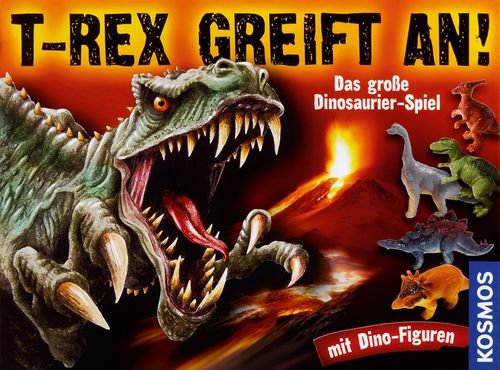
T-Rex greift an!
T-Rex greift an! Rulebook
Table of Contents
Table of Contents
Components
- 5 dinosaur figures: 1 Tyrannosaurus rex (T-rex) and 4 plant-eaters
- 1 game board
- 1 volcano
- 1 volcano fire piece
- 26 red lava stones
- 1 combat die (20-sided)
- 1 number die
- 1 action die (blank die with stickers)
- 24 dino eggs
- 36 food tiles
- 4 player boards
- 4 nests
Goal of the Game
Whoever has the most eggs in their nest at the end of the game wins.
Setup
Before the first game, take the punch-out sheets out of the box and carefully push out the individual pieces.
Stick the six die stickers onto the blank die. Then the action die is ready.
Before each game, place the game board in the middle of the play area. Set the volcano on the designated space in the middle of the game board. Insert the volcano fire into the slot at the top of the volcano, and place the 20-sided combat die into the hollow provided for it in the volcano.
Set the number die and the action die next to the game board.
Distribute the food tiles freely over the 19 food spaces marked with plants. When distributing, make sure that each food space has at least one food tile on it, but no more than two food tiles. Place the lava stones and the dino eggs in separate supply piles next to the game board.
Now each player chooses a dinosaur figure to play: Stegosaurus, Brachiosaurus, Styracosaurus or Parasaurolophus. (Tyrannosaurus rex cannot be chosen! It is moved by all players during the course of the game.) Each player takes the player board of their dinosaur and places it in front of them with the large picture face down. To the left of it, each player places a nest, into which they may place one egg from the supply.
Placing the dinos on the board
The youngest player places T-rex on any nest space on the game board. The remaining players then place their own dinos in turn, clockwise. Each dino must be placed on a different, unoccupied nest space. Finally, the youngest player also places their own dino on a still unoccupied nest space.
Start of the Game
Play proceeds clockwise, and the youngest player begins.
A turn consists of the following steps:
- Roll the dice (with the action die and the number die)
- Perform the action
- Move the dino (your own dino or T-rex)
- Lay eggs (if possible)
Turn Structure
1) Roll the Dice
The player rolls the action die and the number die. The action die shows which action the player may perform — see Perform the action.
The number die shows how far the player may move their dino or T-rex on the game board — see Move the dino.
2) Perform the Action
Volcanic eruption
If the action die shows this symbol, the volcano erupts! The player takes one red lava stone from the supply and places it into one of the seven lava hollows of the volcano. First the six round hollows are filled, then the elongated hollow. Once all seven lava hollows are filled, the lava overflows and spills over the game board. Further lava stones are placed, in order, into the gaps along the lava flow on the game board — always one stone per space.
When placing a lava stone the following applies:
- If the lava stone must be placed on a food space with food tiles, the food burns: these food tiles are removed from the game and put back into the box.
- If the lava stone must be placed on a space on which a player's dino stands, that dino is surprised by the lava. The dino flees and in doing so loses an egg (from its nest), which it must return to the supply. If the dino has no egg in its nest, it only flees. To flee, the player moves their dino onto any free space on which no other dino stands — but not onto a food or nest space.
- If the lava stone must be placed on a space on which T-rex stands, T-rex first takes flight. The player whose turn it is places the T-rex figure on any free space on which no other dino stands. Only then does the player place the lava stone.
Once the player has placed the lava stone, they may move their own dino.
Food AND volcanic eruption
If the action die shows this symbol, the player may first take any food tile from the game board. Afterwards the player places one lava stone into a lava hollow or onto the next space on the game board (see Volcanic eruption). Then the player may move their own dino.
Tyrannosaurus rex (T-rex)
If the action die shows T-rex, the predator goes into action! In this turn the player does not play with their own dino, but with T-rex (see Action T-rex).
T-rex OR volcanic eruption
If the action die shows this symbol, the player may choose between the two actions volcanic eruption and T-rex.
3) Move the Dino (your own dino or T-rex)
There are two ways to move a dino. Dinos wander through the landscape in search of food, because only whoever gathers enough food can lay eggs! The number shown on the number die indicates how the dino may move in this turn.
a) Move space by space on the game board (and eat along the way)
Moving space by space across the game board is slower and more laborious — but only in this way can a dino eat!
The following applies:
- A dino may move horizontally, vertically or diagonally by as many spaces as the die shows. It may turn freely, but may not pass over or onto the same space twice in one turn.
- A dino does not have to move — it may also stay put or forfeit any number of die points.
- A dino may move onto a space on which a fellow player's dino stands — but then it must fight with that dino (see Combat), and the remaining die points are forfeited. A dino therefore cannot move past a space on which another dino stands.
- A dino may not move over or onto a space on which a lava stone lies.
- A dino may not move over or onto a space on which T-rex stands.
- These movement rules also apply to T-rex — see Action T-rex.
Eating
If a dino moves over or onto a space with food tiles, it may eat the top food tile. This means the player takes the food tile and places it in their food supply to the right of their player board (as shown in the example below).
The following applies:
- A dino can only eat one food tile per space — even if another food tile lies on the space!
- A dino may move over several food spaces and thus eat several food tiles within one turn.
- However, a dino can never collect more than three food tiles of the same type, because otherwise it would overeat that type of food! If it already has three food tiles of the same type lying next to its player board, the tile over which the dino figure moves remains on the food space of the game board. The dino must first lay an egg and hand in the three food tiles of that type before it can eat that type of food again (see Lay eggs).
Example: Martin has five food tiles in the food supply of his Stegosaurus at the start of this turn. He rolls the volcanic eruption on the action die and a 5 on the number die. After placing a lava stone, he moves his Stegosaurus five spaces on the game board. In doing so he moves over three food spaces: on the first food space lies a food tile of the upper type, on the second food space lies a food tile of the lower type. The Stegosaurus can still eat these two food tiles, so Martin places them next to his player board.
The food supply of the Stegosaurus now looks as shown on the right. On the third food space that Martin's Stegosaurus reaches this turn, there lies another food tile of the upper type. Since the Stegosaurus already has three food tiles of this type in its food supply, it cannot eat this food tile any more and must leave it lying on the game board. Martin's turn with his Stegosaurus is over and the next player takes their turn.
As long as the Stegosaurus does not lay an egg and hand in food tiles from its food supply for it, it cannot eat any further food tiles of the upper and lower types in the following turns!
Combat (with the combat die)
If a dino is moved onto a space on which a fellow player's dino already stands, the remaining die points are forfeited and a fight over food takes place! (T-rex is too dangerous and cannot be attacked!) The dino that has just moved onto the space attacks the other dino: it rolls the combat die, and everyone notes the number rolled, because it gives the attack strength! The player of the attacked dino also rolls the combat die to defend their dino — the number rolled gives the defence strength. (If both dice show the same number, both players roll again.)
- Defence stronger than attack: The attacker is put to flight! If the player of the attacked dino rolls a higher number than the player of the attacking dino, they were able to fend off the attack and put the attacker to flight!
- Attack stronger than defence: The attacker captures two food tiles! If the player of the attacked dino rolls a lower number than the player of the attacking dino, the attack was successful! The attacker captures two food tiles, which it may choose from the food supply of the attacked dino. If the loser has only one food tile or no food tile in its food supply, the attacker can capture only one or no food tile. In any case the attacker puts the defeated dino to flight.
The loser of the fight flees: the player relocates their defeated dino onto any space on the game board on which no other dino stands — but not onto a nest or food space.
b) Move directly onto a nest space
If the player chooses this way of moving, they can move faster and further — but in this turn they cannot eat!
The dino figure may be placed directly onto a nest space that shows the number rolled — for example, with a 5 rolled, onto a nest space with the number 5. If a fellow player's dino stands on the chosen nest space, a fight takes place.
Action T-rex
If a player has rolled the T-rex symbol or chosen the action T-rex, in this turn the player does not move with their own dino. Instead, they play with the T-rex figure.
T-rex hunts the plant-eating dinos of the other players, and its attacks are much more dangerous than those of the other dinos. This is because the predator is not only after food tiles, but after a valuable egg!
On the hunt for eggs, T-rex may move like the other dinos. That means it may move, according to the number on the number die, either space by space or directly onto a nest space on the game board with the number rolled. (The same movement rules apply as for the other dinos — see above.) If T-rex does not reach a fellow player's dino, it cannot do any damage in this turn.
The T-rex attacks
If T-rex moves onto a space on which another dino stands with its roll, a fight takes place with the combat die — as described above. (The remaining die points are forfeited.)
- Defence stronger than attack: All eggs are saved! If the player of the attacked dino rolls a higher number than the T-rex player, the dino is lucky: it can save all its eggs! T-rex comes away empty-handed, but remains standing on the space.
- Attack stronger than defence: T-rex captures an egg! If the player of the attacked dino rolls a lower number than the T-rex player, the attack was successful! T-rex captures an egg from the nest of the attacked dino — it is returned to the egg supply. If the loser has no egg in its nest, T-rex can only put it to flight.
Whether or not T-rex was able to capture an egg, the attacked dino must flee to bring itself to safety from T-rex! The player relocates their dino figure onto any space on the game board on which no other dino stands — but not onto a nest or food space.
After the T-rex player has moved the T-rex figure on the game board and possibly fought, their turn is over. The next player takes their turn and rolls the action die and the number die to move a dino.
Example: Martin plays T-rex in this round and attacks Jochen's Styracosaurus. Martin's attack is successful and Jochen must return one egg of his Styracosaurus to the egg supply.
4) Lay Eggs (if possible)
If a player's dino has collected three food tiles of the same type in its food supply, it may lay an egg. This is, however, only possible if the player whose dino it is has their turn and rolls or chooses the action volcanic eruption — that is, when they move their own dino. To lay an egg, the player moves their dino (according to the movement rules described above) onto a nest space on the game board; remaining die points are forfeited. It does not matter whether the dino already had the three food tiles of the same type at the start of its turn, or collects them on the way to the nest space.
Once the dino has reached the nest space, the player hands the three food tiles of the same type to their right-hand neighbour. The player may then take one egg from the supply and place it in the nest of their dino. The right-hand neighbour distributes the three food tiles onto food spaces of the game board. Empty food spaces must be filled first. If there is no empty food space left, the three food tiles may also be distributed onto spaces that already hold one food tile each. (Food spaces on which a lava stone lies are burnt — no food tiles may be placed on them any more.)
The following also applies:
- If a dino wants to move onto a nest space that is occupied by another dino, a fight takes place. If the dino whose turn it is loses, it must flee and may not lay any further egg in this turn. If the dino whose turn it is wins, it drives out the attacked dino, may remain standing on the nest space, and may lay an egg as described above.
- A dino may lay only one egg per turn. If it has collected three identical food tiles of another type again, it must wait until its next turn. Only then may it hand these in as well and lay a further egg.
End of the Game
The game ends immediately when the last lava stone has been placed on the game board. Whoever then has the most eggs in their nest wins the battle of the giants! In the event of a tie, the player who has also collected the most food tiles in their food supply wins. If there is still no winner, there are several winners.
Special Rule for the Two-Player Game or a Shorter Game
For the two-player game or a shorter game, seven lava stones are placed into the seven lava hollows of the volcano before the game begins. In the game, the first lava stone is therefore placed straight onto the first space of the lava flow on the game board. Other than that, the course of play remains the same.