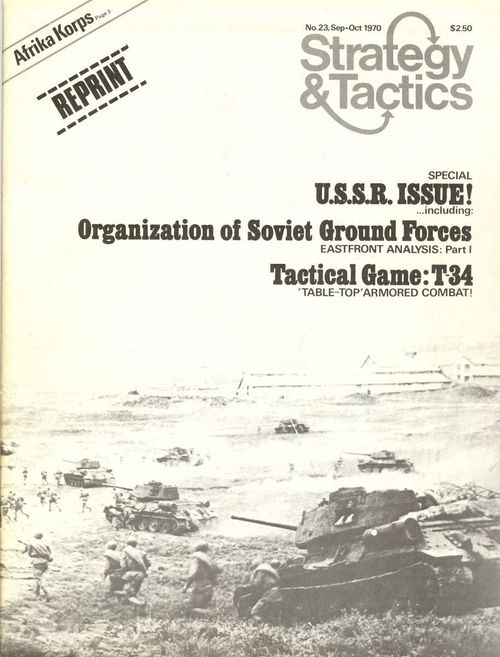
T-34
T-34 Rulebook
Table of Contents
Table of Contents
Test Counters
For those of our readers who do not have the inclination or the cash and/or the mechanical skill to obtain and assemble the plastic models usually used in games such as "T-34," the ever-thoughtful editors of Strategy & Tactics have included with this issue a reasonable facsimile of some of the units in "T-34." Readers who are not miniatures freaks should use these paper facsimiles to test "T-34" before investing in a plastic armored division.
To assemble the counters, cut them out along the solid black lines, and fold them along the dotted black lines so that each counter forms a tent-like structure. Glue or tape them together at the base (see diagram).
Game Situations
Miniatures lend themselves particularly well to use in tactical level games. Perhaps the main advantage of miniatures is the potential of the game situations to be easily put together by the players themselves. And that's what you can do with "T-34." That's what you do in miniatures.
Designer's Comments
Tac 3/20mm isn't exactly the most detailed miniature WWII land wargame around. In fact, it is really just a direct steal from TACTICAL GAME No. 3 of the TSG. What I hope it will do is provide that real bridge between board and miniatures, to get each side of the fence partly on the other. Miniature wargamers are going to find having combat factors and a CRT a bit strange, while board wargamers are going to find all those tank models and painted figures weird too. In fact, the lack of hexagons alone is startling enough.
The rules are neither complex nor comprehensive, if anything they were designed to be clear. This game is a "quickie", fast to set up, almost as fast to play. For those tactical historians with the "what if", it is a tool for endless answers. By now you should have enough organizational information to be able to set up various German and Russian formation using platoons and companies as building blocks. Pick your terrain and objectives, and have at it. If your imagination fails you, some reading into the real campaign and some of the battles should produce enough food for thought. For the fun-minded, I personally have a set of "orders" cards each containing an order of battle and a mission for one side. I set up a Russian and German deck before each battle, and thus players remain in the dark about enemy forces and objectives.
For those who find Tac 3/20mm just a nice take-off point for 1944 vintage land miniatures, note that S&T does indeed have considerably more detailed and simulation-oriented rules around. I know because I have designed and tested one set myself! Naturally, all it takes is a lot of little notices from you to produce them in an upcoming issue.
Rules of Play
Vocabulary
Unit: one playing piece (either a stand of men or a vehicle).
AFV: Any vehicle other than a truck or halftrack.
Infantry: any infantry unit, including engineers and special types of foot troops.
Heavy Weapons: any unit with an artillery piece, mortar, anti-tank gun, rocket, etc., etc.
Procedure of Play
Usually the Russian player will move first. Then the German player. After each player moves, both players fire all their units they wish to at the enemy. The moving player fires all his units he desires first, then the other player fires his survivors. Thus the procedure for a full turn is:
Russians move, Russians fire, Germans fire; Germans move, Germans fire, Russians fire.
This is a complete turn, which has two "moves" (one for each side) and four "rounds" of firing (two for each side).
Scale: each turn is 6 minutes of battle, each inch is about 85 meters.
Movement of Units
You may move during your "move" as many of your units as you wish, including all or none. However, you must finish the move of one unit before starting that of another.
You may move a unit any speed up to its top speed, but never faster, and must take into account all delays and movement restrictions as given below.
You may never move through or onto any other unit, friendly or enemy.
Certain terrain features will affect the movement of a unit:
Hill Slopes: any unit, but infantry, going up a hill slope takes three times as long. Thus for every one inch of slope climbed three inches of regular cross-country movement are used. There is no delay for moving across the flat tops of hills, or moving downhill.
Streams: crossing streams imposes the same delay as climbing slopes except infantry too are affected.
Rivers: rivers are impassable. Fords are considered streams for movement purposes.
Forests: only infantry and heavy weapons are allowed in forests. There is no speed reduction for forests.
Buildings: any unit can move through buildings, and there is no speed reduction for moving through it.
Rough Terrain: rocky and badly broken ground normally will prohibit the movement of any vehicles in it. This is up to the individual players since no general rule can be honestly formulated in this department to ANY degree.
Roads will allow units to move more quickly than normal:
Infantry, heavy weapons, and halftracks move 2" on the road for every 1" of cross-country move expended. (Otherwise saying, they double their speed.)
Trucks triple their cross-country speed while on roads. Both these categories can combine cross-country and road movement in any way they desire.
AFVs have a 17" road bonus. However, to receive this bonus they MUST move at least half their movement rate on the road. When they finish moving this distance they are free to move up to 17" more free of charge to their cross-country rate.
All units, regardless of situation (unless pinned, see optional rules) may move at least 1" if they so desire.
Trucks and halftracks may each carry one infantry or heavy weapon unit each. Tanks can carry only infantry units. Picking up (embarking) and dropping off (disembarking) a unit costs 4" of the carrying vehicle's move. This vehicle must have 4" of cross-country movement left in order to embark or disembark units. Remember that you must move one unit at a time, and complete the move of one before starting another. Thus a unit cannot move "at both ends of the line" in the same turn, so to speak. Units that were both embarked and disembarked in the same turn cannot fire, and should have their weapons pointed away from the enemy to signify this.
German tanks carrying infantry cannot fire while infantry are aboard, and also should have their weapons pointed away to signify this.
While a unit is being carried it is helpless and without defensive value. If the unit carrying it is destroyed, so is the unit being carried.
Firing
To fire at the enemy a unit must have the target visible to it, must have an unobstructed line of fire, and must be within the maximum range of the firing unit.
In the basic game all units are deemed fully visible.
Most weapons have a flat trajectory of fire. Thus you may not fire through other units, buildings, or terrain features (such as hills, intervening forests, etc.). To make sure of this, sight from the firing unit to the target. If more than a quarter of the target is not visible from one point of view of the firing unit, assume it cannot be hit. You must have a CLEAR shot.
Then measure the range from the firing unit to the target. If the distance is greater than the maximum range of the firing unit, the target cannot be hit.
You are allowed to have several units combine their firing factors at one target.
You are allowed to fire at the same target more than once provided you use separate units or groups of units, because each unit can only fire once per round.
When firing you announce the target for each unit or group of units before checking line-of-sight and range. If for some reason the target selected cannot be hit, the firing units are assumed to have fired for that round and missed. You then go on to the next unit or group of units and select their target. It can be the same one!
To resolve firing that is legal, total the firing values of the units shooting. Compare this to the defensive value of the target (which may be doubled in certain circumstances, see below). This gives you a shooter-defender odds comparison, which you must reduce to its simplest form. Divide the defensive value into the firing value, and drop any fractions. Compare this number to "1" and you have it in its simplest form. Two PzKw tanks firing at a Russian infantry company have odds of 26-16, which is rounded to 1-1.
After determining the odds, consult the survival table and roll the die. Depending upon the odds and die roll, the target may survive or be destroyed. Don't forget, if one unit misses, you can always have someone else who hasn't fired yet shoot at it.
Terrain and Defensive Values
In a building all units inside combine their defense values into one number, which is then doubled. This is the only effect buildings have in the game.
In forests each individual unit is doubled. Units may fire into forests or buildings, but may not fire through them at targets beyond.
Units on a hill slope that are fired on from ABOVE have their defensive values cut in half. If the firing units are both above and below the target on the slope, the target keeps its normal defensive value.
Terrain and Firing Values
Any units that are firing at a range of 3" or less triple their firing value.
Any units that finish their turn in a stream AND are firing at 3" or less have their firing values only multiplied by 1½ (ignore fractions) instead of 3.
Any AFVs or Anti-Tank guns firing at any vehicle will double their firing values when firing at ranges over 3" but at or under half their maximum range.
Russian Infantry
Russian infantry always lacked good anti-tank weapons. Therefore, when firing at any AFV these units have a firing value of 2 instead of 5. This new value is still subject to all terrain and range alterations. Optionally guard Russian infantry can be given a value of 3 (depending upon whether you believe Soviet historians or not).
Over-Running
Any AFV or halftrack can overrun any one enemy infantry or heavy weapons unit. The victim must be on flat, open ground; not on a hill slope (but it can be on a hill top), not in rough terrain, nor in a building or a forest. The overrunning unit may not cross a bridge or stream and overrun the enemy in the same move.
To overrun a unit, simply move the overrunning unit directly onto your victim and finish your turn touching your victim and going further. You may not finish the turn upon the victim. No other unit can drive through the space of a dead overrun unit the turn it was overrun, but a unit can be overrun more than once (even if killed the first time).
When a unit is overrun, the "crushing" effect is immediately evaluated. The firing value of the overrunning unit is tripled, and compared to the regular defense value of the victim. The result is resolved like normal firing, but immediately after the overrunning unit finishes its particular move. Any other unit passing through the area of the overrun victim must behave as if it was overrunning, even if the victim was already killed. Thus you cannot overrun a unit successfully and open up a hole for other units to move through.
Minefields
When a unit runs into a minefield the opponent (who had them all marked on a secret map before the game started) tells him of this fact. The victim must immediately stop once fully into the field. During the next firing round the owner of the field gets, he may "fire" the minefield just like a normal gun at the trespassing unit. The minefield has a value of 20, and other units are allowed to join in. On the next move for the trespassing unit, it can move 3" (or less if its maximum is less). If still in the minefield it must again stop and be attacked once more by the minefield. If not, it may continue. A minefield only attacks once between moves of the trespassing unit, on the first firing round immediately after the contact is made. A minefield can attack an unlimited amount of times, and an unlimited amount of units in any one turn.
An engineer unit can lay an area of mines equal to its own size in 5 turns. It can clear an area equal to its own size in 2 turns. Only engineers can lay or clear mines. To do this they must not fire before or after the move, and may not move. This is one "turn" of clearing. If an engineer unit is destroyed by fire before its task is completed, the job must be started all over again. Engineers should not be allowed to lay mines during the game because the troops don't usually go around carrying a dozen or so mines all the time. But in special situations this may be altered.
Optional Rules
The following optional rules are designed for miniature wargamers who desire a more complex and variable battle. Games using these rules to any degree will take longer, and are best handled with multiple commanders on each side. Players are encouraged to choose their own rules, but from a realism standpoint "High Trajectory Fire" and "Pinning Fire" should be the first to be used.
High Trajectory Fire
German artillery (mortars, howitzers, rockets) operating with infantry units maintained good enough communication procedures in fluid situations so that the infantry could often call up for artillery support and guide the fire to target although the firing guns could not see the target. Therefore, any target able to be fired upon by German infantry can also be fired upon by German artillery. The artillery firing upon the target do not have to be able to see the target in order to fire. But remember, the target does have to be within range of the infantry.
In multi-player games, German commanders can use artillery units under their own command only: they may never fire at targets visible only to someone else's command, and cannot "borrow" artillery support or guns from someone else.
In single player games players with a passion for complexity can also recreate this lack of cross-command artillery support networks. At the start of the game organize for each battalion certain artillery units, and give regimental artillery to a battalion also. The guns of each battalion operate separately, as in the multi-player game, under the visual direction of the infantry of that battalion.
Russians are considered to have such a poor communications system that no fire of this nature is allowed.
German artillery, because of its high trajectory, can fire over any friendly or enemy units, but the target has to be visible to the directing infantry unit (and within the firing range of that infantry unit).
Artillery Observers
Individual men are used in this rule as artillery observers. These, instead of infantry units, direct the artillery fire. Artillery observers may travel with any unit they so desire, and when one unit passes next to the other and touches, the figure of the observer may be transferred to the next unit. Observers have no combat or movement power of their own, and share the fate of the unit they are attached to. Observers can see 20"; in buildings this is increased to 25", and on high hills to 30".
German observers are attached at the rate of 2 per battalion, and 1 extra (the artillery officer) per regiment of infantry. Separate artillery battalions also have observers (1 for each). In the battalion each observer has the ability to call down all artillery in that battalion. Any regimental or independent guns attached to the battalion he also controls. At the beginning of the game the German commander should make clear secretly just who controls what. Regimental and independent artillery can remain under the control of their commanders, or be farmed out to the battalions.
Russians are allowed 1 observer for each infantry brigade, and 1 observer for each independent artillery battalion.
With observers all the other high-trajectory rules for both Russians and Germans are in effect. Note that observers considerably complicate the whole game, and should not be used by anybody less than an experienced die-hard artilleryman.
Pinning Fire
Infantry and heavy weapons, being directly exposed to fire, will often take cover in battle situations and advance slowly or not at all. It is assumed in this game that all troops are well enough trained to continue to move under fire to some degree. A poorly trained unit will stop completely when pinned down.
Whenever a "pinned down" result comes up on the survival table the unit is still living but pinned. Units that this happens to should be so noted (a straight pin stuck in the troop stand is a handy symbolic note). Pinned infantry units can only move 1" a turn and have no road bonus. Pinned heavy weapon units cannot move at all. After the movement turn for a player is finished all "pinned" markers from his troops should be removed. Unless the unit(s) are again pinned they are free to move their full rate on their next move. Pinned units are allowed to board trucks or halftracks, but not tanks.
AFVs can support infantry, thus protecting them from being pinned. To support an infantry unit, the AFV must finish its turn adjacent to the infantry, and vice versa. During the firing after the move, the infantry and/or heavy weapons cannot be pinned so long as there survives an AFV touching them.
Pinned units are unable to construct or clear minefields, and cannot dig in (fortify).
Soft Ground and Mud
The scan prints the following two rules after Pinning Fire under the optional rules heading; they are kept here in printed order.
In soft ground or mud all units but infantry and mortars are slowed down. If the mud is bad enough to slow infantry and mortars, it is probably so bad that vehicles and other heavy weapons couldn't get through at all.
In soft ground or mud new overland movement speeds are in order, as follows:
- Heavy Weapons (besides mortars): 0"
- Trucks: 1"
- Halftracks: 12"
- AFVs: 20": T-34/c; 16": T-34/85, SU-85, PzKw V, J.Pz V; 12": JS-II, JS-III, SU-100, PzKw IV, J.Pz IV, StuG III; 11": PzKw VIa, Hetzer; 8": PzKw VIb, J.Pz VI.
Armored Cars
Armored cars have the same movement rate and movement rules as trucks.
Rules for the Game Table
Digging In
At the start of the game players may sometimes wish to fight a more static battle situation. In this case they might allow units to be dug in. In other games more daring players might allow digging in during the game. Units digging or dug should have imitation raw dirt, and perhaps camouflage nets on and about them to signify this fact. In the rules below, digging in and fortification is considered one and the same.
At the start of the game units are allowed to be fortified in a hasty or prepared manner. During the game units will only be allowed to make hasty fortifications. Construction of hasty fortifications takes 5 turns of work. Procedure for infantry building hasty fortifications is the same as for engineers laying mines (see Minefield rules, last paragraph). Only infantry and heavy weapons can make hasty fortifications during the game.
Prepared fortifications are just like having a building around you.
Hasty fortification will double the unit fortified, but there is no combination of defense factors.
Fortification in houses or forests is not normally allowed because it takes a very long time. However, players may allow this, in which case units triple.
Fortified units can be considered to be worth twice their normal point value.
Once enemy units occupy the fortifications they are automatically destroyed.
Blowing Bridges
After any engineer unit passes over a bridge it may try to blow it. When a bridge is declared "blown", roll the die:
- 1, 2, 3, 4: bridge is completely destroyed.
- 5: bridge collapses. Only infantry and 81 or 82mm mortars can cross it, and only at 3" per turn. (These units can be pinned while crossing, of course.)
- 6: charge fails and bridge remains intact.
If one engineer unit fails to do the job right, the next to pass over the bridge can try again. Remember though, the bridge must be blown immediately after the move of that engineer unit.
Capacities
It is suggested that individual buildings should be allowed to hold any 3 German units or any 2 Russian units, but never troops of the same side. Buildings in a town should be within 3" of each other. Factories, state farms, and other conglomerates of buildings (perhaps 3-6 buildings large) should be formed so almost all the buildings are within 3" of each other so an accurate picture of street fighting can be formed.
Forests
It is also suggested that forests be given capacities and organized into sections, each section corresponding to the capacity of one building. This will simplify forest battles considerably. Forests in this game are considered to be relatively dense stands of trees.
Hills
The common method of making hills on the game table: contours, leads to problems as to what is slope and what is hilltop. Players may wish to specify this before the game starts or use an alternate system. This writer builds up hills of wood and books, and then stretches over the top an imitation grass mat (as used in HO train layouts) which is carefully tacked down to the table at various key points so that ridges, valleys, slopes, and hill tops are all easily formed.
Multi-Commander Games
It is not recommended that players have more than one commander for every two feet of table space available. Players should also have at least a brigade (Russian) or regiment (German) of troops to command in an interesting game. With artillery rules command systems take on a vital role. Communication between commanders on the same side should either be during enemy moves via secret notes (can write one note per enemy move) or by verbal communication that can be clearly heard by the enemy.
Unit Construction (Using Models)
All vehicles are generally assumed to be 2½" x 1½". The slight variation in size from this norm by 20mm vehicles is not important. The "Minitanks" line of vehicles is suggested as excellent and cheap scaled models, although they are more and more difficult to find. Some players may also prefer to glue pieces of figures realistically into turret hatches and driver's seats.
All German infantry and heavy unit stands should be 2½" x 1". The 3 figures (a good norm for representative purposes) should be arranged so they are facing lengthwise down the stand, and the "front" is a 1" side of the stand. This is because the 1" side will probably often be facing the enemy in concentrated attack dispositions.
All Russian infantry and heavy weapon units should have stands 2½" x 1½". These stands should have 5 figures each, facing in the same way as the German stands.
3/16" balsa wood makes good stands. Imitation HO scale grass glued to the top around the feet of the men makes a realistic appearance, while sides of the stand should be painted a shade of green close to the color of the grass.
German uniforms were Feldgrau (Gray-Green) which was closer to dark green than anything else. Russian uniforms were khaki, although often dirty, which is close to a tan color. Details of the figures and guns is up to the individual players, of course.
German vehicles were painted camouflage colors individually by their crews, and have no set color. Russian tanks were mostly forest green without any visible insignia. The Russians, fortunately for us, made extensive use of U.S. trucks (easy to find items in hobby stores).
Using 20mm scale, the rest of the game table can be set up using HO scale equipment.
Artillery observers are individual men without stands.
Unit Combat Factors
Units marked with a bullet (•) are the unit types given as paper models with the issue.
Russian Units
| Unit | Speed (inches) | Range (inches) | Attack Factor | Defense Factor |
|---|---|---|---|---|
| • Infantry | 3" | 12" | 5 | 16 |
| • 82mm Mortar | 3" | 36" | 6 | 8 |
| 120mm Mortar | 1" | 60" | 26 | 5 |
| 57mm Gun | 1" | 12" | 6 | 3 |
| • 76mm Gun | 1" | 24" | 9 | 2 |
German Units
| Unit | Speed (inches) | Range (inches) | Attack Factor | Defense Factor |
|---|---|---|---|---|
| • Infantry | 3" | 18" | 3 | 8 |
| • 81mm Mortar | 3" | 36" | 6 | 6 |
| 120mm Mortar | 1" | 60" | 20 | 1 |
| 75mm Howitzer | 1" | 36" | 13 | 2 |
| 150mm Howitzer | 1" | 36" | 24 | 2 |
Survival Table
Basic odds are shown across the top; the die roll is down the side.
| Die Roll | DA | 1-1 | 2-1 | 3-1 | 4-1 | 5-1 or greater |
|---|---|---|---|---|---|---|
| 1 | D | D | D | D | D | D |
| 2 | s* | D | D | D | D | D |
| 3 | s* | s* | D | D | D | D |
| 4 | s | s* | s* |
Explanation:
- "DA": defender's value is greater than that of the attacker. If the defender's value is more than twice that of the attacker, the attacker automatically has no effect.
- "D": as a result, this signifies that the target is destroyed.
- "s": as a result, this signifies that the target survives.
- "s":* as a result, this signifies that the target survives, however, using the optional "Pinned Down" rule it also means that infantry or heavy weapons units as targets are pinned down.
Eastfront Analysis
Omitted. The scan's "Eastfront Analysis" pages (unit organization charts and historical essays on Soviet and German formations) are historical background, not rules, and are not transcribed.