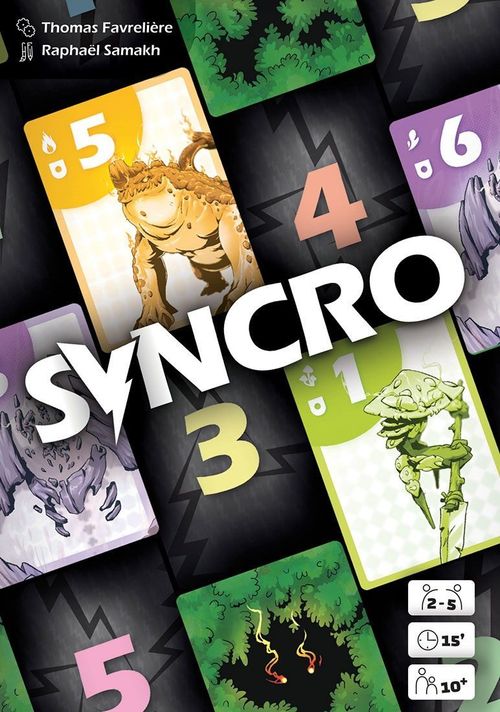
Syncro
Syncro Rulebook
Table of Contents
Table of Contents
Introduction
SYNCRO is a cooperative game: you are a team, you win together, you lose together.
SYNCRO is a game where you are not allowed to communicate with your playing partners. You have to play without speaking nor defining your strategies. You have to learn to know the other players in the team via the actions they carry out so you can synchronise during the game.
Your goal is to manage your hand of Spell cards in order to destroy all the monsters in each level. If no wizard has Spell cards in their hand and there is still, at least, 1 monster in play, you lose the game.
Chapter I has 4 levels: Discover the different kinds of monsters and learn to synchronise with your team.
Chapter II has 5 levels: Play with all the rules and free the realm. You may directly start at chapter II if you have already done chapter I with your team.
A game of SYNCRO lasts between 10 and 15 minutes. A complete Adventure (chapter I and II) lasts around 1h30. You may stop the game whenever you wish and save your progress (cf. Save Your Progress).
Creation of the Adventure Deck
When you open the box, you find 2 decks of cards: 1 A deck of cards and 1 B deck of cards.
- Place the A deck of cards over the B deck of cards: this is the Adventure deck.
- Then, remove the A card (but keep it in order to save your progress) and keep on with the setting up of the game.
When you reach the B card: discard it with no effect.
Setting Up of Each Level
- Give the Leader card to a wizard, he or she will start the turn.
- Put the Reference card next to the Adventure deck.
- Take the Spell cards, shuffle them and deal X cards to each wizard.
| Number of wizards | X |
|---|---|
| 5 | 4 cards |
| 4 | 5 cards |
| 3 | 6 cards |
| 2 | 8 cards |
IMPORTANT! Do not rearrange the cards in your hand, that could give information to the other wizards. Keep them in the order they were dealt to you.
- Take the Monster cards, shuffle them and put the deck, face down, next to the Adventure deck.
- Reveal the first Level card (I a) from the top of the deck.
- Set up the Horde of monsters, in the middle of the play area, as indicated on the pattern, starting with the highest card. (Cards are placed face down or face up as shown on the pattern.)
- Put the next cards so they overlap the card or cards directly above them.
- Then refer to the page indicated in the Quest Log to read the story and the possible unlocked effects.
Estimate
At the beginning of a level, after you received your cards or as soon as one or more wizards draw Spell cards, take a look at the cards and, all together, give an estimation of your hand after you have counted up to 3.
- If you estimate you have a good hand: point your thumb upward.
- If you estimate you have a bad hand: point your thumb downward.
- If you estimate you have an average hand: lay your hand flat, and wiggle it.
Playing a Level
1. Turn Sequence
Each turn, starting with the wizard with the Leader card, then clockwise, you have the choice between:
- ATTACK: play 1 Spell card and put it face down on an accessible Monster card.
- PASS: do not play any card.
(Inaccessible Monster cards are covered by another Monster card. An accessible Monster card is not covered. Spell cards played in an attack in progress are face down.)
Important: It is forbidden to communicate! (cf. Prohibition of Communication.)
Clarifications:
- If all wizards have passed before him or her, the last wizard must attack.
- An accessible monster is a monster whose face is entirely visible, meaning with no other monster cards upon it.
- A wizard may have no cards in hand for several rounds, he or she must pass in such a case.
- A wizard without cards will be able to get some through the level via effects in the game, and he or she, will then be able to play as usual.
Adaptation according to the number of wizards playing:
| Wizards | Adaptation |
|---|---|
| 5 | One wizard must pass. If nobody passes, the last wizard must pass. |
| 4 | Each wizard plays once clockwise. |
| 3 | The wizard with the Leader card starts the turn and finishes it, so he or she may play twice (with the choice between Attack or Pass each time). |
| 2 | Each wizard has the opportunity to play twice alternatively (with the choice between Attack or Pass each time), starting with the wizard with the Leader card. |
IMPORTANT! WITH 2 OR 3 WIZARDS, it is forbidden for a wizard to play a Spell card upon a card he or she played previously. In other words, if you want to play a Spell card on a monster on which you have already played, one of your playing partners must have played a Spell card upon yours.
When the turn is over, go to the resolution.
2. The Resolution
Proceed to the resolution of the attacked monsters and reveal the face down spell cards that were played from the bottom to the top and from left to right.
- IT IS A SUCCESS: If the total strength of the Spell cards on the monster is equal to or greater than its strength: the monster is destroyed. Discard all the Spell cards and the Monster card, then apply, if needed, the effect.
- IT IS A FAILURE: If the total strength of the Spell cards on the monster is lower than its strength: discard the lowest value Spell card. Leave the other Spell cards on the monster, face up.
Resolve each monster, one by one, and their effect, if any, then reveal the face down cards from the Horde that are now accessible, if any.
Clarifications:
- A monster with any number of Spell cards on it, face up and/or down must be resolved.
Illustration: SUCCESS: All the Spell cards and the Monster card are discarded. FAILURE: The lowest value Spell card, 1, is discarded. The other Spell cards and Monsters remain.
3. Change of Leader
Pass the Leader card to the next wizard clockwise. He or she starts the next turn.
4. End of Level
VICTORY: As soon as the last monster is destroyed, the level is over and you win the game!
If you still have cards in hand, you may keep all the cards in your hand, or discard all of them for the next level. If you keep them, you will draw up to the maximum hand size at the beginning of the next level (matching the maximum number of Spell cards in hand you receive during the preparation).
DEFEAT: If no wizard has any cards in hand and there is still, at least, 1 monster in play, you lose the game. You may restart the level that you have just failed.
You may now play the game!
If you want to reset the Adventure deck in order to restart a game: refer to the last card of the Adventure deck. Be careful not to spoil the end of the game!
Prohibition of Communication!
You are not allowed to speak about your strategies, to discuss which monsters to attack this turn and about the values of the cards you have. The only information you can share are the number of cards you have in your hand and your estimation after you drew the cards.
Save Your Progress
After any level, you may stop playing and save your progress. To do that:
- Discard your remaining Spell cards from your hand and your Reward cards (if you have unlocked them thanks to the progression in your Adventure.)
- Place the A card over the top Level card from the Adventure deck.
- Put the Spell cards, and, eventually, the unlocked cards and the Adventure deck in the box.
For your next game, remove the A card, do the preparation of the next level as you would with a new game, but each wizard draws 1 Reward card (if you had unlocked them previously).
Glossary
- HORDE: the pile of cards installed on the table, made of Monster cards.
- ACCESSIBLE MONSTER: a Monster card that has no corner covered by another card.
- INACCESSIBLE MONSTER: a Monster card with a least 1 corner covered by another card.
- DRAW SPELL CARDS: you will learn throughout the Adventure how you can draw new Spell cards.
- AT THE BEGINNING OF YOUR TURN: Before deciding if you pass or attack. Even if you have no Spell cards in hand, you have a beginning of turn phase.
Quest Log
Chapter I
I a.
"A wasteland spreads out before our eyes. What sorcery surrounds this place? No time to investigate, a horde of monsters rushes upon you!"
Mushrooms rules
During the resolution, if the total value of the Spell cards played on this monster is greater than its strength: draw X Spell cards. X is equal to the value in excess compared to its strength. Then proceed to an estimation of your hand of Spell cards (cf. Estimate).
Example: if the monster has a strength of 2 and your total of Spell cards played on this monster is 5: draw 3 Spell cards.
Drawing Spell cards
- When you have to draw Spell cards, deal cards, one by one, starting with the player who has the Leader card, then go on clockwise.
- If someone has to draw or receive a card, but already has reached its maximum hand size limit, go directly to the following player who is not in the same situation and so on. If all the wizards have reached their hand size limit, the Spell cards in excess are put back on the Spell cards deck.
- Maximum hand size limit in hand: you cannot have more Spell cards in hand than the number that was dealt when setting up the level (cf. Setting Up of Each Level).
Spell cards deck
- If you have to draw Spell cards, but the deck is empty, make a new deck by shuffling the Spell cards discard pile.
THIS RULE APPLIES TO THE WHOLE GAME (LEVELS AND FOLLOWING CHAPTERS).
I b.
"Once this first threat is taken care of, you keep on with your journey. You feel an evil energy floating around you as a new horde appears."
Golem rules
During the resolution, if the attack against a Golem fails: it absorbs the lowest value Spell cards instead of destroying it (slid underneath the monster, so that the number can be seen). Its strength is now increased by the value of this Spell card. Each failure will increase its strength. The other Spell cards played on this monster during this attack are discarded.
Example: the monster has a strength of 8, your total attack value is 7, so it is a failure. You have played 3 Spell cards: two 2 and one 3. The lowest value Spell card, the 2, is slid underneath the monster, so that the number can be seen. The other cards played are discarded. The monster now has a strength of 10.
THIS RULE APPLIES TO THE WHOLE GAME (LEVELS AND FOLLOWING CHAPTERS).
I c.
"Well done! This fight was harder, but you made it out. There is no time to catch a breath, the village in front of you is burning. You must intervene!"
Dragon rules
You must play the exact strength value (not greater than) to defeat the Dragons without any negative effects.
During the resolution, if the total value of the Spell cards for the attack is lower (failure) or greater than (success) the strength of the monster: you must discard one or more Spell cards with a total value equal to or greater than the difference between the strength of the monster and the total value of the attack. Starting with the player with the Leader card, then clockwise, choose between:
- DISCARD one or more Spell cards to reach the required value.
- PASS.
Once all the players had the opportunity to discard some cards, if the required value has not been reached: you lose the game.
Loss conditions:
- No wizards have any cards in hand and there is still, at least, 1 monster in play.
- You cannot discard the required value when resolving a Dragon.
Example, FAILURE WITH NEGATIVE EFFECT: The monster is not defeated, as the attack value is lower than its strength. The monster has a strength of 5, your total attack value is 4. You must discard one or more Spell cards for a total of 1 or more. Thomas, who has the Leader card, decides to pass, Valériane passes as well. Then, Céline discards a 2 card as she does not have any lower value in her hand. Then, the lowest value Spell card is destroyed. You may start the attack again next turn.
Example, SUCCESS WITH NEGATIVE EFFECT: The monster is defeated, but the attack value is greater than its strength. The monster has a strength of 7, and your total attack value is 10. You must discard one or more Spell cards for a total of 3 or more. Valériane, who has the Leader card, discards a 1 card and a 2 card. Then, all the cards, Spell and Monster, are discarded.
THIS RULE APPLIES TO THE WHOLE GAME (LEVELS AND FOLLOWING CHAPTERS).
I d.
"With the battle hardly finished, you resume your journey. When you arrive at the foot of the tower, you hear a blood-curling roar. A nefarious Dragon is watching you. Its size is impressive and you know that the battle will be epic! Are you ready?"
Boss rules
The Boss is placed face down. Reveal it when it becomes accessible.
TO BE READ WHEN BOSS IS REVEALED: It has the Dragon effect, in addition to a very high strength.
THIS RULE APPLIES TO THE WHOLE GAME (LEVELS AND FOLLOWING CHAPTERS).
I e.
"Congratulations! You have defeated the Dragon and freed a part of the realm. To thank you, an old enchanter offers you rewards."
Reward cards rules
Shuffle the Reward cards and place the deck, face down, next to the Adventure deck.
Each Reward card offers you a powerful artefact.
When an effect invites you to draw a Reward card, it is the wizard with the Leader card who has to draw the card, except if he or she already has one in his or her hand. In that case, it is the following player, clockwise, that draws the card. If he or she also already has a Reward, keep going clockwise. If all the wizards already have a Reward card, nobody draws the Reward card, too bad!
- You may only have 1 Reward card at a time, and it must stay unknown to the other players. You only reveal the card when you play it.
- A Reward card does not count for the maximum hand size limit of Spell cards in your hand.
- A Reward card is discarded once it has been played.
If you have to draw a Reward card and the deck is empty, shuffle the Reward card discard pile and draw 1 card.
THIS RULE APPLIES TO THE WHOLE GAME (LEVELS AND FOLLOWING CHAPTERS).
Chapter II
II a.
"When you have arrived at the outskirts of the capital, you notice thick layers of fog. You are on your guard and progress slowly. Suddenly, an amorphous mass rises in front of you and it comes with a horde of monsters. The fight is inevitable!"
Fog cards rules
Shuffle the Fog cards and place the deck, face down, next to the Adventure deck. The Fog cards are always placed face down in the Horde.
Resolve all the attacks on Monster cards before revealing, eventually, the Fog cards that became accessible. The Fog cards conceal blessings (positive effects for the group) or curses (negative effects for the group):
- The blessings' effects apply as soon as they are revealed, then they are discarded.
- Some curses have an ongoing effect that applies to the whole current level: remove these cards from the Horde and place them elsewhere in the play area.
- Other curses have immediate effects: apply these effects, then discard the cards.
If you have to place a Fog card in the Horde of monsters while setting up the level and the deck is empty, shuffle the Fog cards discard pile (curses and blessings) to make a new deck and draw Fog cards from this deck.
THIS RULE APPLIES TO THE WHOLE GAME (LEVELS AND FOLLOWING CHAPTERS).
Lieutenant card rules
Shuffle the Lieutenant card and place the deck, face down, next to the Adventure deck.
Each time that a Lieutenant card back appears in the Horde of monsters: draw 1 card from the Lieutenant deck and place it, face down, on the dedicated spot in the Horde. When a Lieutenant card becomes accessible, reveal it, and apply its reveal effect.
Negative powers: The Lieutenant has +1 added to its strength for every other card (Face down Fog card, Monsters, Lieutenant, Boss) still in play.
Positive powers: Reveal the first Fog card from the Fog deck and apply its effect. / Draw 1 Reward card.
Once defeated, a Lieutenant is returned to the game box. If you do not have enough Lieutenant cards while setting up a Horde, shuffle the Lieutenant cards discard pile to create a new Lieutenant cards deck. You have to destroy all the Lieutenant and Monster cards to win the game.
IN CASE OF A LOSS: Start the level again with the same Lieutenants in play, face down. All the wizards with no artefact, draw 1 Reward card.
THIS RULE APPLIES TO THE WHOLE GAME (LEVELS AND FOLLOWING CHAPTERS).
II b.
"After the victory on the first Lieutenant, you feel a new force flowing through you. Suddenly, you hear an evil laugh, stopping you wondering about this peculiar feeling. A new battle is yet to come!"
New Spell cards rules
Add the 2 Spell cards with a value of 6 to your Spell cards deck. Shuffle the Spell cards and deal them as described in the rulebook (cf. Setting Up of Each Level). Replace the Reference card.
THIS RULE APPLIES TO THE WHOLE GAME (LEVELS AND FOLLOWING CHAPTERS).
II c.
"Victorious, you move through this ghost city. A group of monsters and its two Lieutenants are now facing you. You hear a kind of psalm in the cursed language of the demons. Your senses are confused as the horde charges."
Estimation rules for this level
Throughout this level, the estimations are not done with the hand, but by telling, out loud, the sum of the values of all your Spell cards in your hand.
Example: in a 4-player game, Thomas has the cards 5-3-6-4-5. Rather than making a "Thumb up" sign to announce a good hand, he must give the total value, which is 23.
THIS CHANGE ONLY APPLIES FOR THIS LEVEL.
II d.
"Exhausted, you fall on your knees. A dazzling light pierces the grey sky and overwhelms you with a new strength. Gabagast the Great Wizard must be behind this blessing. His voice suddenly resonates in your head, as you thought, it was him: "Do not lose heart, the end is near, save us all!""
New Spell cards rules
Add the 2 Spell cards with a value of 7 to your Spell cards deck. Shuffle the Spell cards and deal them as described in the rulebook (cf. Setting Up of Each Level). Replace the Reference card.
THIS RULE APPLIES TO THE WHOLE GAME (LEVELS AND FOLLOWING CHAPTERS).
II e.
"You walk for hours without any enemies encountered. Finally, you enter the castle grounds. A freezing wind whips your face. A light dazzles you and paralyses you. When you come to your senses again, you find out that Brarguk, the nefarious sorcerer, banished ages ago, is responsible for this invasion. Confront him in this last assault! And save the realm for good!"
Boss and Cerberus cards rules
You are confronting your 2nd Boss. He is made of 3 cards with a red card back, but consider it as 1 single big card. Place them face down as indicated on the pattern.
He comes with 2 Cerberus cards with a pink card back. These must be placed face down in front of him. When the 2 Cerberus cards become accessible, reveal them as well as the Boss card. The Boss cannot be attacked as long as the 2 Cerberus have not been defeated.
TO BE READ WHEN THE BOSS IS REVEALED: The Boss has both the effects of the Dragons and Golems, he also has +2 added to his strength for every other card (Face down Fog cards, Monster, Lieutenant) still in play when you attack him.
THIS RULE APPLIES TO THE WHOLE GAME (LEVELS AND FOLLOWING CHAPTERS).
II f.
"VICTORY! You have vanquished the nefarious sorcerer and ended his reign of terror on the whole realm! You become legends and your names will be sanctified!"
End of the Quest Log - New cards rules
If you wish to do the Adventure once again, reveal these 3 new cards to be put in the different decks used previously.
- Dragon: Replace a strength 5 Dragon by the strength 7 Dragon you have unlocked.
- Reward card: DURING YOUR TURN, shuffle the cards of all the wizards, deal them back, starting with the wizard who has the Leader card, then each wizard draws 1 Spell card and proceeds to an estimation of their hand of cards.
- Fog card - Curse: IMMEDIATE EFFECT. All the wizards give their hand of Spell Cards to the player on their left.