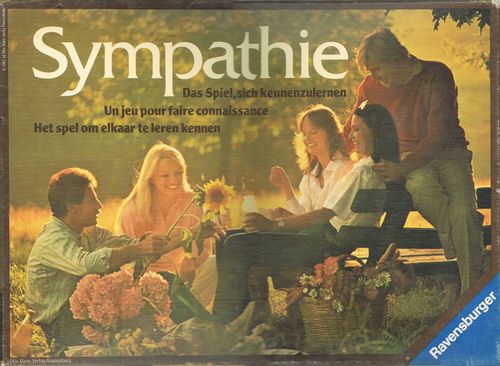
Sympathie
Sympathie Rulebook
Table of Contents
Table of Contents
Contents
120 photographs, 1 game board, 6 Sympathie boards and 30 magnetic coloured dots, 1 scoring pad.
Goal of the Game
Five photographs from one theme are laid out. One player marks, without the others seeing, his order of sympathy for the photographs (what he likes or does most, what comes second, and so on). The other players try to see the photographs through his eyes and to match this order as closely as possible. In the comparison that follows, every match earns a Sympathie point.
Setup
Each player receives one Sympathie board and, from each colour, one magnetic coloured dot (the dots stick to the board). To avoid confusion during play, the Sympathie boards are marked with the numbers 1–6.
One player additionally takes on the recording of results. He receives the scoring pad and writes the players' names next to the number of their Sympathie board. The back of the sheet is for additional evaluations.
The game board is placed in the middle. The 5 places for the photographs are marked with colours that correspond to the magnetic coloured dots.
The photographs are sorted by theme (each theme has a different back design). They may stay in the sorting compartments of the box, since only 5 are needed at a time.
The players decide who begins and agree on how the game will end (see "End of the Game").
Playing the Game
The player whose turn it is may choose the theme. The theme may also be determined by rolling dice (the dot values are printed on the backs of the photographs).
Another player takes 5 photographs from the face-down stack of the chosen theme and places them face up on the 5 places of the game board. In this way each photograph is assigned a colour.
The player whose turn it is marks, on his Sympathie board and without the others seeing, his order of the photographs: he moves his coloured dots accordingly. Rank place 1 is at the top!
It goes against the nature and purpose of this game to bluff the other players with false information.
All the other players also set up, without anyone else seeing, an order of the photographs. However, they do not set up their own order, but the order they suspect the active player has.
When everyone is finished, the Sympathie boards are compared openly.
Every match (same colour in the same place) with the order of the player whose turn it was earns a Sympathie point for the player who was able to empathise so well. The corresponding number of points is crossed off for that player on the scoring sheet. The player whose turn it was receives no point this time.
As soon as all points are recorded, the next player clockwise takes his turn. He chooses a theme, and 5 new photographs are laid out for him, for which he sets his order, and so on.
End of the Game
There are two options:
- The game ends when, depending on what was agreed, 2 or 3 rounds have been played, i.e. when every player has been the active player two or three times. The winner is then the player with the most Sympathie points.
- The game ends when a player has reached an agreed number of Sympathie points; that player is the winner. Example: with 3 players 15 points, with 4 players 20 points, with 5 players 25 points and with 6 players 35 points.
A tip: talking about the pictures and the themes is at least as important as an orderly course of play. It starts already with discussing how a question is to be understood, for example "Home" – for a longer time? Only on holiday? With my family? If I were completely unattached? Each group of players can keep determining its own interpretations here.
Additional Evaluation Options
In every group there will be people who understand each other particularly well. These are not necessarily the partners, and the understanding is not always mutual. Some are assessed accurately by everyone, others seem less comprehensible.
The back of the scoring sheet makes such observations possible. The following examples (for 4 players) show how the sheet is filled in and evaluated:
- The players' names are entered at the top and at the left, next to the number of their Sympathie board.
- The number of matches is entered straight away, against the player it refers to. In the example, Peter was the active player (1st round). Sabine matched him on 3 points, Eva on 5 points, and Klaus not at all (enter 0!). There is space for 4 rounds.
At the end, the sums of matches with the other players are drawn across each row. From these row sums, the sum of matches that a player was able to attract is formed vertically.
From the row sums one can see who understood whom best or least well. In the example, Sabine understood Peter best (13 points) and Klaus least (3 points). Peter, however, did not also understand Sabine best (only 3 points), but Eva (11 points).
From the vertical sum one can see who was most understandable to the whole group of players. In the example this is Peter (28 points), while Sabine was the most puzzling (12 points).
It would not be right to give these results general validity. They refer primarily to the particular situation of this group of players and this evening.