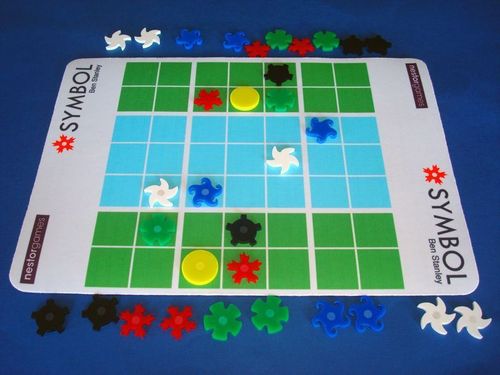
Symbol
Symbol Rulebook
Table of Contents
Table of Contents
Contents
Your Symbol set includes:
- A carrying bag
- A game board
- 30 main pieces (6 green, 6 blue, 6 white, 6 red, and 6 black)
- 2 king pieces
- These instructions
Set-Up
Place the game board between the players with a land area (green) next to each of them and the water area in the middle.
Each player may now select their 15 pieces and 1 king (yellow) if they have not done so already. A basic set of the game only has enough pieces for each player to have three of each color, so the aspect of customizing forces (the advanced game) is not possible unless both players agree to exchange some of their starting pieces. Don't worry, the basic forces with three of each piece is a very effective and balanced one, and how most people play the game anyway. But if you do want to experience customizing your forces some, consider purchasing a second set or some extra pieces for Symbol.
Player 1 uses the pieces facing up (showing the symbol). Player 2 uses the pieces facing down (no symbol showing).
Once both players have their starting 16 pieces, they set them at the edge of the board so both can see which pieces and how many remaining the players have throughout the game.
They select a starting player and determine which side of the pieces will represent each player and the game begins. In tournament settings, players generally play multiple games, require the players to use the same 15 pieces throughout a series of games, and alternate who starts each time.
The first move of the game for each player is always to place their king piece anywhere on the two rows of the board closest to themselves (their own land area), and then the game has officially begun with the players continuing to alternate turns throughout the game.
The Board
The board is divided into two land areas separated by a water area. Those three areas are further broken up into nine distinct regions, three regions per area. In the full game, reinforcements allowed during the game are dictated by control of the nine regions of the board (described below). Water spaces in the row right next to the land are called coasts, and land right next to water is called shore.
The Goal of the Game
The winner of Symbol is the one who removes the opponent's king piece from the game first. The game can also end if a player resigns. The game can also end in an agreed draw, a draw if both kings are removed simultaneously (due to the detonation of a black piece, and only possible in the full game), or a draw if victory is not possible for either player or if the same position repeats on the board three times.
The full game provides some additional interim strategic goals, such as removing more opponent pieces from the board than you lose, controlling as many regions of the board as possible to increase your allowed reinforcements each round, setting up tactical traps, and building powerful "stacks."
The Simple Game
Players alternate turns. On a player's turn, he uses one of his pieces on the board. The result is determined by its color and is different for each piece, but generally involve moving, pushing or removing opponent pieces, or adding a new piece to the board.
Yellow (King Piece)
- Movement: Does not move (except in the full game)
- Power: Can be used to add a new piece to the board
- Restriction: If taken, the game is lost
In the simple game, the king cannot move. If an opponent's piece is used or moved in such a way that it removes a player's king from the game, the player who lost his king also loses the game!
When the king is used by a player, he gets to add a new piece belonging to him to an empty space of the board for that turn. In the simple game, a player can add a piece in any open space surrounding any yellow, green, blue, white, or red piece belonging to that player anywhere on the board (that is, any empty space that is orthogonally or diagonally touching a place occupied by any non-black piece belonging to that player may be filled with a piece). On the very first turn of the game, when there is no other piece belonging to that player anywhere on the board, the player must use the turn to place the yellow piece he owns (the king) on any of the 14 green land spaces closest to that player.
Example: This king piece, represented by the circle, could reinforce by adding a new piece on any of the spaces marked by an 'x'. If the player had other green, blue, white, or red pieces on the board, the added piece could be placed around any of them.
Blue (Water Piece)
- Movement: Up to 3 spaces
- Special: Greatest movement range of any piece
- Restriction: Must travel and/or attack in a straight line; must remain on water (except in the full game)
In the simple game, the water pieces must always remain on water (blue spaces on the board). They can move one, two, or three spaces, orthogonally or diagonally, but they must move in a straight line: they may not change direction in mid-move. If a blue piece ends its turn on top of any opponent's piece, the opponent's piece is removed from the game. Blue pieces may also remove adjacent enemy pieces from the green spaces that are right next to blue spaces, if the blue piece could have reached the green space had the green space been blue.
Example: This water piece could move to any of the spaces marked with an x and remove an opponent in any of those spaces. It could also take an opponent piece in any of the spaces marked with a dot, though it would have to start or move next to the space, and would not actually occupy the space to remove the piece, since those spaces are land.
Green (Land Piece)
- Movement: Up to 2 spaces
- Special: Can change directions during movement
- Restriction: Must remain on land (except in the full game)
In the simple game, land pieces must always remain on land (green spaces on the board). They can move one or two spaces, orthogonally or diagonally. The green pieces do not have to move in a straight line: they may change direction in mid-move. If a green piece ends its turn on top of any opponent's piece, the opponent's piece is removed from the game. Green pieces may also remove adjacent enemy pieces from the blue spaces that are right next to green spaces, if the green piece could have reached the blue space had the blue space been green.
Example: This land piece could move to any of the spaces marked with an x and even remove an opponent in any of those spaces. It could also remove an opponent in any of the spaces marked with a dot, though it would have to start or move once to be next to the space (orthogonally or diagonally), and would not actually occupy the space to remove the piece, since those spaces are water.
White (Air Piece)
- Movement: Up to 2 spaces
- Special: Ignores the distinction between land and water
- Restriction: Must travel in a straight line
The air pieces can ignore the color of the space on the board. They can move one or two spaces, orthogonally or diagonally, but they must move in a straight line: they may not change direction in mid-move. If a white piece ends its turn on top of any opponent's piece, the opponent's piece is removed from the game.
Example: This air piece could move to any of the spaces marked with an x and remove an opponent in any of those spaces.
Red (Fire Piece)
- Movement: 1 space
- Power: Pushes surrounding enemy pieces directly away
The fire pieces can ignore the color of the space on the board. They may only move one space, orthogonally or diagonally. After they move (and only after they move), any opponent piece that they end on top of is removed from the game, and any opponent piece that is in a surrounding space (orthogonally or diagonally) is pushed away from the red piece one space in a direct line away from the resting place of the red piece: those pieces are repelled by the fire. If the push of a red piece causes a piece to be off the board, pushed onto a space it cannot occupy (because the space is the wrong color for a green or blue piece, or the space is occupied by another piece), then the pushed piece is removed from the game. Also, if the piece cannot move (yellow or black), then it is removed from the game.
Example: This fire piece moves, forcing the enemy water, earth, and air pieces to move away from it in a direct line away; one green piece and the white piece are removed from the game because they are forced off of the board.
Black (Destruction Piece)
- Movement: None
- Power: Detonates, removing itself and anything in surrounding spaces
The destruction pieces cannot move. If they are used by the owning player, they are removed from the game. Any time a black piece is removed from the game (because it was used by its owner or removed by the movement of an opponent's piece), the black piece and all other pieces in any surrounding space (orthogonal or diagonal) belonging to either player are removed from the game! In other words, they explode and remove all surrounding pieces when they are removed. This can cause a chain reaction if another black piece is in a space surrounding the first.
Example: This destruction piece, if attacked by the opponent or triggered as this player's action, will be removed and will remove everything in the surrounding spaces, marked by x's.
Game End
Players continue to alternate turns until one player is able to remove the other player's yellow king from the game. If neither player can accomplish this goal, they may agree to a draw.
Differences Between the Simple and Full Games
Once players have mastered the simple game, they may be ready for the next challenge and complex strategy. There are three main differences between the simple and full game rules, outlined below.
-
Players can combine their pieces into stacks! Pieces can share spaces on the board, and when a player takes his turn, he gets to use all the pieces in the same space on the board. That allows for water pieces to carry land pieces to the other side of the board, for example. On a player's turn, he can use all or some of the pieces he owns on a single location on the board, moving the ones he wants to use like any single piece in the stack that turn, and using the power of the yellow, red, and black pieces that are in the stack he moves!
-
Players can earn more than one new piece when adding pieces to the board! Reinforcements can increase if a player gains exclusive control of enough regions of the board. For example, if a player has pieces in three different regions where his opponent does not have a piece, then the player gets to add two pieces to the board whenever the player uses his king piece on his turn.
-
There are differences in where a player may add new pieces to the board in the full game. In the full game, a player must add new green, blue, white, and red pieces into the spaces surrounding and including the king piece only. Just the black pieces may be deployed around and in the same spaces as any yellow, green, blue, white, and red pieces belonging to that player on the board.
Clarifications for the Full Game (With Stacks)
A Turn in Symbol
On a player's turn, he or she uses the powers of a piece or pieces at one location on the board. So when a stack is used, multiple powers may all be invoked. A player only gets one action per turn, but that action can involve both moving a piece, stack, or subset of a stack as well as invoking all the powers associated with those pieces (if there are red, black, or yellow pieces involved), and those powers themselves often involve multiple effects.
Movement
When moving pieces, they can always pass through the same spaces as friendly pieces (pieces controlled by the same player), can end their movement on the same space as a friendly piece (thus forming a stack), but cannot move through spaces occupied by an opponent's pieces or king.
Stacked pieces are sharing a space and thus combining into more powerful pieces. Stacks can include any number of pieces belonging to the same player. The entire stack can be moved and used together as a turn, or the stack can be broken up and only part of it used and moved.
When a stack or subset of a stack moves, it moves as any one piece in the stack; in other words, one piece is designated as the transport, and the stack must still follow the restrictions of that piece (a blue piece cannot change directions, even if a green piece is in the stack, and must stay in the water unless it is joining a waiting friendly green piece on the land, thus forming a new stack).
When pieces are moved by the opponent (through the use of a red fire piece), the result may not eliminate the moved piece if it is pushed into a location that ordinarily cannot support it, if there is a waiting friendly piece that can form a stack with the new piece and make its presense on that square legal.
Stacked Pieces
On a player's turn he or she can move one piece, such as a green piece, onto another, such as a blue piece on the coast adjacent to the shore. The combined pieces can now be moved, on a subsequent turn, three spaces in a straight line in the water or 2 spaces in any direction, with a direction change, on land spaces. In other words, stacked pieces have the movement of any one piece in the stack (the one "transporting" the others for that turn) and they also gain the powers of any pieces in the stack: repulsion effect of red pieces if a red piece is in the stack, the explosive effect (optional) of a black piece if a black piece is in the stack, and the ability to add reinforcements if a king is in the stack (new pieces can be added before or after the stack or part of the stack moves, or both, but calculate the number added at the start of the turn).
It does not matter what order the pieces are in the stack as long as both players can see every piece in every stack.
Reinforcing the Board with More Pieces in the Full Game
When a player uses his king or a stack containing his king for his turn, he has the option of adding new pieces from his reserves onto the board. This is the only choice available as a first move after placing their kings for each player in the game, because the only pieces on the board are the kings. Earth pieces (green), water pieces (blue), air pieces (white), and fire pieces (red) can be added to the board in the same location as the king or in any surrounding space. That is, a player can reinforce a standard piece (green, blue, white, or red) to any of nine spaces surrounding or including the king (less spaces are available if the king is on an edge or corner of the board). Destruction pieces (black) are special: they can be added to any space surrounding and including the king, or surrounding and including any standard pieces belonging to that player anywhere on the board. In other words, a king could make any of his pieces on the board (other than another destruction piece) deploy a destruction piece next to it.
A player cannot reinforce by adding a new piece directly on top of an opponent's piece. Reinforcements can, however, be added on top of friendly pieces, thus creating a stack.
In the full game, a player using the king's power may be entitled to add more than one new piece to the board! A player can place one (1) new piece plus one (1) additional piece for every three (3) regions that player controls. A region is controlled if it is both occupied (contains a piece that belongs to that player, such as the king or any piece) and uncontested (does not contain any pieces belonging to the other player). The board is comprised of nine (9) regions. Generally, players get only one (1) reinforcement if they choose to reinforce early in the game, but they can quickly increase that number to two (2) reinforcements by controlling at least three (3) regions. If a player can gain control of at least six (6) regions, he or she would be entitled to three (3) reinforcements when choosing to reinforce with the power of the king. A player is not required to place as many reinforces as he or she may be entitled to place.
Popular Variants
-
Unlimited Forces
In this variant, each player starts with only a king and eight (8) pieces of their choice, but when pieces are taken, they are not removed from the game. Instead, they are returned to the owner and can be placed as a reinforcement again later in the game. Games can take longer but they require additional positional strategy to control regions and overwhelm an opponent's king with better use of reinforcements.
-
Enlisting Opponents
Similarly, some players like to play that taken pieces can later be used as reinforcements by the player who made the capture. This is not an official variant of the game, but adds to a player's momentum, generally brings games to even faster conclusions, and offers some variety for those interested.
-
Breaking Ties by Region Control
Some players like to declare that if neither player is able to remove the other's king, then whoever can control the most regions wins the game, rather than calling the game a draw.