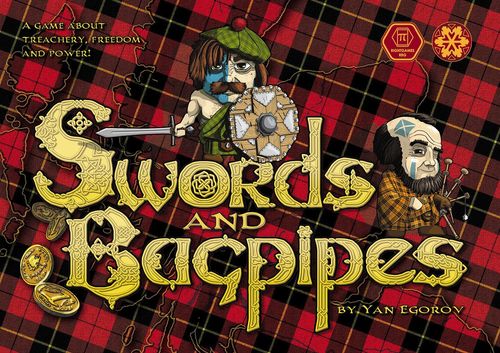
Swords and Bagpipes
Swords and Bagpipes Rulebook
Table of Contents
Table of Contents
- Scots Wha Hae (Scots, Who Have)
- Such a Parcel of Rogues in a Nation
- The Object of the Game
- Game Components
- Standard Game Setup
- Seven Phases of a Game Round
- Bagpipe Cards
- Dagger Cards
- End of the Game
- Victory and Defeat
- The Five Dagger Rule
- Who Is the Traitor among the Two of Us? — Rules for 2-Player Games
- Everyone Can Betray Now! — Rules for 3-Player Games
- Stay Home! — Rules for 5- and 6-Player Games
- Go Village!
- Game Variants
- Component Limitations
- Historical Reference
Scots Wha Hae (Scots, Who Have)
Original lyrics in Scots, with an English translation.
'Scots, wha hae wi Wallace bled, / Scots, who have with Wallace bled, Scots, wham Bruce has aften led, / Scots, whom Bruce has often led, Welcome tae yer gory bed, / Welcome to your gory bed Or tae victorie. / Or to victory.
'Now's the day, an now's the hour: / Now is the day, and now is the hour: See the front o battle lour, / See the front of battle lower (threaten), See approach proud Edward's power - / See approach proud Edward's power - Chains and Slaverie. / Chains and slavery.
'Wha will be a traitor knave? / Who will be a traitor knave? Wha will fill a coward's grave? / Who will fill a coward's grave? Wha sae base as be a slave? / Who's so base as be a slave? - Let him turn an flee. / Let him turn, and flee.
'Wha, for Scotland's king and law, / Who for Scotland's King and Law Freedom's sword will strongly draw, / Freedom's sword will strongly draw, Freeman stand, or Freeman fa, / Freeman stand or freeman fall, Let him on wi me. / Let him follow me.
'By Oppression's woes and pains, / By oppression's woes and pains, By your sons in servile chains! / By your sons in servile chains, We will drain our dearest veins, / We will drain our dearest veins But they shall be free. / But they shall be free.
'Lay the proud usurpers low, / Lay the proud usurpers low, Tyrants fall in every foe, / Tyrants fall in every foe, Liberty's in every blow! - / Liberty is in every blow, Let us do or dee. / Let us do or die!'
"Scots Wha Hae" is the party song of the Scottish National Party. It is sung at the close of their annual national conference each year.
Author: Robert Burns
Such a Parcel of Rogues in a Nation
Fareweel to a' our Scottish fame, Fareweel our ancient glory; Fareweel ev'n to the Scottish name, Sae fam'd in martial story. Now Sark rins over Solway sands, An' Tweed rins to the ocean, To mark where England's province stands- Such a parcel of rogues in a nation!
What force or guile could not subdue, Thro' many warlike ages, Is wrought now by a coward few, For hireling traitor's wages. The English steel we could disdain, Secure in valour's station; But English gold has been our bane - Such a parcel of rogues in a nation!
O would, ere I had seen the day That Treason thus could sell us, My auld grey head had lien in clay, Wi' Bruce and loyal Wallace! But pith and power, till my last hour, I'll mak this declaration; We're bought and sold for English gold- Such a parcel of rogues in a nation
Author: Robert Burns
The Object of the Game
Your goal in Swords and Bagpipes is to protect Scotland's independence and, at the same time, to hoard as much gold as you can.
Game Components
- Badge of Honour token — 1
- Stay Home! token — 1
- Scotland's Defeats marker — 1
- Camp sheets — 6
- Castle sheets — 6
- Choice tokens — 6 pairs
- Unit tokens — 63
- Gold coins — 75
- King Edward cards — 5 cards
- English Arms cards — 14 cards
- Dagger cards — 16 cards
- Village cards — 9 cards
- Bagpipe cards — 40 cards
- Game rules
Standard Game Setup
This is the Game Setup for 4-5 players. If you play a 2-player, 3-player, 6-player or a 5-player game with the Stay Home! token, the rules of the game change a little. Read about these changes in the "Who Is the Traitor among the Two of Us?", "Everyone Can Betray Now!" and "Stay Home!" sections below.
- Place the Game Board with the map of Scotland in the middle of the play area. Shuffle Dagger cards and Bagpipe cards and place them on their areas of the game board.
- Place the Scotland's Defeats marker on its starting location in Glasgow. Place the unit tokens and gold coins nearby.
- Create the English Arms Deck.
- 1st step. Draw randomly one of the King Edward cards (these are the cards with the red backs). Without looking at the picked card, place it on the corresponding game board area, face down. Return the remaining card to the game box.
- 2nd step. Draw 6 English Arms cards randomly (these are the cards with the grey backs) and place them face down on top of the King Edward card. Return the rest of English Arms cards to the game box.
- During the game, when you reveal a card from the English Arms deck, place the revealed card to the right part of the game board.
- Each player gets two playing sheets in their clan colours: the Castle and the Camp. All Castle and Camp sheets are double-sided. Choose from any of 12 clans! You will use the Castle to store your army units and your gold. To participate in battles, you will move your armies to your Camp.
- Each player places 3 units and 3 gold coins to their Castles. Then each player draws one Bagpipe card.
- Each player takes 2 Choice tokens in their clan colours: one token with a crown and another token with the Scottish beret.
- The oldest player becomes the first player. Other players solemnly hand him the Badge of Honour.
The game is played in 7 rounds. The number of rounds is equal to the number of cards in the English Arms deck. However, if Scotland loses, the game may end earlier (see "End of the Game" section).
Seven Phases of a Game Round
Each round consists of seven short steps, or phases. They are:
- Invasion Phase
- Actions Phase
- Badge of Honour Phase
- Choice Phase
- Battle Phase
- Awards Phase
- End Phase
1. The Invasion Phase
First, you will need to clarify the military-political situation of the present moment. To do this, reveal the top card of the English Arms deck.
The card shows the number of the invading English troops and the rewards that the participants of the battle will receive. In addition, the card may have a description of a special effect, which will be applied during this round.
2. The Actions Phase
Starting with the first player (the holder of the Badge of Honour) and following clockwise, each player can do any or all of the three actions in any order: Replenishment, Relocation and Playing Bagpipe Cards.
Replenishment is obligatory, while Relocation and Playing Bagpipe Cards is optional.
Replenishment
During your turn, you must take a single Replenishment action. There are four Replenishment actions to choose from — Collect Taxes, Raise Militia, Assemble Troops, Hire Mercenaries. All of the available Replenishment actions are also shown on the game board, as a reminder.
Collect Taxes Receive one gold coin. All your gold should be stored in your Castle.
Raise Militia Add one unit to each players' Camp. Then add one unit to Scotland's Camp as well. Scotland's Camp is located in the bottom right corner of the game board. Units in Scotland's camp will always fight on the side of Scotland.
"Rally under the banners of Scotland!" The militia action is usually beneficial to players supporting Scotland in this round.
Assemble Troops Add 2 units to your Castle.
Hire Mercenaries Discard one gold coin and add 4 units to your Castle.
Relocation
You may relocate as many units as you wish from your Castle to your Camp. Units in the Camp will join the battle in this round.
Playing Bagpipe Cards
You may play as many Bagpipe cards with the axe symbol as you wish.
3. The Badge of Honour Phase
After all of the players have finished their actions, the holder of the Badge of Honour passes it to any other player of his choice.
You cannot pass the Badge of Honour to a player who passed it to you in the previous round.
4. The Choice Phase
Each player secretly chooses one of their two Choice tokens, and places it in the middle of the table face down.
The holder of the Badge of Honour is the only player who does not have to choose a side to support. If you hold the Badge of Honour, you have to defend Scotland this round!
Until the Choice tokens are revealed, each player may play any number of Bagpipe cards with the Choice-phase symbol.
5. The Battle Phase
All players reveal their Choice tokens simultaneously. Now everyone can see who will defend Scotland this round and who was tempted by the gold of the English king!
Strength of the Scottish Army is equal to the sum of the units in Scotland supporters' camps plus the units in Scotland's camp.
Strength of the English Army is equal to the sum of the units in English supporters' camps plus the number on the shield in the lower right corner of the English Arms card.
Compare the strength of Scottish and English armies. The stronger army wins the battle. If both armies are equally strong, Scotland wins the battle.
If Scotland has lost the battle, move the Scotland's Defeats marker to the next space on the game board. If the marker has reached the space with the skull wearing the Scottish beret (it will happen after four defeats), the game is over with Scotland's ultimate defeat. All the players are declared corrupt aristocrats (see "End of the Game" section). In any case, you must finish the game round and distribute the awards.
6. The Awards Phase
Watch out for deserters! If at the beginning of the battle, a player did not have a single unit in his Camp, he can't receive any awards and can't play any Bagpipes cards in this phase.
The revealed English Arms card is placed at the game board in such a way that the images of berets and the image of the crown are exactly above the corresponding player rewards.
Victory of Scotland Each Scotland supporter gets one card from the Bagpipe deck and some gold coins, equal to the amount indicated on the English Arms card under the picture of the undamaged beret.
Victory of England Each Scotland supporter adds one unit to his Castle and receives gold coins, equal to the amount indicated on the English Arms card under the picture of the beret, pierced with a dagger and with an arrow.
Victory of England or Scotland Regardless of the outcome of the battle, each England supporter draws one card from the Dagger deck.
The king of England buys your loyalty in advance. Whether his army wins or loses — is none of your business. Therefore, regardless of the battle's outcome, England supporters receive the total amount of gold, indicated on the English Arms card on the right, under the crown. The gold should be divided equally between all England supporters. Undistributed gold is discarded.
Generous rewards! Among the English Arms cards there are cards with no coin symbol on the coin under the crown. In this case, each England supporter gets as much gold as indicated under the crown!
In the Awards phase, players can play any number of Bagpipe cards with the Awards-phase symbol. Please note — you cannot play Bagpipe cards you have received during the Awards phase of this round!
7. The End Phase
Discard all units in all Camps, including Scotland's Camp.
The holder of the Badge of Honour starts the next round.
Bagpipe Cards
You may receive Bagpipe cards in the Awards phase. Do not reveal your cards, until you play them.
A symbol at the bottom of each Bagpipe card indicates the phase when you can play that card.
- Axe symbol — Play this card on your turn during the Actions phase.
- Choice-phase symbol — Play this card after all players have chosen their Choice tokens, but before the Choice tokens are revealed.
- Awards-phase symbol (sporran) — Play this card during the Awards phase. You cannot play a Bagpipe card that you have just received in the Awards phase of this round.
Usually, the order of playing Bagpipe cards with the Choice-phase symbol and the Awards-phase symbol does not matter. However, if there is a dispute about the playing order, the holder of the Badge of Honour should play first, followed by other players clockwise. In this case, and only in this case, if a player skips his turn for playing Bagpipe cards, he cannot play it later during this phase of this game round.
General rules for playing Bagpipe cards
- You can play as many Bagpipe cards as you wish during a round.
- There is no hand limit for Bagpipe cards.
- Discard all played Bagpipe cards immediately, except for the cards with the "x2" symbol.
You can play Bagpipe cards with the "x2" symbol twice. After you have played a card with the "x2" symbol, place it in front of you, face up. You can play this card once more, but only during the next round or later. You may not play the same card twice in one round. Discard this card after you have played it for the second time.
Some of the special symbols on Bagpipe cards
- Unit banner symbol (with a number) — The number of units. In accordance with the text of the card, the player can add or relocate the specified number of units (or fewer units).
- Gold coin symbol (with a number) — The amount of gold that the player gets.
- Crossed-out gold coin symbol (with a number) — The amount of gold that the player loses. If the card does not say otherwise, the player who played the card loses the gold.
- Saltire banner symbol — Raise Militia works just like the Replenishment action. Add one unit to each players' Camp and to Scotland's Camp.
Dagger Cards
England supporters get Dagger cards. These are betrayal cards! A Dagger card can have one to three daggers pictured. The more daggers there are on a card, the worse it is for the player who got it.
The player secretly examines the Dagger card after receiving it. He can tell other players how many daggers are on his card, but he is not obliged to tell them the truth.
At the end of the game, all players reveal their Dagger cards. Players add up the number of daggers on their cards. The player with the least number of daggers is the most honest player! In case of England's victory, this player will win the game (see "Victory and Defeat" section).
Besides, if one of the players has at least 5 daggers more than each of the other players, he or she can't become the winner of the game (see "The Five Dagger Rule" section).
Thus, supporting England all too often is disadvantageous. Although, as a rule, England offers a more generous award!
End of the Game
The game ends after the seventh round, with the last English Arms played (it is going to be one of King Edward cards).
The game can end earlier, if the Defeats marker reaches the skull wearing a Scottish beret. This will happen after four defeats of Scotland.
Victory and Defeat
Victory of Scotland — the Defeats marker has not reached the end of the track. A player with the most gold wins. If several players are tied for the gold, the winner is the player among them with the least number of daggers.
Honour and glory will prevail! Don't forget that the player who has at least 5 daggers more than every other player cannot win the game (see "The Five Dagger Rule" section).
Defeat of Scotland — the Defeats marker has reached the end of the track or, in other words, the English lion moves to the space with the skull wearing a Scottish beret. A player with the least number of daggers wins. If several players are tied for the least daggers, the winner is the player with the most gold.
The Five Dagger Rule
This rule applies if Scotland is victorious. It is like a judgment day for the outstandingly treacherous person, if there is such.
At the end of the game, players summarize the number of daggers on their Dagger cards. Then they compare their dagger totals.
If any one player has at least 5 daggers more compared to each of the other players, then this sly player is declared to be the traitor to the Nation and cannot win the game. There can only be one such player.
Here are a few examples.
- William has one dagger, Margarita has two daggers, Robert has 6 daggers and John has 11 (or more) daggers. Corrupt John will be proclaimed a traitor. He will not be able to win this game, even if he has the most gold!
- William has zero daggers, Margarita has one dagger, Robert has 8 daggers and John has 9 daggers. Every player retains a chance to be proclaimed the game's winner, as there must be a difference of five or more daggers with every other player for this rule to take effect. Robert and John have difference of only one dagger, so The Five Dagger Rule has mercy on them!
Who Is the Traitor among the Two of Us? — Rules for 2-Player Games
You can play Swords and Bagpipes with two players using the rules below. The 2-player game mechanics are very different, but the spirit of the game remains the same.
-
Game preparation is done as usual. The only difference being is the Dagger card deck is not placed at the game board. Instead, each player gets 7 Dagger cards and keeps them hidden.
Each player gets: two Dagger cards with 1 dagger, three Dagger cards with 2 daggers, two Dagger cards with 3 daggers.
Before creating the English Arms deck, return two English Arms cards to the box: Irvine Capitulation and Bruce Joins Us Again! During the game, if you draw Affair of Honour card or other Bagpipe card that mentions the Badge of Honour, discard this card and draw another one. These cards cannot be used in a 2-player game.
-
During The Invasion Phase, right after the English Arms card is revealed, add 3 units to Scotland's Camp.
-
During The Actions Phase, the first player to do an action is the owner of The Badge of Honour, as usual.
-
During the third phase, The Badge of Honor should not be passed. Instead, players go straight to the fourth phase and secretly determine the sides that they want to support by placing their Choice tokens.
In the same time, players choose and place one of their Dagger cards face down. They should not show the chosen card.
Then all of Bagpipe cards with the Choice-phase symbol can be played.
After that, the player with The Badge of Honour, may pass it to the other player. He does not have to do it and can keep the Badge of Honour.
If The Badge of Honour was not passed, nothing happens. If The Badge of Honour was passed, then the player that just got it, should move all but one of his units from his Camp to Scotland's Camp.
Today your armies will fight for the honour of Scotland! Even if you are a filthy traitor and if you have planned to betray us, England will have a hard time beating us in the coming battle!
-
Choice tokens and chosen Dagger cards are revealed simultaneously.
If a player is supporting Scotland, the Dagger card that was prepared by his opponent goes to the personal discard pile of that player. Any player can look at this card any time.
If a player is supporting England, he takes the Dagger card that was prepared by his opponent and puts it face up in front of him. This is the Dagger card that the player has received for his betrayal!
-
Determining the game winner happens the same way as in games with three or more players.
The Five Dagger Rule should be followed too. However, it triggers immediately in the beginning of a new round, if one of the players has 5 daggers more than the other player. In this case, the player with most of Daggers is declared to be the dishonourable traitor and his opponent wins.
All other rules of 3-5 player games remain the same.
Everyone Can Betray Now! — Rules for 3-Player Games
If three players have gathered to play the game, the rules are changed a bit. In the beginning of the game, all players get two Bagpipe cards instead of one. The Honour Badge does not make you support Scotland and it should always be passed clockwise. Scotland's Camp receives one additional unit each round.
All Bagpipe cards and English Arms cards that mention the Badge of Honour, were not designed for three player games. Before creating the English Arms deck, return two English Arms cards to the box: Irvine Capitulation and Bruce Joins Us Again! During the game, if you draw Affair of Honour card or other Bagpipe card that mentions the Badge of Honour, discard this card and draw another one.
Stay Home! — Rules for 5- and 6-Player Games
The Stay Home! token makes 6-player games possible. Besides, you can use it in 5-player games as a variant.
During the setup, give the Badge of Honour to the oldest player. This goes as usual. After that, bow and bring the Stay Home! token to the youngest player. That player will become the first arbiter of fates in this game!
In the beginning of the first game round, the Stay Home! token does not affect any players. The token lays down waiting to be used.
In the third phase of a game round, The Badge of Honour Phase, the owner of The Badge of Honour gives it to one of the players, as usual. Then, the owner of the Stay Home! token should give it to any player that does not now have the Badge of Honour.
In addition, one can't give the Stay Home! token to the player that gave it in a previous round.
The player that has just received the Stay Home! token has to do these actions, in the following order:
- Do any three Replenishment actions. You can do the same action two or even three times. You just should not exceed a total of three replenishment actions.
- Discard all units from your Camp.
- Go home. In other words, you sit through the battle in your Castle.
Thus, the player that got Stay Home! token will not participate in the coming battle. This player will not choose a side to support and will not get an award. He cannot play Bagpipe cards before the Choice tokens are revealed and during the Awards phase. He also cannot be affected by these Bagpipe cards of other players. Finally, this player is not affected by English Arms cards, and so on.
Who said it is a retreat?! It's just a careful preparation for future battles!
When using this variant in a 5-player game, the rules remain the same as in a 6-player game.
If you are playing a 6-player game, you might want to play a longer game, consisting of 9 rounds. In this case, see the Game Length variant.
Go Village!
The war was waged not only by castles of Scottish lords. Like any war, it laid on the shoulders of ordinary people who lived in settlements on lands around the castles. The outcome of battles largely depended on the common people!
We recommend you to add the Village deck after you have played one or two games of Swords and Bagpipes.
Randomly deal one card from the Village deck to each player before the beginning of the game. After receiving a card, a player should put it near himself, face-up. Put the remaining cards back to the game box, they will not be needed in this game.
There are two types of Village cards: one-time and permanent. One-time cards are always discarded after they are played.
Permanent Village cards are Blacksmith and Monastery. They are activated each time when the specified condition is met.
One-time Village cards that trigger at the beginning of the game are Mill and Musician's House. If you draw one of these cards before the beginning of the game, immediately follow the card's instruction and discard it.
One-time Village cards that you activate yourself are Ferry, Marketplace, Spy Guild. In general, these cards can be played at the same time, when you can play Bagpipe cards. In addition, Marketplace card can be played before the final calculation at the end of the game.
One-time Village card, activated in response to the actions of other players: Church. You decide whether you want to activate Church or not, if the other player played a Bagpipes card, making you lose gold or troops, moving your troops between Camps and Castles in any manner, making you lose your Bagpipe cards, and so on. A harmful Bagpipe card does not have to be aimed exactly at you. You cancel the effect, if you were aimed by it. The player who played the Bagpipe card that you canceled, cannot choose a new target for the cancelled effect of his card.
One-time Village card, which works at the time of determining the winner: Memorial. This occurs before the daggers count. You can place Memorial card in front of yourself, considering it as "-1 dagger".
Game Variants
Scottish Ensemble
At the beginning of the game, each player draws not one, but three Bagpipe cards. This rule adds more chaotic fun to Swords and Bagpipes. However, it may also result in granting a distinct advantage to one of the players, if he is lucky to get a great card combination.
Scottish Ensemble variant is highly recommended, if you just want to get more fun and if you don't like heavy double thinking during the game.
Game Length
You may play a longer game with nine rounds instead of seven rounds. For this variant, at the beginning of the game the deck of the English Arms should have one card with the red back (one of King Edward card) and eight cards with the gray backs, instead of the standard six gray backs cards.
In this variant, Scotland loses after five defeats instead of four. Do not place Defeats marker on the game board at the beginning of the game. Place it in Glasgow after the first defeat.
Predictable Retribution
During the game setup, find one Dagger card with 1 dagger, two cards with 2 daggers and two cards with 3 daggers. Shuffle these five cards. Then find one more Dagger card with 1 dagger, two cards with 2 daggers and two cards with 3 daggers. Shuffle these cards and place them underneath the previous five cards. Finally, shuffle all the remaining cards and place them underneath as well.
This way, you'll get a more predictable Dagger Deck. Players will have a better idea of the Dagger cards everyone draws.
Component Limitations
Basically, there are almost no component limitations in Swords and Bagpipes. It is highly unlikely that you will ever run out of game components. However, if this happens, do the following:
-
Bagpipe or Dagger deck runs out: reshuffle the discarded cards to form the new deck.
-
All Dagger cards are distributed among the players: count all Dagger cards that you would have to draw as cards with 2 daggers. Keep track of these virtual cards by any convenient means. For example, whenever you have to draw a Dagger card, place a unit token or a coin on top of your dagger cards.
Thou shalt be ashamed! If you have dealt out all Dagger cards to the players, you can as well just stop playing at this point. Ah, corrupt aristocrats!
-
All Bagpipe cards are distributed among the players: just do not draw these cards anymore. That's sad, but there's not much you can do about it.
-
Unit tokens or coins run out: use any substitutes to replace the originals.
Historical Reference
We did not aim to provide an accurate reconstruction of the events of the past with Swords and Bagpipes. However, some cards have a historical background.
Bruce's Trick Robert the Bruce was an important political figure, and later became the King of Scots. In 1296, he swore allegiance to King Edward I of England. A year after that, Robert took part in the rebellion of William Wallace, but then again swore allegiance to Edward I, immediately after the revolt was crushed. Robert supported the King until the year 1306 and then again has flopped over to the side of Scotland.
Wallace's Gratitude William Wallace is Scotland's national hero, an ardent Patriot and a freedom fighter. In 1297, he organized a revolt, bringing together many Scottish clans under his banner.
The famous movie Braveheart is not only inspired by these events, but also has William Wallace as the main character. Mel Gibson brilliantly played his role in this movie.
Lamberton's Help William Lamberton was Bishop of St. Andrews. He played an important role in the wars of independence. Lamberton actively influenced Scottish aristocrats, swaying them to support Scotland.
Bruces vs Comyns Bruces and Comyns clans vied with each other for many years. Eventually, Robert the Bruce slayed the leader of his enemies — the Red Comyn.
Moray's Rebellion William Wallace was popular among the common people, and sir Andrew de Moray was a major patriot among the nobility. During the battle of Stirling Bridge, Scots won their first significant victory in the war, but de Moray was mortally wounded. After losing his companion, Wallace also lost the support of many aristocrats, who considered him insufficiently noble.
David's Lineage In 1290, after the death of Queen Margaret, 13 applicants for the Scottish throne emerged. Yet, only a true descendant of David I could become the King. Five candidates had proven affinity with David. King Edward I of England decided to choose John Balliol and put him on the throne.
Vive la France! In 1294, France and Scotland formed an alliance in response to the aggressive actions of England. This anti-British agreement was called the "Auld Alliance" and it lasted until the mid-16th century.
Treaty with Eric II King Eric II of Norway decided to support the anti-English campaign, by sending 100 ships to Scotland amounting to 50000 silver coins.
Balliol's Plan In response to Franco-Scottish negotiations, Edward I started to strengthen his borders. In response, John Balliol appointed the assembly of troops at Caddonlee. However, some Scottish clans preferred to ignore it.
Pope's Influence In 1296, the English troops captured the Scottish King John Balliol. Bishop Lamberton immediately went to Rome to ask the Pope for help. Due to political pressure from the Pope, the English had to let go of their captive.
William "The Hardy" William Douglas "le Hardi", nicknamed the Bold, many times acted against King Edward I. He was captured three times. Together with Wallace they successfully plundered English treasury in the Scone. The way of Hardy ended in 1298 in London's dungeon.
The Guardians "The Guardians of Scotland" were a group of Scottish noblemen, who administered the country during the Wars of Independence. At different times, the title of a Guardian belonged to Robert Bruce, William Wallace, William Lamberton and the Red Comyn.