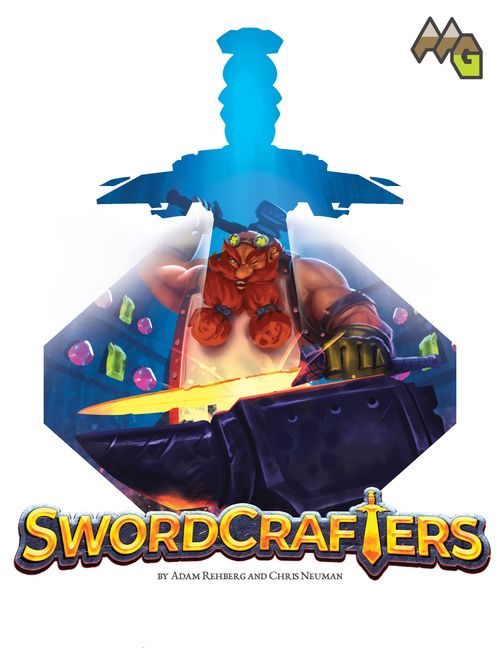
Swordcrafters
Swordcrafters Rulebook
Table of Contents
Table of Contents
Contents
- 5 sword pommels
- 10 sword hilts
- 12 sword guards
- 91 sword tiles
- 18 sword magic cards
- 1 first player token
- 1 forge tile
- 1 scoring tracker and player tokens
- 10 solo player variant cards
Game Setup
- Shuffle the sword tiles and create 2-3 stacks on the table.
- Shuffle the sword magic cards and place 3 of them face up on the table. These cards are double-sided. Choose to play with the beginner side, intermediate side, or mix and match.
- Give each player 1 sword pommel and 2 sword hilts to assemble. Note: Leave pommel and hilts assembled after the game to help prevent wear and tear.
- Shuffle the 12 sword guards and randomly give each player 2 sword guards to assemble.
- Spin the First Player Token onto the table. When the token lands on the table, the direction the anvil horn is pointing determines the first player for the first round. Give that player the first player token.
- Create a grid of tiles according to the setup diagram following the appropriate player count. A 4-5 player game will use 15 random sword tiles and the forge tile in the position as shown. The player creating the grid should place tiles left to right, top to bottom to keep grid setup quick and randomized.
For 2-3 players, remove 3 sword tiles of each color from the game and use 11 random sword tiles and the forge tile in the position as shown.
See Two Player Rules for additional game play rules.
Game Flow
Swordcrafters is played over 6 rounds and each round has 3 phases. At the end of the game, points will be awarded based on your sword length, quality, and magic.
Phase 1: Slice
Starting with the first player and proceeding clockwise, choose any group of tiles and make a slice into the group. Each player will make one slice. A slice MUST ALWAYS create exactly two new groups of tiles. If the slice does not create exactly two new groups, then the slice is not legal. The slice must be created along a straight line, either vertical or horizontal. At the start of the round, the entire grid of tiles is one group. Once complete, proceed to the Phase 2: Select.
Phase 2: Select
Starting with the first player and proceeding clockwise, select and take one group of tiles. Each player will select and take one group of tiles. If a player takes the group containing the forge tile, she will be the starting player next round. There will always be one group of tiles not taken. Return the group not taken to the game box. Do not return the forge tile to the game box if it is in the group not taken.
At the end of the select phase, the player with the forge tile takes the first player token and returns the forge tile to the center of the table. If no player took the group containing the forge tile, then the first player token should be passed one player clockwise. Once complete, proceed to Phase 3: Crafting your sword.
Strategy if not starting player: Keep starting player in check while selecting gems you need. Try to rotate the starting player or make them select a smaller group if they want to maintain their position.
Phase 3: Crafting Your Sword
Assemble your sword by slotting sword tiles into the sword guard and further slotting more sword tiles into previously assembled sword tiles. The order a sword is assembled is up to the player, but all selected tiles must be assembled this round. An assembled sword MUST have 4 sides and cannot have any open spaces in the sword. To assemble the sword tiles into your sword, push the slots together completely to ensure a snug fit.
After each player has crafted their selected tiles into their sword, create a new grid of tiles and proceed to Phase 1: Slice to start a new round. After the 6th round, proceed to end game scoring (you will not have enough sword tiles to create a new grid).
Note: A sword may be held in hand during game play or rested on the table. You must have the sword above the table during play, but you are not required to rotate the sword for another opponent to see.
End Game Scoring
At the end of scoring, the player with the most Victory Points (VP) wins the game. Set the scoring tracker on the table and give each player a token to track their score.
Longest Sword: All players hold their sword in the center of the table to determine who has the longest sword. The player with the longest sword (most total sword tiles) wins 6 VP. All players that tie also win 6 VP.
Sword Quality: All players score each side of their sword for quality. Each point of quality is worth 2 VP. Quality is determined by the largest set of matching adjacent gems on one side of a sword. Quality may only be scored once per side, and must be at least 2 matching adjacent gems to score.
Sword Magic: Points for sword magic are calculated for each player by comparing the number of relevant gems in each player's sword. More than one player may score for each sword magic card as determined by the scoring grid on the card and each player is eligible to score for each card. Start with the first sword magic card and have each player count the relevant gems found on all sides of their sword. Determine the first, second (if applicable), and third (if applicable) place based on the method of comparison (Most, Least, Most Pairs, Most Triads, Largest Difference). If several players tie, the points for the respective places are shared and rounded down. Repeat for the second and third card.
Two Player Rules
Each player takes two turns instead of one during the Slice and Select phases. Turn order should still be followed so that no player should ever make two slices or two selections in a row.
Dual Wielding (Two Player Variant)
Each player holds and scores two swords. Each player must select one group of tiles for each sword each round. The rest of the two player rules are the same.
Lightweight Variant
Use the beginner sword magic cards only. Score ONLY the best side of your sword for sword quality. Score 5VP per quality instead of 2VP per quality.
Solo Mode Rules
Follow the setup instructions for a 4-5 player game. Shuffle the solo mode deck of cards and draw between 1 and 4 cards to represent your opponents (increasing the number drawn for more difficulty). You will score your sword versus the opponent cards at the end of the game. At the start of each round, draw a card from the remaining solo mode deck. Make one slice for each icon on the card following the order on the card top to bottom. A slice is either horizontal or vertical. After a slice is made, there will always be two groups of sword tiles created and you must discard one group back to the box. After all 4 slices have been made, craft the remaining group into your sword. After 6 rounds, score your sword as normal.
Disclaimer
Swordcrafters is a game in which a sword-like 3D object is constructed and held in hand during play. The object is not meant to be used as a sword and could result in injury if used improperly. This product contains small parts which are a choking hazard. Adam's Apple Games is not liable for any misuse or injury from the product. This product is made in China.