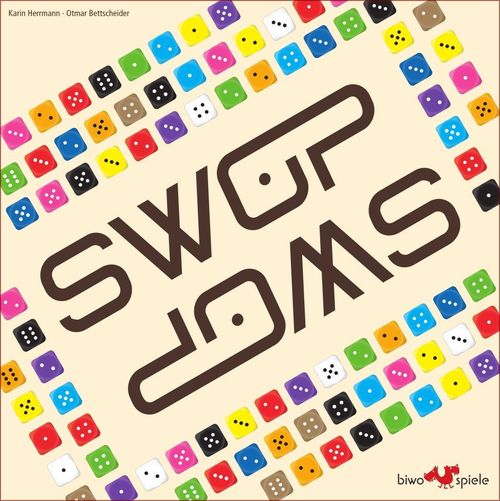
SWOP
SWOP Rulebook
Table of Contents
Table of Contents
Game Material
- 1 game board
- 1 score board
- 4 pawns
- 8 Swop chips
- 66 dice in 11 colours
- 1 starter disc
- 20 colour cubes
Basic Game
Game Preparation
Distribute all 66 dice in a random arrangement on the game board by placing 1 die on each of the small spiral symbols. Make sure that you do not form long clusters of dice that have the same number of dots or the same colour. For instance, three dice placed next to each other should not have the same colour or number of dots. Place your own pawn on the score board.
Each player takes black Swop chips and places them on one of the big spirals on the game board:
- 1–2 players: each player places 3 chips
- 3–4 players: each player places 2 chips
Gameplay
The player who has won a dice game most recently is the start player. This player takes the white start player disc. Of course, you can also cast lots to see who is the start player. During the game, players take turns to move clockwise until the game ends.
When it is your turn, you always try to exchange the positions of exactly two dice in order to form new sequences of dice. For these new sequences you score positive points.
So, when it is your turn, you do 3 actions one after another:
- You exchange the positions of 2 dice on the game board.
- You score the sequences of dice that you have formed by moving the 2 dice.
- You move your pawn on the score board forward as many fields as you have scored positive points.
Exchanging the Positions of 2 Dice
In the Basic Game you may exchange the position of each die with the position of any other die. The colour is not material. The only restriction is: You are not allowed to exchange the positions of 2 dice that show the same number of dots (see "Restrictions" below).
For gaining positive points, you must form at least 1 new sequence of dice in your move.
A sequence is a formation of at least 3 dice and at the most 6 dice that are lying in direct neighbourhood. A sequence can be arranged horizontally as well as vertically. Also, sequences can overlap.
Scoring New Sequences
There are 2 kinds of sequences by which you can score positive points:
- Straights = dice showing a consecutive number of dots
- Sets = dice showing identical numbers of dots
Straights and Sets result in the identical number of positive points you can score. The relevant aspect is the length of the respective sequence:
- 3 dice = 1 positive point (Straight of 3 or Set of 3)
- 4 dice = 2 positive points (Straight of 4 or Set of 4)
- 5 dice = 3 positive points (Straight of 5 or Set of 5)
- 6 dice = 5 positive points (= Swop)
NOTE: The maximum length of a sequence is 6 dice. So, if you form a Set consisting of 7 dice, only 6 dice of this Set are scored. (see example on page 7)
The Swop
A sequence of 6 dice is called a Swop. Swops can be formed in 3 ways: With Straights, with Sets and with 2 Sets of 3. A "Set of 3" consists of 2 sets of each 3 dice that have the same number of dots and that are placed adjacently.
- Swop (Straight or Set) = 5 points
- Swop Triples = 2 Sets of 3 = 5 points
The Swop is the longest and most valuable sequence possible. For a Swop, you receive 5 points. However, when you form a Swop, you must "spend" 1 of your Swop chips.
This is because after realising a Swop, you remove that particular die which you used for forming the Swop from the board and put a black Swop chip in its place. Put the die you removed from the board aside; it is out of the game.
You have only a small number of Swop chips available. They are necessary for forming a Swop. So, it is important to be economical with these chips. When you have no Swop chip left, you cannot form any more Swops. Instead, you must then form other (shorter) sequences.
At the end of the game each Swop chip that a player has not used is worth 1 bonus point.
Scoring Positive Points
For the scoring, the length as well as the number of the sequences you achieve are relevant. And the more sequences you realise in your move the more bonus points you get.
The bonus points are added on the bonus points you receive for your new sequences. After that, you move your pawn forward on the score board as many fields as you have scored positive points and bonus points.
Bonus Points
You receive bonus points when you realise 2 or more new sequences in your move. For 2 sequences you receive 1 bonus point, and for each new sequence more you receive 1 additional bonus point. As both dice you move are scored, up to 7 bonus points for 8 new sequences are possible in a move (although this is hard to achieve).
- 1 bonus point for 2 sequences
- 2 bonus points for 3 sequences
- 3 bonus points for 4 sequences
- 4 bonus points for 5 sequences
- 5 bonus points for 6 sequences
- 6 bonus points for 7 sequences
- 7 bonus points for 8 sequences
Example for a move with the maximum of bonus points: The example shows that by exchanging the positions of 2 dice up to 8 new sequences can be formed (a rare achievement, admittedly). And this is the scoring: Positive points for the die Green3: 3 x sequences with 3 dice + 1 x sequence with 4 dice = 3 x 1 point + 2 points = 5 points. Positive points for Red5: 4 x sequences with 3 dice = 4 x 1 point = 4 points. To be added 7 bonus points for the 8 new sequences. To sum up: 5 + 4 + 7 = 16 points.
Restrictions
Dice that have the same number of dots may not be used in your move.
Two dice that have just been used in the previous move may not be put back into their previous positions in the next move following. However, it is possible to use one of those two dice to exchange the position with a different die.
Example: Anke has exchanged the positions of Green1 and Violet3 in her move. Mic may not exchange the positions of Violet3 and Green1 because that would mean undoing the previous move. Also, he may not exchange the positions of Green1 and Blue1 because these 2 dice show the same number of dots. However, he may, for example, exchange the positions of Violet3 and Blue1.
Black discs that have been placed on the game board after a Swop may not be moved or removed.
End of Game
The Basic Game ends, as does the Master Level, as soon as one pawn reaches the finish field on the score board or when the sixth Swop chip has been placed on the game board.
Finish the playthrough, and then the final scoring is done:
- For each Swop chip that a player has not used, that player receives 1 positive point.
- In the Master Level a player receives 1 positive point for each small colour cube that he still has in his possession.
Move your pawn on the score board forward the corresponding number of fields.
The winner is the player whose pawn after the final scoring is in the most advanced position. When the pawns of 2 or more players have the most advanced positions, these players share the win.
Master Level: The Colours Game
The Master Level is based on the Basic Game. The difference lies in the use of the small colour cubes, which imply restrictions for the exchange of dice positions. This makes you plan your moves even more carefully.
Game Preparation
Like in the Basic Game, each player receives 3 or 2 Swop chips, dependent on the number of players, and one pawn. Lay out the game board, the score board and the white start player chip. Place the 66 dice randomly on the game board.
When this is done, the 20 colour cubes are distributed. First you form 2 sets of these cubes, each set containing 10 cubes in 10 different colours. Then you split one set (2 players) or both sets (3 and 4 players), so that each player receives 5 cubes. When only 2 players are involved, only one set of cubes is needed; put 1 set back into the box.
Placing the dice on the game board: You can choose: Either you distribute the dice on the game board at random, or, if you like it more neatly, you place the dice in a manner that each colour only appears once in a row. Also, you can make sure that all of the 6 white dice show a different number of dots.
Gameplay
Generally, the rules of the Basic Game apply. In your move, you exchange the positions of 2 dice. And you try to form as many and long sequences as possible. However, your options for exchanging the positions of dice are now limited considerably. In the Master Level you must consider the colours of the dice for your move.
The white dice have a special function. They may always be moved by all players. White is a neutral colour. So, when you use at least one white die in your move, you may exchange the position of that white die with the position of any other colour die in your move, without having to "invest" one of your colour cubes.
Exchanging the Positions of 2 Dice (Master Level)
When it is your turn, you exchange the positions of 2 dice, just like in the Basic Game. You must, however, take the colours of the dice into consideration. There are 3 options for your move:
- Exchange the positions of 1 white die and 1 colour die (no matter what colour).
- Exchange the positions of 2 white dice.
- Exchange the positions of 2 colour dice.
NOTE: When choosing option 3), at least one of these dice must have the same colour as one of your colour cubes!
The actions 1) and 2) do not "cost" you anything. However, action 3) implies "costs": After that action you must part from the cube that has the colour of the die that you moved. You put that cube aside, but still visible for all players. When you exchanged the positions of 2 dice that have "your" own colours you can choose which of the corresponding colour cubes you put aside.
- Options 1) and 2) (white die involved, or two white dice): these actions are always possible, they do not cost a colour cube.
- Option 3) (two colour dice): only possible when you possess 1 cube in the particular colour. This action costs 1 colour cube.
As you can see, when using a white die in your move you can exchange the position with any other die, even with a die that has the same colour as one of the cubes that other players have. White dice are neutral as regards colour cubes.
The colour cubes that players "spend" are grouped next to the game board where they form a pool. During the game, there are two chances that players can pick up individual cubes from that pool of cubes.
There are 2 fields on the score board (fields 17 and 31) where you find a symbol. Once a player reaches or surpasses one of these fields this leads to an extra opportunity: That player whose pawn is in the last position at the end of the playthrough may take one colour cube of his choice from the pool and add this cube to his own collection of colour cubes. In case two or more players are in the last position, none of them can take a cube from the pool.
In the example on the left the player with the GREEN pawn has the last position on the score board. So, GREEN can take 1 colour cube from the pool.
Each colour cube a player still possesses at the end of the game is worth 1 positive point (see End of Game above).
Some Examples and Special Cases
Example 1: The longest sequence scorable is a Swop with 6 dice. Orange2 is being placed. Thus, horizontally a Swop is formed (here a Set of 6 dice); vertically a Straight of 3 dice is formed. Although horizontally we have a formation of 7 dice with the same number of dots, only a sequence of 6 dice (= Swop) is scored. Scoring result: 5 points for the Swop + 1 point for the Straight of 3 + 1 bonus point for realising 2 sequences in 1 move = 7 points in total.
Example 2: Swop only when possible! Red6 is being placed, thus a Swop is realised (2 Sets of 3). You can form a Swop only when you have at least one Swop chip left. And a Swop cannot be split up in two sequences. So, it would not be possible to "renounce" a Swop and split up a Swop-sequence into 2 separate sequences. The die Red6 that has just been moved is replaced by 1 Swop chip after the scoring.
IMPORTANT: When you have no Swop chip left over you cannot form a Swop sequence. By moving a die, you can form a maximum of 4 sequences with that die: 1 in each direction (up, down, right and left). In our example the Swop is on the left. Therefore, in this direction no Straight can be scored.
Example 3: This can happen only in a line (horizontally). The positions of Green1 and Violet3 have been exchanged. For scoring, each die is valued individually. With Green1, 2 sequences have been realised: 1 Swop (5 points) and 1 Straight of 3 (1 point). With Violet3 a Set of 4 has been formed (2 points). Added are 2 bonus points for forming 3 sequences.
Example 4: Where do I put the Swop chip? In this example the positions of Pink5 and Blue3 are exchanged. Thus, a Swop (Straight of 6) is formed. As both dice are involved in this Swop sequence you can choose which of these 2 dice you want to replace by a Swop chip on the board. Scoring: 5 positive points for the Swop.
2 in one go: In rare cases it happens that you can form 2 Swops in a move, one with each of the 2 dice moved. In this case, you must invest 2 Swop chips, 1 for each Swop. If before doing this move you have only 1 Swop chip left over or no Swop chip at all you cannot do this move!
Team Game
Swop can also be played in two teams of 2 players each. The team members take opposite places, so that it is alternately the turn of Team A and Team B. Depending on which game variant you play, either the rules of the Basic Game or of the Master Level apply.
Your advantage: team members can consult each other on which move to make. Four eyes can see more than two.
Each player moves his own pawn. At the end of the game the points (= positions on the score board) of the 2 members of each team are added up. The team that has the most points is the winning team.
Solo Game
Your goal is to reach the Finish field with 11 moves. For moving and scoring, the rules of the Master Level apply.
In the Solo Game there is no neutral colour; the white dice are treated in the same manner as the other coloured dice.
Take one set of colour cubes (10 colours); for white take the white starter chip. Take 3 Swop chips. Place the 66 dice in a random arrangement on the game board.
In the Solo Game you may exchange the positions of 2 dice only when you (still) possess a cube with the colour of at least one of these dice. After each move, you submit one cube the colour of which corresponds with one of the dice you just moved. Thus, when the game goes on it becomes more and more difficult to make moves that result in many points.
The game ends immediately either when you place your 3rd Swop chip on the game board or after your 11th move, when you submit your last colour cube.
Hint: You want to play with fewer restrictions? Then take back one of the colour cubes you have submitted before when reaching or surpassing the fields 17 and 31 on the score board. This way, you can do 2 moves more.