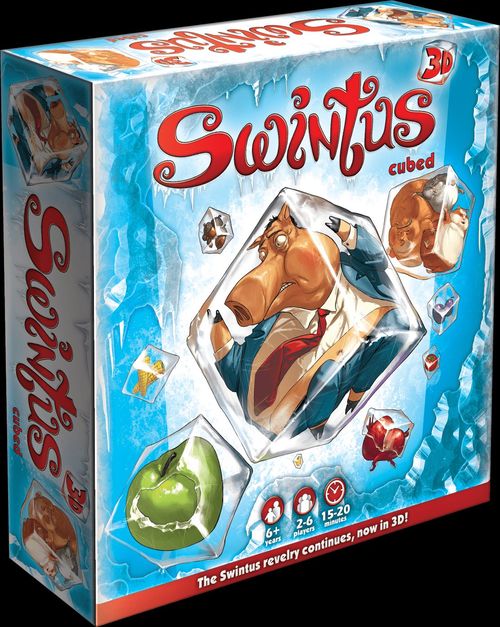
Swintus 3D
Swintus 3D Rulebook
Table of Contents
Table of Contents
Game Contents
- 42 dice (6 colored sets of 7 dice)
- 83 cards with dice combinations and pictures of food
- these rules
Goal of the Game
Each player has 7 dice of their own color. The players roll the dice and use the results to obtain food cards right before their opponents can do the same. The first player who collects 7 pieces of the same food wins the game.
Setting up the Game
Divide the cards into six piles as follows:
- 1 Hungry Hamsters card (dice combination: 3 ones)
- 16 Tasty Cards with one food item (dice combination: 4 twos)
- 16 Tasty Cards with one food item (dice combination: 4 threes)
- 16 Filling Cards with two food items (dice combination: 5 fours)
- 16 Filling Cards with two food items (dice combination: 5 fives)
- 18 Fattening Cards with three food items (various dice combinations)
Shuffle each pile separately. Line up the first five piles of cards face up in the middle of the table in a decreasing order of values (left to right: Filling Cards with fives, Filling Cards with fours, Tasty Cards with threes, Tasty Cards with twos, Hungry Hamsters). Only the top card should be visible in each pile. These five piles form the top row.
The Fattening Cards are put below these piles, forming the bottom row. Place the Fattening Cards pile in the left side of the row face down. Draw three cards from this pile and place them to the right of the pile face up.
Each player takes 7 dice of the color of their choosing. The person who weights the least make the first turn, followed by his or her neighbor to the left and so on, clockwise.
Taking Your Turn
When it is your turn, roll all of the dice you have on hand. At the beginning of the game each of the players has 7 dice of their color on hand. During the course of the game some of the dice might be placed on top of cards. The dice that have been placed on a card do not return to their owners until the card is taken (and also in some other cases — see below). It is possible that at the start of your turn you do not have any dice on hand because they all are on top of cards. In this case you simply skip your turn, waiting for at least one die to come back.
Once you have rolled the dice, place them on top of the cards:
- All dice showing a one must be placed onto the Hungry Hamsters card;
- Dice showing twos, threes, fours or fives can be placed on the corresponding Tasty and Filling Cards of the top row at your discretion;
- Sixes can replace any other values: dice coming up sixes can be placed on any of the cards of the top row at your discretion.
All dice that have not been placed on the cards go back to your hand. Only the dice with ones on them have to be placed obligatory. You can choose whether or not you intend to place any of the other dice on the corresponding cards. When you place a die with a six on a card, you should not rotate the die to match the value on the card. A six remains a six even if it is being used to replace another value. You can even place a six on the Hungry Hamsters pile (as if it were a one), but you are not obliged to do so.
Having placed the dice on the cards, you check whether you can take any of them. You can take only one card per turn.
First of all you should check whether you have met the conditions described on one of the three face-up Fattening Cards of the bottom row. If the condition is met, you can take the card. In this case take all your 7 dice back to your hand, regardless of where they have been. Then draw a new card from the Fattening Cards pile and place it face up instead of the one you took. You are not obligated to take a Fattening Card even if you have met the conditions.
If you don't take a Fattening Card, proceed to check whether you can take any of the cards from the top row:
- You take a Tasty Card (with one food item) when there are 4 or more of your dice on it, and all dice on the card are returned to their owners.
- You take a Filling Card (with two food items) when there are 5 or more of your dice on it, and all dice on the card are returned to their owners.
When you take a Tasty or Filling Card, the next card in the pile is revealed. It doesn't have any dice on it for the time being, but the next player will be able to place some on it if they roll any with appropriate values.
Place the cards that you take on the table in front of you face up. This is yout Storage. All players must be able to see what cards you have in your Storage.
Finally, if you have taken no cards during your turn (no Fattening cards, no Tasty Cards and no Filling Cards), and there are 3 or more of your dice on the Hungry Hamsters card, do the following:
- Choose one card from your Storage and place it underneath the Hungry Hamsters card (this card no longer belongs to any player and cannot be taken)
- All dice that were on the Hungry Hamsters pile are returned to their owners.
If there are no cards in your Storage, you don't lose anything, but all dice on the Hungry Hamsters card still go back to their owners.
After this your turn is over.
Example of a Turn
Illustrated with two board diagrams (1 and 2) showing Piglet's Storage, the top row and the bottom row of the Fattening, Tasty and Filling Cards. The diagrams are not reproduced here; the text of the example follows.
At the begining of the game Piglet has 5 Ears of Corn, 3 Beets and 2 Acorns. Two of his dice (ones) are on the Hungry Hamsters pile, two more (threes) on the Tasty Card with 1 Ear of Corn. Piglet rolls the remaining three dice and gets a one, a three and a six.
One of the Fattening Cards is a Swinbag with 1 Beet, 1 Acorn and 1 Apple. To take this card, a player has to roll exactly 10 points. This is exactly what Piglet has rolled (1 + 3 + 6 = 10), but he does not want to take the Swinbag card, because Corn is his favorite food.
Piglet proceeds to place the dice as follows: the one goes to the Hamsters, while the three and the six are placed on the card with the Ear of Corn. Now the latter card has 4 Piglet's dice on it. The Piglet takes the card along with the 4 dice that were on it. The other dice from the card go back to their owners. Now Piglet is just one step away from victory. All he needs is another Ear of Corn!
Even though 3 Piglet's dice are on the Hungry Hamsters card, he does not lose any supplies from his Storage, because he's just grabbed a Tasty Card. Piglet hopes that one of his opponents will fall prey to the Hamsters, and all dice from this card will go back to the players. But even in the worst case the Hamsters are not a problem for Piglet because he can sacrifice a Beet or Acorn card without losing any precious Corn.
Note that if Piglet have chosen to take the Swinbag card, he would get back all his dice including the ones on the Hamsters card.
End of the Game
The game ends when one of the players manages to store 7 pieces of the same kind of food: Ears of Corn, Beets, Apples, or Acorns. This player wins the game and receives the title of the Thriftiest Swintus.
And may the calories be with you!
Fattening Cards (Consumer's Manual)
Card reference printed on the sheet. Its text is present in the PDF's text layer but is not visible in the rendered layout; transcribed from the text layer.
Swinbag
You can take this card if the sum of points on all of the dice you have just rolled equals that indicated on the card (5, 10, or 15). Only the dice that were rolled during this turn count towards the total. The dice already on cards do not count. If you have chosen to take this card, it no longer matters how you distribute your dice this turn, since they are all returned to you immediately.
Multitrough
You can take this card if after you have rolled the dice and distributed them, your dice on cards of the top row (including the Hungry Hamsters) form one of the following patterns:
- 1 die each on four different cards;
- 2 dice each on three different cards;
- 3 dice each on two different cards.
Lucky Three
You can take this card if you managed to roll the same number on three different dice. Only the dice that were rolled during this turn count. The dice already on cards do not count. If you have chosen to take this card, it no longer matters how you distribute your dice this turn, since they are all returned to you immediately.
Lonesome Squeak
You can take this card if you had only one die to roll this turn. If you have chosen to take this card, it no longer matters what's on the die, since all you dice are returned to you immediately. (Printed as "all you dice" in the source.)
Sweet Sixes
You can take this card if after rolling the dice and distributing them, you have exactly four sixes laying on the cards of the top row (including the Hungry Hamsters).