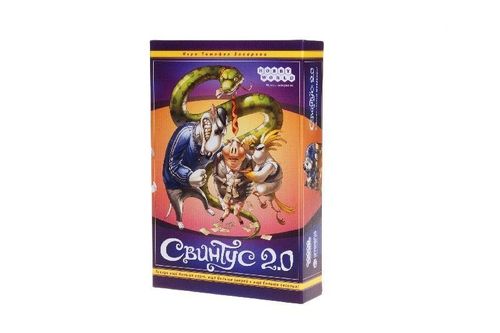
Swintus 2.0
Swintus 2.0 Rulebook
Table of Contents
Table of Contents
Game Components
Swintus 2.0 is more than one game: it is a game constructor. In the box you will find cards of several types, from which you can assemble decks for any number of players and any settings. Tips on building the various game decks are given at the end of the rules. The basis of this constructor is the classic "Svintus", popular with tens of thousands of players across Russia. If you wish, you can limit your deck to the traditional cards and play the new "Svintus" as the usual game, but it is much more interesting to experiment with combining familiar and new game possibilities.
- 64 number cards
- 56 Prescription cards, "Swine Bureaucracy": special cards from the classic "Svintus", plus the new "Temnodel" and "Svinorost"
- 18 Etiquette cards, "Snake Primness": allow you to deal cards to players who have performed certain actions
- 16 Courage cards, "Parrot Show Business": force opponents to entertain those around them to the best of their abilities
- 22 Challenge cards, "Dog's Pugnacity": a wonderful tool for scaring and subduing rivals
Goal of the Game
The winner of a game is the player who first gets rid of all their cards. For that game they receive a number of points equal to the total number of cards left in the hands of all opponents. Play continues until one of the players has 30 or more points in total across all the games played. That player becomes the absolute winner of the game.
| Number of participants | 2 | 3–4 | 5–7 | 8+ |
|---|---|---|---|---|
| Play to how many points | 30 | 40 | 50 | 60 |
Setup
At the start of the game, shuffle the deck and deal each player 8 cards. Place the deck in the middle of the table face down. The dealer turns over the top card of the deck and places it face up beside the deck, starting the play pile. Then the player to the dealer's left makes the first move. Players take turns until one of them gets rid of all their cards.
Game Turn
Slip It to a Comrade
On their turn, a player must play one card from their hand onto the play pile. The card must match the top card of the play pile either by colour or by rank. For example, if the top card of the play pile is a green seven, you may play either any green card, or a seven of any colour. If a player has no matching card (or does not want to make a move), they take the top card of the deck into their hand, and if it fits, they may play it immediately. Then the turn passes clockwise to the next player.
Svintus!
Immediately before playing or passing to another player their second-to-last card, a player must glare contemptuously at the opponents and say "Svintus!". If they do not do this, any opponent may "catch" them while they hold one card in hand and make them take three cards from the deck. This can only be done until the next player has made their own move.
Interception
Many cards in the deck are represented by at least two copies (two blue fives, two red "Khlopkopyt" cards, and so on). If someone has just played a card and you hold another copy of it, you may seize the initiative and play that card out of turn, without waiting for your turn. The next player to move will then be your neighbour in the current direction of play.
Transfer
If the player who moved before you played "Zakhrapin" or "Khapyozh", you may play the same card (not necessarily of the same colour). Then the player following you will, in the first case, skip their turn, and in the second case will draw 6 cards. That player also has the right to "transfer" the effect further, bringing still greater trouble on the player after them.
Don't Dawdle!
"Svintus" is especially interesting when the game moves quickly. If a player drags out their turn, they skip the turn and draw two cards from the deck. You may regulate the pace yourselves, but we recommend limiting thinking time to a specific period — from 2 to 5 seconds. The same penalty of two cards and a skipped turn applies if a player moves incorrectly — if they carry out the general rules of the game or the instructions of a specific card incorrectly. Of course, in that case they must correct their mistake, for example by taking back into hand a card that was played incorrectly.
If the deck runs out, shuffle the play pile (except for the top card) and use it as the deck.
As soon as a player, observing the rules, plays their last card from hand, the game ends. This happens even if the card (for example, "Razborka", a showdown) requires them to carry out some further action.
Number Cards
The game set contains 64 number cards: four colours, with values from 0 to 7, two copies of each — which makes interception possible. Number cards are the basis of every deck; however, the "seasoning" that creates one game atmosphere or another is the special cards.
Special Cards
A detailed description of all special cards is given at the end of the rules.
Prescription Cards: Swine Bureaucracy
Most Prescription cards exist in four colours — two of each colour ("Temnodel" has only one copy). All of these cards can be played onto any card of the same colour, or onto another such card of any colour. The exception is the grey "Polisvin" and "Svinorost", which can be played onto any card. Immediately after a player plays a Prescription card, its unique game effect takes place.
Etiquette Cards: Snake Primness
Etiquette cards are grey, with values from 0 to 7. They can be played in two ways. The first is like an ordinary number card: on your turn, play it onto a card of any colour and the same value, then name a colour. The next player must play a card either of the named colour or of the same value as your Etiquette card.
The second and main way to use an Etiquette card is to play it out of turn at the moment when one of your opponents performs some action. In that case you pass the Etiquette card to that opponent together with two other cards from your hand; the victim takes all of these cards into hand. Then play continues in the usual order.
After you reward one of the opponents with an Etiquette card and two penalty cards, you may be left with no cards in hand — in that case you have won. If this seems unfair to you, you may agree before the game that after an Etiquette card is applied, the player must keep at least two cards in hand (to achieve this, if necessary, give fewer penalty cards).
Courage Cards: Parrot Show Business
Courage cards are grey, with values from 0 to 7. As with Etiquette cards, they can be played in two ways. The first is like an ordinary number card: on your turn, play it onto a card of any colour and the same value, then name a colour. The next player must play a card either of the named colour or of the same value as your Courage card.
The second and main way to use a Courage card is to play it out of turn at the moment when one of your opponents has played a number card of the same value (before the next card is played). In that case you give the Courage card to that opponent; they place it face up in front of themselves and from then on must carry out the task it describes. Then play continues in the usual order — the move is made by the neighbour of the player who received the Courage card.
Courage cards lying in front of a player are considered to be in that player's hand: they can be played from the table exactly as from the hand, and to win, a player must get rid of these cards too.
There may be no more than two Courage cards in front of each player, and all of them must be different. When a player receives a third Courage card, or a Courage card they already have, they discard to the box one of the two Courage cards lying in front of them, of their choice.
The description of each Courage card says what task the player who receives it must perform. They perform it until they get rid of the Courage card, or until the end of the game. For each mistake in carrying out the task, as well as for repeats in cases where they are forbidden, the player immediately draws two cards from the deck into hand.
Challenge Cards: Dog's Pugnacity
Each Challenge card is of one of four colours (raspberry, orange, green or blue). On your turn you may play a Challenge card if it matches the colour of the top card of the play pile. However, this card does not go onto the play pile: you immediately discard it to the box and carry out the actions prescribed by it. Then the game continues by the usual rules, starting with the player after you. A played Challenge card returns to play only in the next game.
How to Build Your Deck
Only the most seasoned and hardened Svintuses can play all the cards from the set at once without losing their minds. The rest of us recommend exercising discernment and building a deck using our "recipes". Simply decide what mood suits your company this evening, choose the special cards you need, add them to the number cards, shuffle thoroughly — and consume while still warm. Of course, you can always engage your imagination and experiment with the card sets on your own.
Simple
For beginners and conservatives
- 2 players: all number cards; Prescription cards "Khapyozh", "Zakhrapin" and "Polisvin"
- 3+ players: all number cards; all Prescription cards except "Temnodel" and "Svinorost"
Paranoid
For developing maniacal suspicion
- 2 players: all number cards; all Prescription cards except "Tikhokhryun", "Perekhryuk" and "Khlopkopyt"; all Etiquette cards except "Shmotrun"
- 3+ players: all number cards; all Prescription cards except "Perekhryuk", "Temnodel" and "Zakhrapin"; all Etiquette cards; Courage cards "Parodist", "Suflyor" and "Reyting"
Artistic
For those who do not want to bury their friends' talent in the ground
- 2 players: all number cards; all Prescription cards except "Tikhokhryun", "Perekhryuk" and "Khlopkopyt"
- 3+ players: all number cards; all Prescription cards except "Tikhokhryun" and "Perekhryuk"; all Courage cards
With Challenge
For those who want to let off steam without swinging their fists
- 3–4 players: all number cards; all Prescription cards except "Tikhokhryun", "Perekhryuk" and "Zakhrapin"; Etiquette cards "Shmotrun" and "Shurikén"; Courage cards "Pokloonnik" (threats instead of compliments) and "Zapevala" (chanson only); all Challenge cards except "Ni Sebe, Ni Lyudyam"
- 5+ players: all number cards; all Prescription cards except "Tikhokhryun", "Perekhryuk" and "Zakhrapin"; Etiquette cards "Shmotrun" and "Shurikén"; Courage cards "Pokloonnik" (threats instead of compliments) and "Zapevala" (chanson only); all Challenge cards
When composing a deck, also take into account where and with whom you plan to play:
- do not use the card "Odin za Vsekh" (One for All) in company with children or with ladies with elaborate manicures — it is the most injury-prone;
- we invented the card "Kto Uspel, Togo i Tapki" (Whoever Is Quick Gets the Slippers) specially so that cards tear faster (try it — you will understand why), and so that you buy new game sets from us. If you are too thrifty, destroy this card yourself so that it does not tempt you to put it into the deck;
- if you play sitting on the floor, either do not use the cards "Shtul!" and "Shtol!", or agree in advance how they are to be applied;
- and so on...
Deadly Combinations
Pleasant surprises for players will come from card combinations with a dramatic effect:
- it is obvious that "Tikhokhryun" is the enemy of practically all Courage cards;
- "Ovatsii" (Ovations), followed by "Shtul" — an excellent means of irritating an opponent.
In the course of the game you will meet other devious combinations. You may either forbid such card combinations in your company, or, on the contrary, actively use them.
Game Pace
A number of cards — for example, "Slabo?" (Weak?), "Otkuda Rastut Ruki" (Where Do the Hands Grow From?) and so on — slow the game down. Decide for yourselves whether you want to make the game more dynamic or more varied.
Familiarise the players in advance with all the cards in use, otherwise it would be not entirely fair to demand from them observance of the most important rule of "Svintus" — "Don't Dawdle!". Even more "joy" will be brought to a company of newcomers by the cards "Shevelis!" (Get Moving!) and "Shalun!" (Naughty One!). And although "Svintus" has not yet become an Olympic sport, the approach "from simple to complex" works here too. Train the team on the classic variant, and only then move on to the new cards and daring combinations.
Good games — and do not forget the main commandment of "Svintus":
Slip the Pig to a Comrade!
Special Cards (Full Descriptions)
Prescription Cards
Khapyozh — the next player takes 3 cards from the deck into hand and skips their turn.
Perekhryuk — reverses the direction of play: the turn now passes counterclockwise (or clockwise, if it is the second, fourth, and so on "Perekhryuk" card played in the game).
Zakhrapin — the next player skips their turn.
Polisvin — may be played onto any card; the player names the colour the next player must play. "Polisvin" may be played even if you have other matching cards in hand. You may choose any of the four colours, including the colour of the card it was played onto.
Tikhokhryun — until the player who played this card plays a card on their next turn, all players must keep complete silence. A violator of the silence lifts the ban earlier than prescribed, but takes 2 cards from the deck into hand.
Khlopkopyt — immediately after this card is played, all players must place a palm on the deck. Whoever's hand ends up on top (last) takes 2 cards from the deck into hand.
Svinorost — the player who plays this card shouts "Svinorost!" and immediately places onto it a number card of any colour with a value of no more than 2. The next player must play onto it a number card of any colour with the same value or one higher. If someone cannot or does not want to continue, they take from the deck a number of cards equal to the value of the last card played, and skip their turn. Then play continues by the usual rules.
While Svinorost is in effect, special cards, including those with numbers, may not be played at all. "Svinorost" can be played onto any card, but only if the player has a number card of value 0, 1 or 2. During Svinorost one may make an interception (which does not end the effect of "Svinorost"), and also get rid of the last card in hand.
Temnodel — place one more card face down onto "Temnodel" and name its colour and value (you are not obliged to tell the truth, but the named card must be a number card and must match the card it is placed on). The next player either does the same, or reveals the card played by the previous player. If the revealed card matches the declared one, the checking player takes into hand all the cards played in the dark. If it does not match, those cards are taken by the player who played the checked card. After the check, regardless of its outcome, play continues by the usual rules. The next move is made either by the checking player (if they caught the previous player and made them take cards), or by the player after them (if the checking player was forced to take the cards themselves).
Players continue to play cards face down until one of them decides to check the last card played. If during Temnodel a player has got rid of their last card, the rivals, starting with the player after them and continuing round the circle, have the right to check the last card played. If in the check it turns out that the pseudo-winner has lied, they take the cards, and play continues by the usual rules, starting with the checker. If not, the winner receives an additional winning point for each card played in the dark. Interception during Temnodel is not allowed.
Etiquette Cards
0 Shtul! — goes to the player who has got up from a chair (from the floor, a windowsill, a desk or any other place where the players are seated).
1 Shalun! — goes to the player who has broken any rule of the game.
2 Shevelis! — goes to the player who thinks about their move for longer than five seconds.
Before rewarding a rival for slow thinking, check whether they are busy with a pen or another form of creativity. If they are simply puzzling over their cards, give them a chance — start counting: "One, two, three…". Having reached five, pass them "Shevelis!" and the penalty cards. And remember: to count, you do not have to hold the "Shevelis!" card in hand — bluff is always in fashion!
3 Shtol! — goes to the player who has put a hand on the table (the floor, a windowsill or any other surface where you are playing).
4 Shinkognito — goes to the player who addressed you by name or nickname.
5 Shmotrun — goes to a player you winked at, if nobody else noticed it. To be sure, wink twice. The addressee of your wink has no right to pretend they did not notice. If anyone else caught you winking, you give no cards to the victim; on the contrary, you receive two penalty cards from the player who noticed your gesture.
6 Shmunitet — goes to a player who played an Etiquette, Courage or Challenge card against you. Their card has no effect: it returns to the hand of its owner, together with "Shmunitet" and penalty cards from your hand. The next move is yours.
7 Shto? — goes to the player who answered any question of yours.
7 Shurikén — goes to the player who made an interception (including on their own card). However, you must hit the target: throw the "Shurikén" card at the player. If you hit, give them this card and the penalty cards from your hand. If you miss, take "Shurikén" for yourself and receive two penalty cards into hand from this player.
When throwing the card, remember what people say: "An eye for an eye, a tooth for a tooth." Do not aim for the eye, unless you want to receive the same there — but with greater force, and clearly not with a card.
Courage Cards
0 Parodist — each time anyone plays a special card, the player must pronounce the corresponding word: "Oink" for Swine Bureaucracy, "Sh-sh-sh" for Snake Primness, "Piastres" for Parrot Show Business, "Woof" for Dog's Pugnacity.
1 Zapevala — the player who played this card chooses a song genre for the victim. Each turn the player must loudly, and trying to carry the tune, sing two lines from a song of the chosen genre (without repeating).
The genre may only be a popular one: children's song, chanson, a song about love, a song in English, patriotic, folk. A repeat counts even if other lines are used, as long as they come from a song already sung. Repetition is forbidden not only in the current game, but throughout the whole game evening.
2 Folklorist — each of the player's turns they must read aloud, with expression, a proverb, a saying or a tongue-twister (without repeating). Repetition is forbidden not only in the current game, but throughout the whole game evening.
3 Pokloonnik (Admirer) — each turn, when laying a card, the player must bow to the rival from whom they received "Pokloonnik", and pay them a compliment (without repeating). Repetition is forbidden not only in the current game, but throughout the whole game evening.
4 Suflyor (Prompter) — the player must speak only in a whisper, and must repeat everything the opponent from whom they received "Suflyor" says.
5 Ovatsii (Ovations) — the player must play standing and clap each time anyone plays a special card.
6 Antrakt (Intermission) — this card by itself imposes no obligations. However, the player who played "Antrakt" passes to their victim, together with it, any Courage card lying on the table, of their own choice.
7 Reyting (Rating) — the player must announce the sum of the numbers on the number cards played (a running total) from the moment they received "Reyting".
If Etiquette and Courage cards are played as number cards, their values must also be counted. Otherwise the value of such cards is considered equal to zero — like all other special cards. If the player loses count, they take the two penalty cards due and start counting again.
Challenge Cards
Razborka (raspberry) — challenge any player to a duel. Play any number card from your hand; the opponent must place their matching number card on it, then you, and so on. The duel takes place in a separate pile; it is forbidden to draw cards from the deck and to play special cards during it. As soon as one of you cannot or does not want to lay the next card, they take the whole resulting pile into hand.
Russian Roulette (raspberry) — turn over the top card of the deck and place it in a separate pile face up, remembering its colour. Then all the other players in turn turn over one card from the top of the deck and place it on this pile, until a card of the same colour as the first one is turned over. The player who did this takes the whole resulting pile into hand.
Grey counts as a separate colour in this case.
One for All (green) — immediately after playing this card, place a fist in the middle of the table with the thumb pointing up. Everyone must join you, grabbing the raised fingers with their fists (the result should be a "tower" of fists). Each player must put out both fists, but may not grab their own finger. The player whose fist ends up at the very top is given one card from hand by each of the other players.
Whoever Is Quick Gets the Slippers (blue) — all the other players lay one card from hand in front of themselves, face up. Then, on your command "Fas!" (Attack!), each player (including you) grabs a card lying in front of one of the opponents. The player who got no card is given one card from hand by each of the other players.
Slabo? (Weak?) (orange) — do something outstanding (do 50 squats, juggle apples, touch your nose with your tongue, and so on). If none of the rivals can repeat what you did, throw three cards from your hand into the box. If someone does the same, they give you three cards from their hand.
It is forbidden to harm other players or other people's property, and also to repeat in the course of not only one game but the whole game evening. We recommend agreeing in advance to ban unseemly challenges such as "dare you to remember my grandmother's phone number?"
Neither to Yourself Nor to People (orange) — take two cards from the top of the deck into hand and choose an opponent. Everyone except you gives the chosen opponent one card from hand.
Where Do the Hands Grow From? (orange) — all players, including you, build two "shalashiks" (little huts) from their cards, two cards each. If someone has fewer than four cards in hand, they draw the missing ones from the deck and then keep them. To the player who builds the shalashiks last, all the other players give one card from hand each.
It is forbidden to interfere with rivals, blow on them or shake the table.
We Should Chip In (orange) — name one of the four game colours. All players in turn, starting with you, lay one number card of the named colour from hand onto the play pile. If someone cannot do this, all the other players give them one card from hand each. After that (or after each player has laid a card of the required colour), play continues by the usual rules.
Judged by Their Clothes (raspberry) — loudly and clearly name an item of clothing worn by one of the players. Each player, including you, must touch that item of clothing. You must not be the first. To the player who touches it last, all the other players give one card from hand each.
After touching the clothing, keep the contact, so that it is easier to determine who was last.
Don't Darken (blue) — name one of the four game colours, choose an opponent and pull one card out of their hand. If you pulled a card of the named colour or a grey card, take it into your hand, and all the other players give you one card each. If you pulled a card of any other colour, it stays in the hand of the chosen opponent, and all players, including you, give them one more card from hand each.
Awl for Soap (grey) — you may play this card only immediately after making an interception. Exchange all the cards in your hand with the player whose turn you have just intercepted.
Game Layout
The printed layout diagram, "Svintus 2.0 — secret game scheme", labels the play area as follows:
- Deck (Колода): where cards are drawn from.
- Discard (Сброс): challenge cards and other cards that have been removed from the game.
- Temporary pile (Временная стопка): for "Russian Roulette", "Razborka" and similar cards.
- Play pile (Игровая стопка): if the deck runs out, the pile is shuffled and becomes the deck again.
- Courage cards (Карты куража): laid out in front of a player (no more than two).
- Player's hand (Рука игрока): to win, a player must get rid of all their cards.