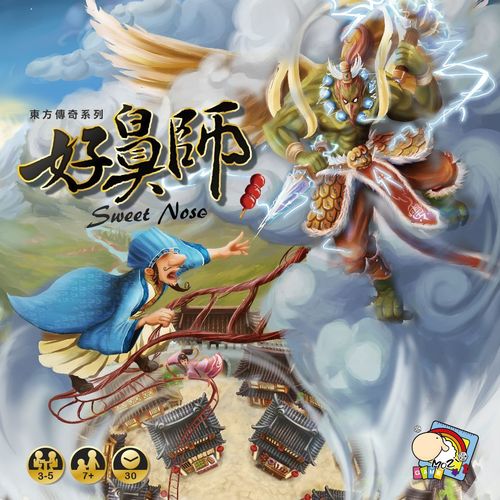
Sweet Nose
Sweet Nose Rulebook
Table of Contents
Table of Contents
Components
Assemble the stand up and the thunder god.
- 45 Sweet tokens
- 5 Round markers
- 1 Game board
- 5 Player boards
- 25 Sweetness markers
- 10 Store tiles
- 5 Plate tiles
- 5 Bowl tiles
- 5 Player markers
- 1 Thunder god
- 1 Plastic stand up
- 1 Sweets bag
Components Overview: A Store Area, B Market Area, C Scoring Ladder, D Player Area.
Preparation
- Place the game board in the middle of the table.
- Give each player a set of sweetness markers (same shape), a player board, a round marker, a plate tile and a bowl tile.
- Place all player markers on the bottom of the scoring ladder.
- Place the store tiles face up on the store area according to the sweet points of the different store tiles.
- According to the number of players, set up the sweet tokens:
- 3 players: remove 4 sweet tokens of each kind. Put the rest of the sweet tokens into the bag. Each player draws out 8 sweet tokens and places them on their plate. Take out the last sweet token and place it on the market. Draw 2 sweet tokens from those removed, and place them on the market.
- 4 players: remove 2 sweet tokens of each kind. Put the rest of the sweet tokens into the bag. Each player draws out 8 sweet tokens and places them on their plate. Place the rest of the sweet tokens from the bag on the market.
- 5 players: remove 1 sweet token of each kind. Put the rest of the sweet tokens into the bag. Each player draws out 8 sweet tokens and places them on their plate. Draw 2 sweet tokens from those removed, and place them on the market.
- Note: there are always 3 sweet tokens in the market.
- The player who ate a sweet most recently will be the start player. The start player takes the thunder god and puts it in front himself as start player marker.
Overview
- Each game lasts 3 rounds. Each round has 3 phases: Set up, Exchange and Use Store, Count Sweet Points. After counting sweet points, all players will reset the game, and start a new round.
- At the end of the counting sweet points phase of the 3rd round, the game ends immediately.
Round sequence: Set up → Exchange Sweets → Use Store → Count Sweetness.
Phase 1: Set up
- According to the sweet tokens on the plate, secretly set up the sweetness markers.
- If you think you will end up with many sweets of one kind, make sure you assign it a low sweetness, and vice versa. Otherwise, you're actively trying to lose.
- Keep the side with numbers facing towards you so other players cannot see them.
Phase 2: Exchange Sweets and Use Store
This phase will be played in clockwise order. Starting with the start player, players take turns choosing an action. A player can exchange sweets then use the store, or use the store and then exchange sweets. When a player runs out of sweets on his plate, the phase ends immediately.
Exchange Sweets
A player can do 1 of the following actions:
A. Exchange 1 sweet with an opponent: Take a sweet token from the opponent's plate, and place it on your bowl. Take a sweet token from your plate tile, and place it on the opponent's bowl.
B. Exchange 1 sweet with the market: Take a sweet token from your plate, and place it on the market. Take a sweet token from the market, and place it on your plate.
Note: You cannot exchange the same type of sweet.
Use Store
- In the 1st round, players will not have a store, they are gained during reset.
- After using the store, place the store back to the corresponding space.
Phase 3: Count Sweetness
- All players reveal their sweetness markers without changing the order.
- For each sweet, count the number of tokens you have, multiply this number with its sweetness marker. Add them all together, these are your sweet points (SPs). Important: If your sweet tokens match the sweet tokens in the market, add them to your sweetness marker before multiplying. See the example.
- All players move their round markers to record the SPs of the current round.
- All players move their player markers to record the total SPs they have. Important: After counting the SPs, move the round marker to remember your SPs of the current round. (In the case below, move the round marker to the space of 34.)
Example
The example shows one player's sweets (red, 3 green, brown, 2 pink, yellow), their sweetness markers, and the market (1 red, 2 green). Sweetness markers are 3 for red, 5 for green, 1 for brown, 2 for pink and 4 for yellow.
| Red | Green | Brown | Pink | Yellow | |
|---|---|---|---|---|---|
| Sweets (player area) | 1 | 3 | 1 | 2 | 1 |
| Sweetness marker | 3 | 5 | 1 | 2 | 4 |
| Market | 1 | 2 | 0 | 0 | 0 |
| Subtotal | 1 × (3+1) | 3 × (5+2) | 1 × 1 | 2 × 2 | 1 × 4 |
SUM: 4 + 21 + 1 + 4 + 4 = 34 SPs
Reset
- All players put the sweets they have back on their plate.
- Return any store that is still in a player's hand to the corresponding spaces.
- Starting with the player with the highest total SPs and in decending order, each player chooses a store tile depending on the amount of SPs they have in the current round:
- 31+: 1 from all store tiles.
- 26+: 1 from the store tiles except for '31+' tiles.
- 22+: 1 from the store tiles except for '26+' and '31+' tiles.
- 19+: 1 from the store tiles except for '22+', '26+' and '31+' tiles.
- 17+: 1 from the '17+' tiles.
- The player with less than 17 SPs will not have a store tile for the next round.
- If there are no proper tiles available, players will not have a store tile for the next round.
- If there is a tie, the player whose turn is earlier in the next round can choose a store tile first.
- The player with the highest total SPs takes the thunder god and will be the next round's start player.
End of the Game
At the end of the 3 rounds, the player with the least SPs wins the game. If there is a tie, both tied players share the victory.
Variation I: To the Sky
Keep playing the game until one of the players reaches 100 SPs.
Variation II: Shopkeeper
If you are familiar with the basic rules, you can adapt this rule before starting the game:
Bid for the store tile
- Begin with the start player, in clockwise order, a player may either move the player marker forward or pass.
- When moving the marker, a player is not allowed to move the marker to the same space as another player marker.
- When every player has passed, the auction ends. The player with the highest bid can choose 1 from all store tiles. The player with the second highest bid can choose 1 of the store tiles except '31+' tiles, and so on.
- If a player decides to place no bid at all, they will not have a store tile for the 1st round.
Store Tiles
Each store tile has a front (showing its Level and Store Type) and a back (showing its Function, Role and Requirement). The store tile icons are described below in words.
Front (Store Type):
- Place a sweet from your plate to your bowl.
- Place a sweet from your bowl to your plate.
- Choose an opponent, place a sweet from his bowl to his plate.
- Exchange a sweet between your bowl and plate.
- When counting SPs, ignore the sweets in the market.
- Exchange a sweet with an opponent. The sweets should be the same color.
- Exchange a sweet with the market. You can put the sweet to your bowl.
- Exchange a sweet between your bowl and an opponent's bowl.
- Exchange 2 sweets between your plate and an opponent's plate.
- In phase 2, you can switch 2 of your sweetness markers.
Note: The printed rulebook shows these store-tile effects as pictograms only. The lines above are the printed captions for each icon, listed left column top to bottom, then right column top to bottom.