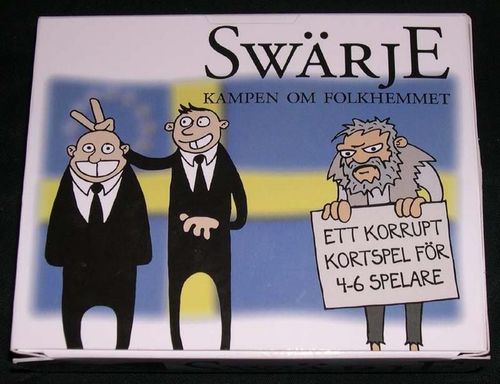
Swärje
Swärje Rulebook
Table of Contents
Table of Contents
Components
Swärje contains:
- 64 Money cards ("Pengar").
- 7 Minister cards, 1 New Election card and 1 Bank card.
- 101 Swärje cards.
- This rulebook.
Card labels are rendered in English. The Swedish labels on the printed cards are "VÄLJARE" (Voter), "VALFLÄSK" (Pork-Barrel), "Avgångskort" (Resignation card) and "Nyval" (New Election).
Object of the Game
Swärje is a game for 4 to 6 players, in which the players take on the roles of those who (really) govern Swärje. The winner is the player who, when the game ends, has smuggled the most money out of the country (and into his Swiss bank account).
Swärje is about pilfering as much money as possible and then smuggling it out of the country. To get hold of money, you must control the national budget. And to control the budget, you must control as large a part of the government as possible.
Unfortunately, all the players are after the same thing…
How to Start
It is entirely possible to play your first game of Swärje as soon as you have opened the box. One of the players reads through the rulebook chapter by chapter, and the players gradually do what has just been described.
Before the Game Begins
- Place the Bank card (the card with a bank on both sides) in the middle of the table with the "Bank Closed" side facing up.
- Place the New Election card (the card with the "newspaper" on both sides) next to the Bank card, with the heading "New Election" facing down.
- Shuffle the money (the paper slips with lots of zeros on them). Make sure the "denomination sides" all face the same way. Place the money pile on the table with the denominations facing down.
- Sort out the seven Ministers (the cards with minister portraits on both sides) from the deck and set them aside for now.
- Shuffle the Swärje cards (all the other cards) and deal each player five cards. Players should not show these cards to each other. If a player does not receive a single card marked VOTER, he or she must discard their cards (put them at the bottom of the deck) and draw five new ones. Place the cards left over in the middle of the table with the SWÄRJE side facing up.
The Ministers
The Minister cards depict the men and women who govern Swärje. (So that players get a little variety, each card has two different portraits to choose from.) The player who currently controls a Minister places that card in front of himself.
Each minister has one vote when the budget is voted on, and some also have special duties and abilities:
- Prime Minister – appoints the other ministers and begins each turn of play.
- Finance Minister – draws up the budget and may open and close the bank.
- Minister of Justice – may save ministers from being forced to resign (but cannot save himself).
The Foreign Minister, the Defence Minister, the Social Minister and the EU Minister have no special duties in the game apart from voting on the budget.
Forming the Government
Before the game begins, the players must elect a Prime Minister, who must form a government. (For those who wonder, it is good to be Prime Minister, because then you sit closest to the meat pot.)
Follow these instructions step by step:
- Starting with the owner of the game, the players take turns placing one of their cards marked "VOTER" in front of themselves. If a player has several different cards to choose from, it is a good idea to play the card that gives the most votes.
- The players compare the cards on the table and see which player or players have the most votes. Each Voter card has a number on it showing how many votes that card gives. The player or players with the most votes are best placed for the coming election for Prime Minister.
Tension rises.
- Those players who can then (again starting with the owner of the game) place one more Voter card. But this time, one edge of the new card must have the same colour as one of the edges of a card the player already has on the table. For example, if you have played "The Staunch Conservatives", which has only light and dark blue edges, you cannot play "We Who Built the Country", since that card has only light red edges. It is fine, however, to play "The Police", since it has a dark blue edge.
Voter cards must always be "linked together" when they are played, edge to edge. A card with, for example, only a green edge can only be placed edge to edge with another green-edged card. During this puzzling, the cards may be turned in any direction.
-
The player who now has the most votes on the cards in front of him wins the Prime Minister election. To the cheers of the other players, the player takes the Prime Minister card, places it in front of himself and thanks the people for their trust. If two or more players have the same number of votes, they must decide between them in some way (a duel, or a coin toss if nothing else helps) who will shoulder the burden of being Prime Minister.
-
The player elected Prime Minister now forms the government. He distributes the remaining six Ministers to the other players as he sees fit, but must follow these three rules:
- The player who holds the Prime Minister may not hold any other ministers.
- No player may ever hold more than three ministers, or no minister at all.
- The Finance Minister and the Minister of Justice may not be assigned to the same player.
(There is no perfect way to distribute ministers, but as Prime Minister you should make sure the Finance Minister is controlled by some servile type without too many opinions of his own.)
When this is done, a new government is a fact, and there is reason for a few short speeches and a toast to a brilliant future.
The game can begin…
A Year in Swärje
Now it is time to start playing. Each turn of play corresponds to one year in Swärje and proceeds as follows:
- The players each draw two new Swärje cards and then discard cards so that each player has only five cards left in hand. Before discarding, the players may also trade cards with each other (or sell them).
- The Prime Minister draws seven money from the money pile and hands as much of this money as he wants to the Finance Minister. (He does not need to hand over a single piece of money, but then there will be no budget and consequently a new election.)
- The Finance Minister proposes a budget in which he decides how much money each player receives. The players vote on whether the budget is to be approved, with one vote per minister. When the budget is approved, the money is handed out.
- The Prime Minister either plays a card, draws a new card or goes to the bank. The players then take turns doing the same, for two laps around the table.
- Ministers who have been forced to resign resign, and the Prime Minister appoints a new player to handle the minister. The player whose minister was forced to resign must also discard one of the Voter cards he has lying on the table. (If the Prime Minister has to resign, a new election is called; skip this point and the next and go to point 7.)
- If the bank is open, the players who have money in the bank may now put it in their pockets (move it out of the country).
- If a new election has been called, it is time to choose a new Prime Minister.
If fewer than seven money remain to be drawn, the game ends and the player with the most money in his pocket wins. Otherwise a new year begins.
The following pages now describe these steps in detail.
But first…
Two Small Matters
Where is my money? A player's money is either in the country, in the bank or abroad.
- Money that is in the country is kept on the table next to the player's ministers.
- Money in the bank is kept next to the Bank card.
- Money that is abroad is kept in the player's pocket.
Only money in the country may be used for bribes or to pay for certain cards. Money abroad or in the bank may not be used for anything. Only money abroad counts when deciding who wins. Money can only be moved out of the country, never back in.
Morals and order. Players must follow the rules of the game but may otherwise behave towards each other however they like. They are never obliged to show each other their cards other than when playing them. Players never need to reveal the denominations of the money they handle.
The Turn in Detail
The steps of each year are described in detail below.
1. Draw New Cards
Each player draws two new Swärje cards from the deck. Since a player may only hold five cards in hand, players may need to discard a few cards at once. Players may also take the opportunity to trade cards with each other if they wish.
2. The Prime Minister Reviews the State's Revenue
The Prime Minister draws seven money from the money pile without showing the denominations to the other players. He then hands as much of this money as he wants to the Finance Minister and keeps the rest. The Prime Minister may give the Finance Minister as little money as he likes, or top it up with his own money that he has in the country. It is in any case not a good idea to be too greedy, since you can quickly be forced to resign.
3. The Finance Minister Presents the Budget
The Finance Minister now proposes how the money he has received is to be divided between the players. This is done entirely at the Finance Minister's own discretion, and the only requirement is that the players approve his budget. When it comes to approving the budget, each minister has one vote, that is: a player with two ministers has two votes.
If the budget does not get enough support, the Finance Minister must immediately put forward a new proposal. He may put forward new proposals until the budget either goes through or it becomes clear that he will never succeed. If failure is a fact, a new election is called, the Finance Minister must discard the money he has received from the Prime Minister, and the Bank is closed for the rest of the year. Turn the New Election card to the side marked "NEW ELECTION".
4. Turns of Play
The Prime Minister begins each turn of play by either playing a card, drawing a card or going to the bank. The players then take turns doing the same, two laps clockwise. Each time it is his turn, a player may choose between three different actions, but he need not do anything at all if he does not want to.
Special abilities. Players who control certain ministers may use the ministers' special abilities instead of doing something else (playing a card or going to the bank) when it is their turn.
- The Finance Minister may open or close the bank.
- The Minister of Justice may remove one (and only one) Resignation card from a minister (other than from himself).
Draw a card. The player may discard one of his Swärje cards and draw a new one instead.
Go to the bank. If the bank is open, a player may announce that he is "going to the bank" in order to move money out of the country. He places up to three money (with the denomination facing down) next to the Bank card. At the end of the year, if the bank is still open, the player may put this money in his pocket.
Play a card. When it is his turn, the player may choose to play one of the Swärje cards he has in hand. All cards except those marked "PORK-BARREL" (Swedish "VALFLÄSK") may be played.
It should be obvious how most cards work, but:
- New Voter cards may only be played if they fit together with the Voter cards the player already has on the table.
- Cards that open and close the bank turn the Bank card over. These do not work once a new election has been called.
- Once a new election has been called, the bank closes and may not open again during the year. The turn of play is nevertheless finished as normal.
- A Resignation card may be placed on any minister. A minister with a Resignation card on him must resign at the end of the year. Note that a Resignation card on the Prime Minister does not immediately call a new election (and close the bank). These things instead take place when the turns of play are over.
- Some cards may only be played by certain ministers. These cards are marked with the minister's title at the top.
- Some cards only affect voters of a certain gender and so cannot affect voters who have no obvious gender. For example: the Union; the Grey Mass; and the figures in hoods. (But be very sure that the figure from the Vegetarian Resistance is a feminist!!!) The Family with Children cards are, as you can see, of both genders.
5. Resignations
If one or more ministers have been forced to resign, the Prime Minister now takes the minister card and appoints a new player to handle the minister in question. The player who has just lost the minister cannot get him back. If nothing else helps, the Prime Minister may force players to swap ministers with each other.
If the Prime Minister has been forced to resign, a new election is also called. The Bank closes and it is time to choose a new government.
A player whose minister must resign must also immediately discard one of the Voter cards he has lying on the table. This also applies to a Prime Minister who is forced to resign.
6. The Bank
If the bank is still open, players who have money in the bank may put it in their pockets. If the bank has closed during the turn of play, the money stays in the bank until it opens again.
Voter flight. If, during the game, a player is forced to remove a Voter card so that his "chain of voters" is broken, he must immediately repair the chain by rearranging his cards. If some card then cannot be fitted in, he must discard that card as well.
7. New Election
The outgoing Prime Minister leads the election. It is the same procedure as when forming the government at the start of the game, with two exceptions.
Firstly, each player (starting with the outgoing Prime Minister) may play only one Voter card or one Pork-Barrel card. This is the only time during the game that Pork-Barrel cards are used, and they are discarded as soon as the election is over.
Secondly, it is no longer enough to have the most voters to become Prime Minister. Instead, the winner is the player who can get the most players to place their votes (voters and pork-barrel) on him. A player with more votes than all the other players combined naturally wins the election without the support of anyone else, but in most cases the players will be forced to form coalitions in order to win the election.
End of the Game
If, when a new year begins, there are no longer seven money left to draw, the game ends and the player with the most money in his pocket wins.