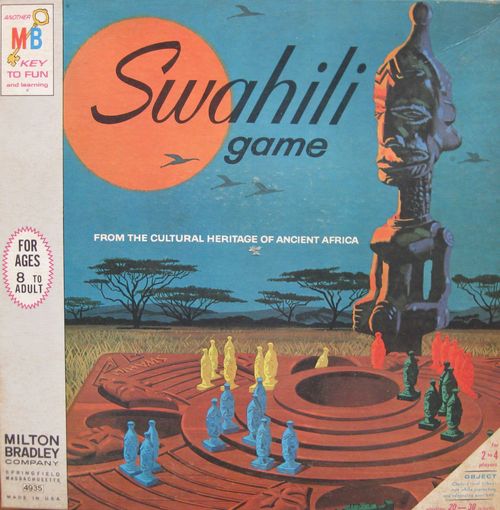
Swahili
Swahili Rulebook
Table of Contents
Table of Contents
Swahili—For 2, 3 or 4 Players
Object of the Game
Capture opponents while moving pieces into the center hole.
The Board
The playing board is made up of eleven rows, a center hole and four compounds. Starting at the outer edge of the board (see diagram #1), the first six rows are flat and are called "safe" rows. The four holes on the edge of the board are "compounds" and are used to hold captured playing pieces. Each player sits behind a set of rows, using the "compound" to his right for storage of captured pieces.
Diagram #1 labels: CENTER HOLE; CAPTURE ROWS; SAFE ROWS; STARTING POSITION OF PIECES; COMPOUND; PLAYER SITS HERE. The rows are numbered 1 to 11 from the outer edge toward the center hole.
Playing Pieces
Each player selects 12 pieces, or tribesmen, of the same color and places 3 in each of the first four rows as shown in diagram #1.
How to Move
Understanding the "move" is the most important part of the game. The "move" is like walking forward, one step at a time for as many steps as you have pieces. The LAST STEP is the most important.
- Pieces are always moved toward the center hole.
- In his turn, a player chooses ANY of his rows which contain one or more pieces and PICKS UP ALL OF THE PIECES IN THAT ROW.
- He moves the lifted pieces toward the center, one piece in each row ahead, until they are all used up. An example of a move is shown below.
Diagram #2 (START and FINISH).
The player chose to move the pieces in row two (three pieces). One is placed in row three, one in row four, and one (the last) in row five. Starting and ending positions are shown above.
- If the LAST PIECE moved lands in an empty row, the move ends.
- If the LAST PIECE moved lands in a row containing one or more of his pieces, the player has a CHOICE of doing one of two things. a. He may stop and end his move—OR— b. He may pick up all of the pieces in that row and advance them again one piece in each row ahead as in row three.
For example: A player starting as in diagram 3A picks up row one, advances as in diagram 3B, landing his last piece in row four which now contains four pieces. He continues his move by picking up the pieces in row four and advancing them to end his turn as in diagram 3C.
Diagram #3: A (START), B, C (END).
- Whenever a player chooses a row to move, ALL of the pieces MUST be moved, leaving that row empty.
- When a piece (or pieces) has advanced to step number 11, the next move will put one into the center hole. ONLY ONE PIECE AT A TIME MAY LAND IN THE CENTER HOLE. Any remaining pieces are placed back consecutively starting in row number one.
In diagram number 4, the player has five pieces in row number 9. He chooses to move this row. Note that the third piece is placed in the center hole and the remaining two placed consecutively back into rows one and two.
Diagram #4 (ROW 9, five pieces).
How to Capture
The stepped rows (7 to 11) are "capture" rows. Whenever a player has a single piece on any of these steps, it may be captured by an opposing player as follows:
- If a player lands the LAST PIECE of his move on a capture row containing a single opposing piece, he captures the piece. He removes the captured piece from the row and places it in the "compound" on his right. Note—The "capturing piece must be the ONLY ONE of that color on that row."
- More than one opponent's piece can be captured in a move, provided that they are all single pieces (of that color) on the same row.
In diagram #5, a player has three pieces in row #8. He chose to move this row. The third piece lands in the 11th row containing a single opposing piece. The player captures this piece. He removes the piece from the board and places it in the compound on his right.
Diagram #5 (ROW 11): "THIS PIECE IS CAPTURED" marks the single opposing piece on row 11 that the third piece lands on.
- If a player has two or more pieces on a (capture) row, they are safe and cannot be captured.
Ending the Game
Whenever any player has landed all of his remaining pieces in the center hole, the game ends. All players count their score as follows:
- For each piece captured—5 points.
- For each piece in the center hole—10 points.
All pieces left on rows 1 thru 11 DO NOT COUNT for score.
The player with the highest score is the winner!