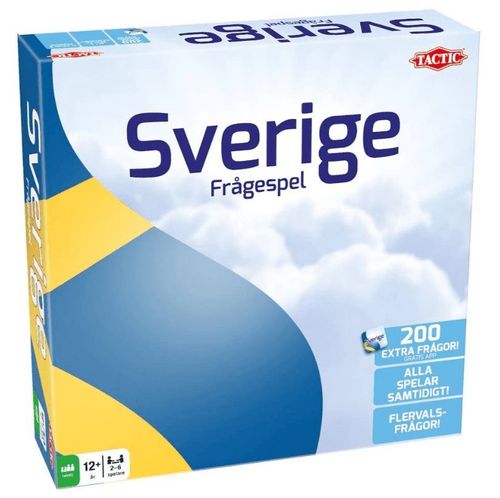
Sverige frågespel
Sverige frågespel Rulebook
Table of Contents
Table of Contents
Overview
The game consists of questions in six categories: history, culture, nature, geography, sport and mixed questions. You answer questions in the category where your pawn is. Move your pawn around the board and collect pieces of your category puzzle by answering a question correctly in each category. When your puzzle is complete, head for the centre square. The first player to reach the centre square with a complete puzzle and answer the last question correctly wins!
Setup
The question cards are placed in four equal piles on the table, question side up. Each player takes a pawn and places it on one of the Sweden squares on the board (see Picture 1). More than one pawn may be on the same square. Players roll the die, and the player with the highest roll starts. Play proceeds clockwise.
Question Cards
The questions are divided into six categories: history, culture, nature, geography, sport and mixed questions. Each card contains one question from each category, and the answers are printed on the back of the card. The colour symbols in front of the questions correspond to the colours of the different squares on the board (see Picture 2).
At the start of the game, agree together on how exact the answers must be to count as correct. For example, is it enough to name only the surname of a well-known Swede when the question asks about one, or how exact must answers be for questions about dates, and so on?
Playing the Game
Roll the die and move your pawn either clockwise or anticlockwise, in either direction you choose. Then answer a question in the category matching the colour of the square where your pawn stands (see Picture 2). If your pawn stands on a Sweden square, you choose the category yourself. The player on your left takes a card and reads you the question.
- If you answer correctly, you move your pawn to the next square and may try a new question the next time.
- If you answer incorrectly or do not answer at all, your pawn stays where it is, and next time you must answer a question in the same category.
- If you answer incorrectly or do not know the answer, the turn passes to the next player.
- If you answer correctly, you may take a piece of the category puzzle in the same colour as the category of the question you answered correctly. Place the puzzle piece in front of you on the table. (To win, your puzzle must be complete.) The turn passes to the next player.
- If you answer correctly a question in a category of which you already have a puzzle piece, you do not get a new piece of that colour. Instead, you roll the die again.
The Path to the Goal
When you have collected all six pieces of your puzzle, you may move to any Sweden square. You do not need an exact roll to stop on such a square.
The next time, you may start your way towards the centre square (see Picture 3). The path to the centre square consists of two question squares. To advance along this path you do not roll the die; instead, the way forward is to answer correctly the two questions whose categories are shown on the board.
Winning
After you have answered both questions correctly, you may move your pawn to the centre square (see Picture 3). On your next turn you answer a question in a category chosen by the player sitting to your left. That player must name the category before looking at the questions.
- If you answer the question correctly, you win the game.
- If you answer incorrectly, your pawn stays where it is, and in your next turn you must answer a new question in the category chosen by the player to your left.
Tips for Game Variations
- Use the question cards without the board. Roll the die to see how many questions you will be asked. You win the card or cards if you answer the question(s) correctly. After a predetermined playing time, the player with the most cards wins.
- Play so that you may only move your pawn clockwise around the board.
- You may also play in teams. Decide in advance whether the team members may discuss the question together before answering.