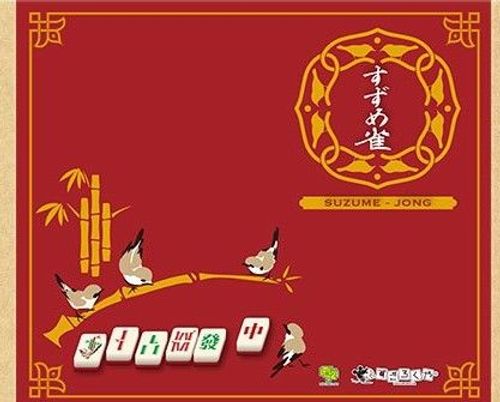
Suzume-Jong
Suzume-Jong Rulebook
Table of Contents
Table of Contents
Components
- 44 tiles: the numbers 1-9 (36 tiles, 4 of each number) plus Green Dragon and Red Dragon (4 of each)
- Of the 36 numbered tiles, one copy of each number (1-9) is printed in red instead of green. These 9 tiles are the "red tiles."
- All 4 Red Dragon tiles are also red.
- 50 point sticks: 25 worth 1 point, 15 worth 5 points, 10 worth 10 points
- 1 Dealer marker
- 1 Round Wind marker
- 5 double-sided quick-reference cards
- 1 rulebook
Setup
- Give each player one quick-reference card and 40 points in point sticks (2 worth 10, 3 worth 5, 5 worth 1).
- Turn all 44 tiles face down and mix them well, then pile them in the middle of the table without stacking them, forming the wall.
- Each player takes 5 tiles from the wall and stands them up so only they can see their faces. This is each player's starting hand.
- The dealer draws one more tile from the wall and places it face up on the Dealer marker. This is the dora indicator tile.
- Decide the first dealer (for example, by rock-paper-scissors) and give that player the Dealer marker and the Round Wind marker. Place the Round Wind marker showing its East face toward the dealer, oriented so everyone else can also see which round it shows.
- Play proceeds counter-clockwise from the dealer.
Playing a Turn
You win by holding six tiles that form two sets of three worth 5 or more points in total (see Scoring below). A set of three is either:
- A sequence: three consecutive numbers of the same suit (for example 4-5-6).
- A triplet: three copies of the same tile (for example three 7s, or three Green Dragons).
On your turn:
- Draw one tile from the wall and add it to your hand, so you are holding six tiles.
- If your six tiles already form two sets of three worth 5 or more points, you may declare Tsumo (a self-drawn win): announce it to every other player and reveal your hand face up. Score the hand (see Scoring and Payment below).
- If you cannot win, or choose not to, discard one tile from your hand face up. Lay discards in a row between the wall and your hand, from left to right, in the order you discard them.
- Any other player who can complete a winning hand of two sets of three worth 5 or more points using the tile that was just discarded may declare Ron: announce it to everyone and reveal your hand face up. Score the hand (see Scoring and Payment below). If nobody declares Ron, play passes to the next player counter-clockwise.
You may never declare Ron using a tile of the same kind you have already discarded yourself, regardless of whether the copy you discarded was a red tile or a normal-colored one. For example, if you have already discarded a red 3, you cannot Ron on a normal (green) 3 either.
Scoring
A winning hand must be worth 5 points or more, counted before any dealer bonus. Add up the following for your six winning tiles:
- Each sequence (three consecutive numbers) in your two sets of three: +1 point.
- Each triplet (three identical tiles) in your two sets of three: +2 points.
- Each red tile among your six tiles: +1 point each. (There are nine red numbered tiles, one per number 1-9, plus all four Red Dragon tiles.)
- Each tile among your six that matches the dora indicator tile: +1 point each.
- Tanyao: none of your six tiles is a 1, a 9, a Green Dragon, or a Red Dragon: +1 point.
- Chanta: both of your sets of three are "terminal-anchored" — each set is either a sequence of 1-2-3 or 7-8-9, or a triplet of 1s, 9s, Green Dragons, or Red Dragons: +2 points.
If you win as the dealer, add a further +2 points to your final score. This dealer bonus is not counted toward the 5-point minimum needed to win.
Special Hands (Yakuman)
Three specific all-or-nothing hands score a flat bonus instead of the Tanyao/Chanta/red-tile/dora bonuses above. You still add the sequence (+1) or triplet (+2) points for your two sets of three on top of the flat bonus, but no other bonus applies.
- All Green: both sets of three are made entirely from the non-red tiles 2, 3, 4, 6, 8, and Green Dragon. Worth 10 points.
- Chinyao: both sets of three are made entirely from 1, 9, Green Dragon, and Red Dragon tiles. Worth 15 points.
- Super Red: both sets of three are made entirely from red tiles. Worth 20 points.
Payment
- Tsumo (self-drawn win): every other player pays an equal share of the winner's score. If the total does not divide evenly, round each player's share up.
- Ron (win off a discard): the player who discarded the winning tile pays the winner's whole score alone.
End of a Hand
A hand ends as soon as a player wins and is paid, or as soon as the wall of tiles runs out with nobody winning. Even if the dealer is the one who wins, the Dealer marker still passes to the player on the dealer's right, who becomes the new dealer. Once the Dealer marker has gone all the way around the table back to the player holding the Round Wind marker, advance the Round Wind marker forward by one before dealing the next hand.
End of the Game
The game ends once the Dealer marker has gone around the table four times — that is, once the Round Wind marker has advanced all the way through East, South, West, and finally North. Total up everyone's points; the player with the most points wins.
Special Situations
Misdeclared win. If you declare Tsumo or Ron but your revealed hand turns out to be worth 4 points or less (not counting the dealer bonus), you must pay every other player 2 points each. Stand your tiles back up and continue the hand as if nothing had happened.
Running out of points. If a player cannot pay a score in full because they do not have enough points left, they pay down to 0 and owe nothing further. They are not eliminated and continue playing.
Multiple players declare Ron on the same discard. All of them score against the discarder. Pay them one at a time in seating order starting from the discarder's right (so the closest player to the discarder's right is paid first, and the player to the discarder's left is paid last). If the discarder runs out of points partway through, any remaining players in line receive no further payment.