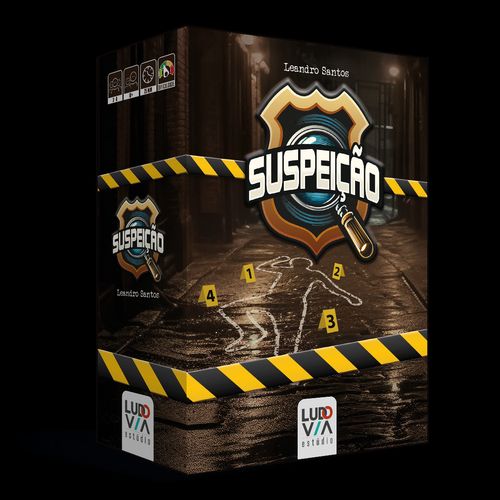
Suspeição
Suspeição Rulebook
Table of Contents
Table of Contents
Components
- 1 crime scene board (A)
- 56 evidence cards (B)
- 8 crime scene cards (C)
- 1 detective card (D)
- 36 scoring cards (divided into -1, +1 and +2, 12 of each) (E)
Each evidence card shows: the evidence number, the card's category (CLUE, WEAPON, or LOCATION), the card's action text, and the number of players required for the action.
Preparation
Shuffle the crime scene cards and reveal 4 on the table. The 4 cards must be in the same direction, following the orientation of the arrows in the center.
Place the game board over these cards, displaying only 4 numbers, which will be the incriminating evidence used in the round. Arrange the scoring and detective cards on the table to be used in the game.
In games with 3 or 4 players, remove the cards with the 5-6 icon in the bottom right corner from the deck of evidence cards.
Shuffle the evidence cards, deal 4 to each player, and form a draw pile in the center of the table with the remaining evidence cards.
The player who recently read a crime news article will be the first player.
Objective
Your goal is to achieve the highest score. To do this, throughout the game, you must:
- reveal one of the incriminating evidence cards in the hand of another player;
- keep hidden in your hand one of the incriminating evidence cards until the end of the game.
How to Play
On your turn, play one evidence card from your hand, read the text aloud, and perform the action described.
Discard the played card and any other cards revealed as a consequence of the actions, provided they are not one of the 4 incriminating evidence cards.
At the end of your turn, draw cards from the draw pile until you have 4 in your hand, and the player to your left begins their turn.
Players who were targeted by an action do not replenish their hand of cards at this time. Therefore, a player may start their turn with only 2 or 3 cards and will have fewer options to play.
The player only replaces the cards in their hand:
- at the end of their own turn; or
- if you are left with only 1 card in your hand after another player's turn, then, BEFORE the current player draws cards, the player with only 1 card will draw cards until they have 4 cards in their hand.
If, during their own turn, the player uses one of the incriminating evidence cards (intentionally or not), the other players must accuse them and interrupt the game, and that card will be revealed in front of the player whose turn it is. Furthermore, they will not perform the action of the card. Finally, the player whose turn it is will draw cards until they have 4 in their hand and end their turn.
However, if the incriminating card is played and nobody notices during the turn, the player cannot be accused later.
Actions and Effects
These actions DO NOT allow you to reveal incriminating evidence cards. If you receive them through trades, don't let anyone notice:
- EXCHANGE 1 CARD: Take any card from another player's hand and give them one card from your own hand.
- TAKE: place the card in your hand without the others seeing what the card is.
These actions help to find incriminating evidence cards in the hands of other players:
- REVEAL: Choose one card from another player's hand at random and place it face up on the table, revealing it to all players. If it is one of the incriminating evidence cards, you gain one point (+1), and the revealed card remains in front of the player who was targeted by the action. Otherwise, simply discard it.
- BUY: Add 1 card from the draw pile to your hand. You cannot perform this action if the draw pile is empty.
- FORCE: A player of your choice must reveal 1 card that meets the described requirement. If it is one of the incriminating evidence cards, it must remain revealed in front of that player, and the current player gains +1 point. If not, simply discard it. Cards with an X in the number field do not meet any of the requirements. If a player says they cannot meet the requirement (bluffing or not), they will undergo the polygraph test (see Polygraph Test).
- PASS: This card can only be used if there is already an incriminating evidence card revealed in front of you. You must pass it to another player.
Polygraph Test
What if you choose a player and they say they don't have the requested type of card? For example, when forcing another player to reveal an odd-numbered card or a card from 1 to 17, could they lie, claiming not to have it?
Yes, he can bluff, but in that case, the player performing the action will ALWAYS undergo the "polygraph test":
The current player takes two random cards from the player being tested, looks at the cards without showing them to the others, chooses one of them to be revealed, and returns the other to the player who was tested.
Considering only the revealed card, if the player being tested:
- He lied, meaning the revealed card fulfills the requirement of the obligation, and the player who suffered the action receives a -1 point penalty.
- He lied, and the revealed card is incriminating evidence; the player who failed the test receives a score of -1, the evidence found is revealed in front of him, and the player who performed the action receives a score of +1.
- He didn't lie, but the revealed card is incriminating evidence that doesn't meet the requirement of the obligation; the evidence found is revealed to this player. The player whose turn it is gets a +1 point.
- He didn't lie, and the revealed card is not incriminating evidence; the revealed card is disregarded. The game continues as normal.
Note: only one of the cards should be revealed, and the other will be returned to the player without revealing it, even if both cards contain incriminating evidence.
End of the Round
As soon as a player buys the last card from the deck, or when the last incriminating evidence of the 4 indicated on the board is revealed, the current player will take the detective card and place it in front of them as a reminder that they will be the last player.
All players will take one final turn of actions, but without drawing cards, starting with the player to the left of the player holding the detective card. The player with the detective card is the last to play.
There are two additional rules in the final action: 1) players can choose to pass their turn and not play any cards in this last round; and 2) players who have 2 cards or fewer in their hand can no longer be targeted by actions that involve their cards in hand (e.g., revealing, drawing, exchanging), but they can still be targeted by the transfer of incriminating evidence cards already revealed on the table.
If none of your opponents can be targeted (for example, all other players have 2 cards or fewer in their hand) and you cannot perform the "Pass incriminating evidence..." action, you will be forced to pass your turn.
Note: If, in the last turn, an action to be performed on two different players is not possible, choose only one player as the target.
Score
Points earned throughout the game:
- When you reveal an incriminating evidence card in another player's hand as a result of an action, you gain +1 point.
- If you are caught lying during the polygraph test, you receive a score of -1.
Points earned at the end of the round:
- Each player receives a score of -1 for each incriminating evidence card revealed in front of them.
- Each player receives a score of +2 for each incriminating evidence card that ended up in their hand without being revealed.
New Round and End of Game
At the end of a round, add up the scores and shuffle all the evidence cards, forming a new draw pile.
Shuffle the incriminating evidence cards and perform a new setup (see Preparation).
The score cards remain in front of each player. The first player in the next round will be the one to the right of the last player from the previous round.
Note: even if a +1 card seems to cancel out a -1 card, resulting in a score of zero, do not return the cards, as the number of -1 cards obtained throughout the game will serve as a tie-breaking criterion.
After 3 rounds, the player with the most points is considered the most INNOCENT, and the player with the fewest points is the MAIN SUSPECT.
In case of a tie, the player with the fewest negative cards (-1) accumulated during the game wins. If the tie persists, the players involved in the tie share the victory.
Game Mode with Blocking
In this game mode, the block symbol that appears on some cards with an X is used. There are 6 cards with this symbol, but only 3 are used in games with 3 or 4 players.
Follow the game preparation steps as usual. After playing an action card and choosing a target, the target player may play a block card and prevent the action from being performed, forcing the current player to choose another target. If the next chosen player also has a block card, they may play it, once again forcing the current player to choose another target. If all players in the turn use a block card, the played action card is discarded, and the current player ends their turn.
The block can be used as a defense against any action: "exchange," "reveal," "force," "pass evidence of a crime," etc. Cards with an X used as a block are discarded after use. When using a block, the player does not replenish the cards in their hand, except if they are left with only 1 card.
Note: Cards with an X that contain the block symbol can be played normally to perform the action described on the card.