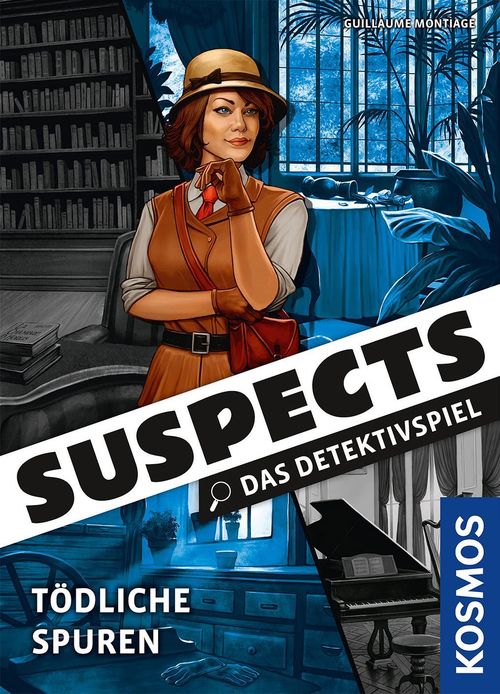
Suspects: Tödliche Spuren
Suspects: Tödliche Spuren Rulebook
Table of Contents
Table of Contents
Cases in the Box
This Suspects box contains 3 investigations of Claire Harper. The three investigations follow each other chronologically, so you are invited to play them in order.
Chapter 1: Murder at Allister Manor
Contents:
- 53 Clue cards
- 1 cover card
- Introduction with questionnaire
- Document A: Plan of the manor
- Document B: Family tree
- Solution envelope
Chapter 2: The Last Tirade
Contents:
- 56 Clue cards
- 1 cover card
- Introduction with questionnaire
- Document A: Unfolding of the room
- Document B: Plan of the theatre
- Solution envelope
Chapter 3: The Wings of Vengeance
Contents:
- 55 Clue cards
- 1 cover card
- Introduction with questionnaire
- Document A: Crime scene
- Document B: Plan of the hotel
- Solution envelope
Players: 1-6. Age 10+. Playing time: 90 minutes.
Instructions
Setup
Take out of the box the deck of Clue cards, the introduction and the two documents of the investigation you are going to play.
- Place the Clue cards within reach as a draw pile.
- Keep the two documents of the investigation within reach. You will only look at them when you are invited to.
- Take a sheet of paper and a pen to note your reasoning, your conclusions, your suspicions...
- Leave the solution envelope in the box. You will only open it at the end of the investigation.
- One of the investigators reads the introduction aloud. Once the reading is finished, the investigation can begin.
General Principle and Objective
In a Suspects investigation, you will mainly read Clue cards to advance in the plot as in a book, discuss among yourselves, reason and draw conclusions.
Start by reading the introduction. At the end of this reading, you will be invited to read the questionnaire.
Your objective is to score as many points as possible by answering the questionnaire. The more "quickly" you answer (that is, having drawn and read the fewest Clue cards possible), the more points you score.
Course of the Investigation
After reading the introduction and looking at the questionnaire, the investigation begins.
You will draw Clue cards and reveal the documents. You will find on them various types of icons corresponding to the different possible actions, notably:
- Interrogate someone (icon with a number in a speech bubble). Example: draw and read Clue card 7 to interrogate the designated person.
- Go to a location (icon with a number in a map pin). Example: draw and read Clue card 54 to go to the designated location.
- Examine an element (icon with a number in a magnifying glass). Example: draw and read Clue card 12 to examine the designated element.
Each time you encounter one of these icons, you may perform the action concerned.
IMPORTANT: you are totally free to perform the different actions in the order you wish. You can quite well start by interrogating someone, then go to a location, then go to another location before coming back to interrogate the suspect, etc.
Sometimes, some simple instructions will be written on Clue cards. You just need to follow them to continue the investigation.
Answering the Questionnaire
-
At any moment of the investigation, you may answer one or several of the questions asked. Write your answer on a loose sheet. Then, in the solution table, tick the box corresponding to the number of Clue cards drawn (see below).
IMPORTANT: all Clue cards count. Even the first one.
-
At any moment of the investigation, you may change any of your answers. But then you must tick the box corresponding to the number of Clue cards drawn at the moment of this change of answer.
IMPORTANT: if at some moment of the investigation you draw a Clue card that tells you to draw a second one, you may quite well draw this second Clue card AFTER having noted your answers.
VARIANT: if the investigators do not agree on the answers, they can answer individually and compare their scores at the end of the investigation.
End of the Investigation
The investigation ends once there is no Clue card left to draw.
At that moment, and once you have agreed on the answers to the questions asked, you may unfold the solution, read it and count your points. You are to evaluate yourselves in all objectivity.
For each question:
- if your last answer is correct, score the number of points corresponding to the rightmost ticked box,
- if your last answer is wrong, you score no points.
Example of End-of-Game Scoring
Imagine the following plot: "Doctor Lesombre was murdered by Miss Fuchsia in the garage with a 12 key." The questionnaire of the investigation would take the following form:
| Number of Clue cards drawn | 1-30 cards | 31-45 cards | 46 cards and more | Wrong answer |
|---|---|---|---|---|
| Victory points | 5 | 4 | 3 | 0 |
| 1. Who is the murderer? | X (ticked) | |||
| 2. Where did the crime take place? | X (ticked) | X (ticked, circled) | ||
| 3. What is the murder weapon? | X (ticked) | X (ticked, circled) | ||
| Total score | 5 + 0 + 3 = 8 |
- Your answer "The culprit is Miss Fuchsia" is correct. You answered when you had drawn 30 cards. You score 5 points.
- Your answer "The crime took place in the garage" is correct. After 30 cards you had answered "in the kitchen", but you changed your mind after 46 cards and wrote the right answer. You score 3 points.
- Your answer "The murder weapon is a threshing machine" is wrong. You answered after 45 cards. Had the answer been correct you would have scored 4 points, but as it is incorrect, you score 0.
Your final score: 5 + 3 = 8 points.
Clarifications
- Since scores depend on thresholds (for example 5 points if the number of cards turned is between 1 and 30), it is in your interest to wait for the last card of the threshold (here 30) to pause and discuss among yourselves.
- At the start of the game, we advise you to appoint an investigator who will be in charge of noting the number of Clue cards drawn as you go. This will make your games smoother and more enjoyable.
- From the moment you draw the first Clue card of the third threshold (46 cards), it is no longer necessary to count Clue cards. You can then draw the rest of the Clue cards as you go, in order to disprove or confirm your theories.
Specific Rules
1. Link Between Two Cards
To carry out a piece of reasoning, you will sometimes have to connect information located on two different cards.
To check whether two elements match, the cards must be placed side by side, the right way up (do not try to turn the cards over, for example). If a link of the same colour joins the two adjoining cards, it means you can draw a valid conclusion from it.
EXAMPLE: by placing card 22 next to card 10, the green link connects the fingerprint perfectly to Claire Harper. We conclude that the fingerprints found on the teapot do indeed match those of Claire Harper.
(Illustration: card 10, "Claire HARPER, 25 years", an interrogation card, with a green link line and a caption "Verify the belonging of the print by placing the 2 cards side by side"; card 22, "A fingerprint", found on the handle of the teapot in which floats a dark, perfumed tea; beside it, a few black tissue sheets in a luxurious sachet embroidered with golden letters "Authentic Darjeeling, Alubari tea estate, India". Card 10 lists further interrogations: 23 - interrogate her about her last investigation; 45 - about her studies; 37 - about her favourite novel.)
2. Unlocking Cards
Some cards are only accessible if several others have already been revealed. The unlocking conditions are written on these cards.
EXAMPLE: (a "teapot" token symbol) "YOU MAY DRAW CARD 10 IF YOU HAVE REVEALED 3 'TEA' SYMBOLS." At the bottom of card 10: "YOU MAY DRAW THIS CARD IF YOU HAVE REVEALED 3 'TEA' SYMBOLS."
Claire's Advice
- In Suspects, you must show deduction and discernment. The point is to unmask a murderer: relying on your convictions or your simple intuition will probably be insufficient to solve the case.
- If your theories are not backed by facts or tangible clues, they are probably false. Do not let your imagination carry you away at the expense of facts and logic. Conversely, a clue does not automatically point to a culprit. Keep an open mind! Thus, a character whose fingerprint is the only one present on the murder weapon may legitimately be suspected, but is not necessarily the culprit. And if you find a screwdriver, it is probably the tool that was used to unscrew a chest, but not necessarily. It is the set of clues that will allow you to have certainties.
- Finally, to make your task easier, know that if the question is asked as follows "Who is the murderer?" (singular), it means the culprit acted alone. If the question is "Who is/are the murderer(s)?", it means it is possible that there are several accomplices (but not necessarily).
Who Is Claire Harper?
Born in 1910. An avid reader of Agatha Christie before the Eternal, an inveterate traveller, more British than a 5 o'clock tea.
Oxford University snapped her up as soon as the first quotas for female students were introduced in 1927. Following in her father's footsteps, she came out with the key to her dream: a degree in criminal law.
From now on, Claire Harper investigates, observes, ferrets out and foils. No riddle is devious enough for her cunning, no case complex enough to resist her.
Claire Harper is not just a detective. She is the best.