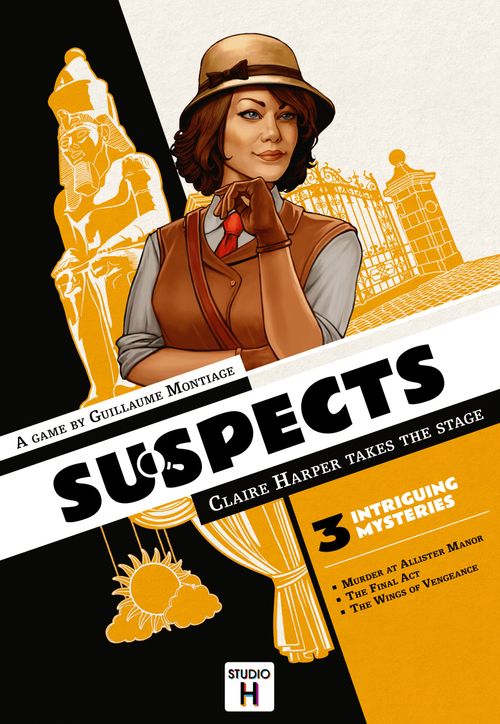
Suspects: Claire Harper Takes the Stage
Suspects: Claire Harper Takes the Stage Rulebook
Table of Contents
Table of Contents
This Suspects Box Contains 3 Claire Harper Mysteries
These three mysteries take place in chronological order. We recommend that you to play them in order.
Chapter 1 — Murder at Allister Manor
by Guillaume Montiage
Contents:
- 53 Clue cards,
- 1 cover card,
- Introduction with the questionnaire,
- Document A: Diagram of the manor,
- Document B: Family tree,
- Solution envelope.
Chapter 2 — The Final Act
by Sébastien Duverger Nédellec
Contents:
- 56 Clue cards,
- 1 cover card,
- Introduction with the questionnaire,
- Document A: The playbill for the play,
- Document B: Diagram of the theatre,
- Solution envelope.
Chapter 3 — The Wings of Vengeance
by Paul Halter
Contents:
- 55 Clue cards,
- 1 cover card,
- Introduction with the questionnaire,
- Document A: Crime scene,
- Document B: Diagram of the hotel,
- Solution envelope.
Instructions
Setup
Take the pack of Clue cards, the introduction, and the two supporting documents for the mystery you are going to solve out of the box.
- Place the Clue cards in a pile that you can reach easily.
- Keep both of the supporting documents nearby. Do not look at them until you are instructed to do so.
- Make sure you have a pen and paper ready to take notes and write down your thoughts, conclusions, suspicions, etc.
- Leave the solution envelope in the box. You will not open until you have reached the end of the investigation.
- One player reads the introduction aloud. After the introduction has been read, the investigation may begin.
General Principles and Goal
In a Suspects mystery, you will read the Clue cards to work your way through the investigation as you would in a book, discuss the case amongst yourselves, make deductions, and come to conclusions.
Start by reading the introduction. After reading the introduction, you will be instructed to read the questionnaire.
Your goal is to score as many points as possible when you answer the questions in the questionnaire. The "faster" you answer (by drawing and reading as few Clue cards as possible), the more points you score.
Investigation
After you have read the introduction and the questionnaire, the investigation starts.
You will be instructed to draw Clue cards and discover certain documents. There are a several different symbols you may come across, which correspond to things you can do, such as:
Question Someone Example: Draw and read Clue card 7 to question the person indicated.
Go to a Location Example: Draw and read Clue card 54 to go to the location indicated.
Examine an Item Example: Draw and read Clue card 12 to examine the item indicated.
Each time you see one of these symbols, you may do the action indicated.
Note: You are free do these actions in the order you choose. You can start by questioning someone, then go to a location, then go somewhere else, then come back to question them, etc..
Some Clue cards have simple instructions on them. Follow these instructions to continue the investigation.
Answering the Questionnaire
- You may answer one or more questions at any point in the investigation. Write your answer on a piece of paper. Then, in the scoring chart, tick the box next to the number of Clue cards drawn (see below).
Note: All of the Clue cards count. Even the first one.
- You may change any of your answers at any point in the investigation. If you decide to do this, tick the box next to the number of Clue cards drawn when you change your answer.
Note: If you are instructed to draw a second Clue card at any point in the investigation, you may draw the second Clue card AFTER you have written down your answers.
Variant: If the players do not agree on the answers, they may answer individually and compare their scores at the end of the investigation.
End of the Investigation
The investigation ends when there are no more Clue cards left to be drawn.
At that point, once you have come to an agreement on the answers to the questions, you may unfold the solution, read it, and tally up your points. You'll need to assess your investigating skills objectively. For each question:
- if your final answer is correct, you score the number of points that corresponds to the box you ticked that's the furthest to the right in the chart,
- if your final answer is wrong, you score zero points.
Examples of Scoring at the End of the Game
Say you're trying to solve the following mystery: "Dr Lesombre was murdered by Miss Fuchsia in the garage with a 12 mm spanner." The questionnaire for the case would look like this:
| Number of Clue cards drawn | 1-30 cards | 31-45 cards | 46 cards or more | Wrong answer |
|---|---|---|---|---|
| Points scored | 5 | 4 | 3 | 0 |
| 1. Who is the killer? | X | |||
| 2. Where did the crime take place? | X | X | ||
| 3. What is the murder weapon? | X | X |
Total score: 5 + 0 + 3 = 8
- Your answer "Miss Fuchsia is the murderer" is correct. You answered after drawing 30 Clue cards. You score 5 points
- Your answer "The crime took place in the garage" is correct. After drawing 30 cards, you answered "in the kitchen", but you changed your mind after drawing 46 cards and wrote down the right answer. You score 3 points.
- Your answer "The murder weapon is a combine harvester" is wrong. You answered after drawing 45 cards. If your answer had been correct, you would have scored 4 points. However, since your answer is wrong, you score 0 points.
Your final score: 5 + 3 = 8 points.
Further Details
- Since the scores change at different cut-off points (for example, you earn 5 points if the number of cards drawn is between 1 and 30), it's a good idea to wait until you've drawn the last card before the cut-off (the 30th card) to take a break and discuss the case.
- When the game starts, we recommend choosing one player to be in charge of keeping an eye on the number of Clue cards drawn. This will make the game go more smoothly and be more fun.
- Once you have drawn the first Clue card in the 3rd stage (the 46th card), there is no longer any reason to keep counting the Clue cards. You can draw the rest of the Clue cards as you go to confirm or disprove your theories.
Specific Rules
1. Connections Between 2 Cards
Sometimes you will need to combine information on two cards in order to come up with a theory.
To see whether two items go together, place the cards next to each other, facing the same direction (do not turn the cards, for example). If the coloured line matches up on both cards, this means that you can draw a logical conclusion.
Example: When card 22 is placed next to card 10, the green line is a perfect match between the fingerprint and Claire Harper. You may conclude that the fingerprints found on the teapot are Claire Harper's.
Card 10 — Claire Harper, 25 years old. Her eagle eye skims the pages with disconcerting liveliness. She raises her big blue eyes from her notes and speaks with a calm, yet determined voice: "When it comes to murder, it is always worthwhile to understand who the victim was, as the victim's personality is the direct cause of many crimes. I may be young, but I have learned from the best: my professors, my father, and the great masters of detective stories."
Card 10 also lists: 23 — Question her about her most recent investigation. 45 — Question her about her education. 37 — Question her about her favourite novel.
Card 22 — Fingerprint. Found on the handle of the teapot, which is full of a strong and fragrant tea. Next to the teapot is a luxurious cloth tea bag with "Authentic Darjeeling, Alubari tea estate, India" embroidered on it in gold. The tea bag contains a handful of dark leaves.
2. Unlocking Cards
Some cards only become available after several other cards have been drawn. The conditions for unlocking the card are written on these cards.
Example: "You may draw card 10 if you have collected 3 'teapot' symbols." The bottom of card 10 repeats: "You may draw this card if you have collected 3 'teapot' symbols."
Who is Claire Harper?
She was born in 1910. She is an avid reader of Agatha Christie, a world traveller, and more British than 5 o'clock tea.
Oxford University admitted her after implementing quotas for female students in 1927. She followed in her father's footsteps and graduated with the key to unlocking her dreams: a degree in criminal law.
Now Claire Harper investigates, observes, discovers, and thwarts. There's no mystery that is too twisted for her brilliant mind, no case that's too hard for her to crack.
Claire Harper isn't just a detective. She's the very best.
Claire's Tips
- In Suspects, you must use deduction and critical thinking. Your goal is to unmask a killer: relying on just your beliefs or your gut instinct won't be enough to solve the case.
- If your theories aren't backed up by facts or tangible evidence, they're probably wrong. Don't get carried away by your imagination and ignore the facts and logic. On the other hand, a clue doesn't automatically indicate someone's guilt. Keep an open mind! Although you might legitimately suspect someone because their fingerprints were the only ones found on the murder weapon, that doesn't necessarily make them the culprit. If you find a screwdriver, while it's likely that it was the tool used to unscrew a safe, that doesn't mean it's actually what happened. Gather all of the clues to reveal the truth.
- Finally, to make things a bit easier, if you're asked: "Who is the murderer?", then the guilty party acted alone. If the question is "Who is/are the murderer(s)?", this means that it's possible that there are several accomplices (but not necessarily).