Suspect
Suspect Rulebook
Table of Contents
Table of Contents
Contents
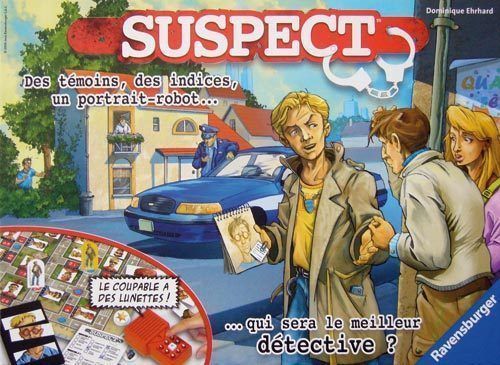
- 1 game board showing a city full of suspects. On the left is a rank scale showing each player's score.
- 1 interactive police headquarters (the electronic "central").
- 1 police sketch holder.
- 12 police sketch tiles (for the culprits).
- 18 Investigation tokens.
- 12 Siren tokens.
- 1 pad of clue sheets (for the informers).
- 6 Detective figures.
- 6 Rank pawns.
Preliminary Note
It is very important to note the vocabulary used in the game.
A witness: gives information only about the face of the informer; this information is to be ticked off on a clue sheet. It may also give an indication of the informer's geographic location.
An informer: gives information about the culprit's police sketch. Only in this case is a police sketch tile taken and placed on the police sketch holder.
In general this game is simple to learn: read the rules once, particularly the paragraph on movement, switch on the interactive police headquarters and let yourself be guided by its instructions.
Operating the Module
The first time you play: insert 2 × 1.5 V LR6/AA batteries. For this, see the advice on page 8.
Switching on: press the ? button on the headquarters and follow the sound prompts to indicate the difficulty level (level 1: 2 gangsters; level 2: 3 gangsters; level 3: 5 gangsters).
To reset the game: press the ? button for 5 seconds.
To switch off the module: without any action on your part, the module will automatically go into standby after 15 minutes.
If you make an error entering a number:
- if the witness's or culprit's number does not exist, the module does not react;
- if the first digit of the witness's number is wrong, the player can correct it by pressing the R key; the last phrase is then repeated and the correct number can be entered again.
To hear information again: press the R key and the last phrase will be repeated.
Aim of the Game
The bank has been robbed and the criminals are still hiding in town!
Move through the streets and key locations, question the witnesses, listen to the clues provided by your police headquarters, the scientific laboratory and the tails, build the gangster's police sketch and arrest him!
The game ends as soon as all the bandits have been arrested.
Each time you advance the investigation by adding an element to the police sketch, or by arresting gangsters, you score points. The player who has scored the most points wins the game.
Game Preparation
The first time you play: detach the Detective figures, the police sketch tiles, the Investigation tokens and the Siren tokens. Fix each Detective figure onto a plastic stand.
Get pencils and paper.
Each player chooses a Detective figure of a colour and places it on a free metro space of their choice (spaces with a red and blue circle).
Each player takes the Rank pawn of their colour and places it on space 0 of the rank scale to the left of the board.
Each player places in front of them three Investigation tokens, two Siren tokens and 1 clue sheet.
Place the police sketch holder and the police sketch tiles beside the board.
Game Play
The youngest detective begins. Play then continues clockwise.
On their turn, each player moves to find the first informer who will give them an element of the bandit's police sketch.
To find this informer, players question the various characters on the board. To question a character, the player must first go to that character's space, then enter the character's two-digit number on the headquarters.
Example: to question Charlie, go to his space at the bottom left of the board and enter number 47.
1 - Movement
Each player has 3 movement points, which they may use as they wish: on foot, by taxi or by metro.
Each move "costs" one movement point:
- spaces with a blue dot represent taxi stations;
- spaces with a red circle and a blue dot represent taxi and metro stations;
- moving in a straight line from one taxi space to the next taxi space costs one movement point;
- moving in a straight line from one metro space to the next metro space costs one movement point;
- moving on foot from one space to the immediately following space costs one movement point;
- the player may combine their points as they wish; they are not obliged to use all of their movement points;
- several pawns may be on the same space;
- metro and taxi moves always go in a straight line.
Movement example 1: the red player moves by metro, then by taxi, and advances one more space on foot to question witness 84. In total they have used three movement points.
Movement example 2: the red player moves twice by taxi, then turns back on foot. In total they have used three movement points.
The player may use one of their Siren tokens in addition to their three movement points. This gives them three additional movement points, which they can use at any time during their turns.
2 - Interrogations
If the player ends their movement on a neutral space (with no number, or without the icons shown on the board: a microscope, a radio and a magnifying glass), their turn ends and it is the turn of the player to their left.
If the player ends their movement on a numbered space in front of a character, they may either question that character or name that character as the culprit.
This character may be either a witness, an informer, or the culprit.
If it is a witness:
- Either the witness knows nothing: the player's turn ends and it is the turn of the player to their left.
- Or the witness knows something: they then give a physical piece of information to help you find the informer. This information is to be ticked off on a clue sheet. The witness may also give an indication of the informer's geographic location.
It is then the turn of the player to the left to play.
If it is an informer:
The informer gives a precise indication about one of the elements of the culprit's police sketch. The player who questioned the informer takes the corresponding police sketch tile and places it on the culprit's police sketch holder. They advance their Rank pawn one space.
Players then continue their search to find a new informer, who will give a new element of the police sketch.
Warning: information travels quickly around town, and this new informer may be any character on the board, including a character the players have already questioned who had not given any information previously.
It is then the turn of the player to the left to play.
If it is the culprit:
If, at the end of their movement, a player is in front of a character and believes they have found the sought gangster, they press the ? button and then enter the suspect's number.
- If it is indeed the culprit, the headquarters signals this with a congratulatory message. The player advances their Rank pawn three spaces. They remove all the tiles from the police sketch holder. The players continue the game, looking for the new informer to obtain information about the next criminal.
- If on the contrary the player was wrong, the headquarters gives them a reprimand. The player must move their Rank pawn back two spaces.
It is then the turn of the player to the left to play.
3 - Investigation Tokens
If, at the end of their movement, a player is on a space with a radio icon (number 25), a microscope icon (number 42) or a magnifying glass icon (number 18), they may call the headquarters by dialling the corresponding number. They then discard one of their Investigation tokens.
- Laboratory space: the player calls the headquarters by dialling 42 and receives information about a new element of the police sketch. They place the corresponding tile on the police sketch holder and advance their Rank pawn one space. Sometimes the laboratory also indicates that it has not been able to find a new clue. Even in that case the Investigation token is lost.
- Remote call space: the player calls the headquarters by dialling 25, then indicates the number of the witness they want to question at a distance. This may allow a player who has identified the informer to question them quickly, without moving to their space.
- Tail space: the player calls the headquarters by dialling 18, then indicates the number of the suspect they want to tail. The headquarters tells them whether it is indeed the sought gangster or whether that suspect is innocent (even in that case the Investigation token is lost). If it is indeed the culprit, the player advances their Rank pawn one space and immediately receives 3 additional movement points to try to arrest them.
If the communication is poor, the call fails and it is the turn of the player to the left. Even if the call fails, the player does not recover their Investigation token.
For each new culprit, the players recover their Investigation tokens and their Siren tokens.
Batteries
Printed as "Attention!" on the last page of the manual, and referred to from the Operating the Module section. The distributor and copyright block and the recycling symbol line are not reproduced.
Inserting and/or replacing the batteries:
- Battery installation must be carried out by an adult.
- This game runs on 2 × 1.5 V batteries of type LR6 (AA; UM3).
- Unscrew the screw of the battery compartment.
- Insert 2 new batteries (preferably alkaline), respecting the polarity.
- Close the battery compartment, screwing the screw firmly back in.
Use only 1.5 V LR6 / AA batteries. Alkaline batteries are recommended.
- For good operation, batteries must be in good condition. If the device malfunctions, fit new batteries.
- Replace all of the batteries; do not mix new batteries and used batteries.
- Do not mix zinc-carbon batteries with alkaline or rechargeable batteries.
- Place the batteries in the direction indicated: an incorrect position may damage the toy, or cause a fire or the battery to explode.
- Respect the polarity. Do not short-circuit the power terminals.
- Rechargeable batteries are not recommended, because the electronic unit cannot guarantee a correct estimate of their state of wear.
- Rechargeable batteries must be removed from the toy before being charged.
- Rechargeable batteries may only be charged under adult supervision.
- Never try to recharge ordinary batteries.
- Remove used batteries from the device and take them to a collection centre. Only hand in fully discharged batteries.
- If the device is not going to be used for a long time, remove the batteries to prevent them from corroding.
- Do not store batteries together with metal instruments: risk of fire or explosion.
- If a battery is swallowed, consult a doctor or the nearest poison control centre immediately.
- Do not forget to take the toy with you.
- Important: keep the pack and the manual for future reference.