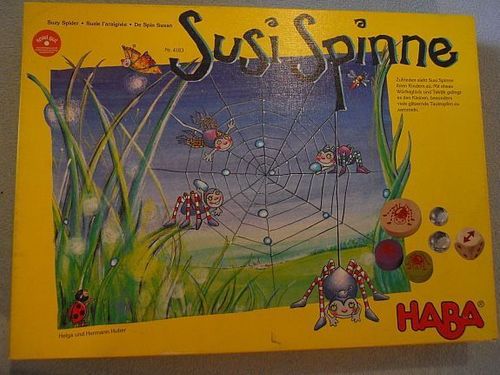
Susi Spinne
Susi Spinne Rulebook
Table of Contents
Table of Contents
Components
- 8 slats (spanlatten), numbered 1 to 8
- 1 hub of the web (middenstuk voor het web)
- 1 white cord (wit snoer) and 1 red elastic band (rood elastiek), for the web
- 9 glass dewdrops (glazen dauwdruppels)
- 11 spider children (spinnenkinderen) in 4 colours
- 1 Spin Susan
- 1 special die with arrows (speciale dobbelsteen met pijlen)
Setup
Building the web
To begin, you must help Spin Susan build her web. (Look carefully at the photo on the back of the box, where the finished web can be seen.)
Look at the hub of the web: on its underside are notches for the slats of the web. Place the hub in the middle of the table, smooth side up.
Now place the slats in order. Put slat no. 1 at the top and the others in a row beneath it. Arrange them so that the numbers are on the left and the notches are on the right. Then slide the slats one after another into the recesses of the hub. The notches must always be on the outside.
Weaving the web
Now the web can be woven. The slats have a notch on their outside edge; clamp the red elastic band into these notches. Be sure to hold the hub with one hand while doing so!
Next, take the white cord and clamp one of its ends, with the small bead, into the innermost groove of slat no. 1. Pull the cord taut and carefully run it through the grooves of the following slats (2, 3, and so on) in a spiral around the hub. Clamp the bead behind the last remaining groove of slat no. 8.
There. Now the web is ready; quite a job, isn't it. It should look like this:
(Diagram labels: red elastic, white cord, slats.)
Place Susan on any slat, at the place where the red elastic band is clamped.
Spider children and playing pieces
If you play with two or three players, each player receives three spider children. With four players, each child receives two spider children as playing pieces.
The spider children are stacked and placed on the hub of the web.
Dewdrops
Distribute the 9 dewdrops at random over the slats. Place each one where the cord runs through the grooves. These spots, and all other intersections, are the spaces over which the spider children will walk.
All that is still missing is the die, and you can begin playing.
Playing the Game
The player who is the bravest and can best imitate a spider's cry may begin.
Roll the die once.
On top of the die a number or an arrow appears. The number and arrow rules are set out below.
Number on the die
A number on top of the die lets you do one of the following:
- Move one of your spider children. The first space is at the start of the cord, where the bead is. Spider children walk from slat to slat, always along the thread. They may move forward as well as backward. Bring all of your spider children into play in turn. That way, after each roll, you can choose whichever spider child is best placed near a dewdrop.
- Move Susan. She may move in any direction from slat to slat, but always along the edge, over the red elastic band. You can use Susan to make spider children jump sideways (= along the slats). Perhaps they can thereby pick up a dewdrop.
Susan ends her turn on a certain space. The children sitting on the same slat or on the opposite slat jump one space in the direction of the big spider. If they sit right on the inside edge of the opposite slat, they jump over the hub.
(Table of die results: "1x roll" = roll the die once; "roll a number" = a number appears, then choose: move a spider child, or move Susan and push spider children closer, possibly collecting dewdrops.)
Arrow on the die
An arrow on top of the die lets one of your spider children make a large jump. It jumps sideways, one space along the wooden slat on which it is sitting. It jumps inward or outward to the next intersection. In doing so it may also jump over the central hub. No one may ever land there!
Example: Susan lands on this slat. The little spider jumps sideways, to the right, and wins the dewdrop.
If the arrow is already showing at the very start, your spider child first jumps to the space with the bead, and then once more over the slat outward to the next intersection.
Occupied Space
If your spider child lands on a space on which another spider child already sits, push that spider child along to the next free space. Shift it in the same direction in which you have just moved (forward, backward, or sideways). If a dewdrop lies on that space, the spider child that was pushed away was lucky and may take the dewdrop.
Collecting Dewdrops
If at the end of a turn your little spider lands on a space where a dewdrop lies, you may take that dewdrop and keep it.
End of the Game and Winning
With two players, the first player to collect five dewdrops wins.
With three or four players, the first player to collect three dewdrops wins.
Summary: 2 children — 5 dewdrops. 3 or 4 children — 3 dewdrops.
Parallel French Text (page 1, left column)
The following is the printed French column, translated into English. It restates the same rules as the Dutch text above.
Die with arrows
An arrow appears on top of the die.
- One of your spider children makes a large jump and springs one space sideways along the wooden slat on which it is sitting. It jumps inward or outward toward the next intersection. In addition, it may jump over the central point of the web. No landing takes place on the hub!
- If the arrow appears right at the start, your spider child first jumps onto the first space with the bead, and then once along the slat outward to the neighbouring intersection.
Example: Suzie lands on this slat. The little spider jumps sideways and picks up the dewdrop.
Occupied space
When a spider child lands on a space on which another spider child is already sitting, push that one to the next free space. Push it in the direction in which you have just moved (forward, backward, or sideways). If a dewdrop lies on that space, the displaced spider child was lucky and may pick the dewdrop up.
Collecting dewdrops
If your little spider lands at the end of a move on a space where a dewdrop lies, you may take it.
End of the game
With two children, the first to collect five dewdrops wins. With three or four children, the first to collect three dewdrops wins.