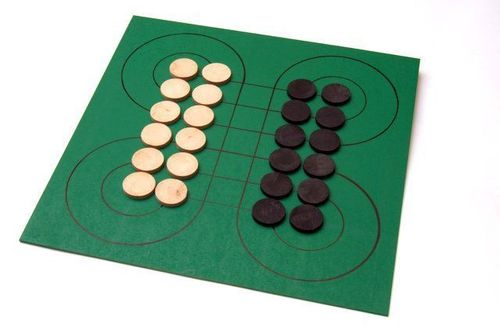
Surakarta
Surakarta Rulebook
Table of Contents
Table of Contents
Introduction
An ancient game for 2 players.
Surakarta is a little-known Indonesian strategy board game for two players, named after the ancient city of Surakarta in central Java. The game features an unusual method of capture which is "possibly unique" and "not known to exist in any other recorded board game".
Material
Board, 12 red discs, 12 black discs.
Setup
Set up the board and pieces as follows:
(The printed rulebook shows the setup as a diagram: the 12 black discs occupy the two intersection rows nearest one edge of the board, and the 12 red discs occupy the two intersection rows nearest the opposite edge, each side's discs filling the points on the grid lines of its half of the board.)
Rules
Players decide who moves first, then turns alternate. The object of the game is to capture all 12 of the opponent's pieces; or, if no further captures are possible, to have more pieces remaining in play than the opponent.
Pieces always rest on the intersections of the board's grid lines.
On a turn, a player either moves one of their pieces a single step in any direction (orthogonally or diagonally) to an unoccupied point, or makes a capturing move.
Examples of non-capturing moves: the printed rulebook shows a red disc with three arrows to the unoccupied points it may step to (straight ahead, and diagonally forward left and right).
Capturing move
A capturing move consists of traversing along an inner or outer circuit (coloured blue or green on the board) around at least one of the eight corner loops of the board, followed by landing on an enemy piece, capturing it. Captured pieces are removed from the game.
Any number of unoccupied points may be travelled over, before or after traversing a loop. An unoccupied point may be travelled over more than once during the capturing piece's journey. Only unoccupied points may be travelled over; jumping over pieces is not permitted.
Capturing is always optional (never mandatory).
Example: A captures B by moving along a green circuit. The printed rulebook illustrates this with a black disc (A) on the outer green circuit that travels around one corner loop and lands on a red disc (B) on the inner position, capturing it.
End of game
A game is won when a player captures all 12 of the opponent's pieces. If neither side can make headway, the game is ended by agreement and the winner is the player with the greater number of pieces in play.
Scoring
A match consists of more than one game. Players agree beforehand how the winner will be determined. A couple of methods are typically used:
- Playing a fixed number of games: Each game is scored by the number of pieces in play at the end of the game. The winner is the player with higher total points after all games have finished.
- Playing to a fixed number of points: New games are played until one player reaches or exceeds that number.