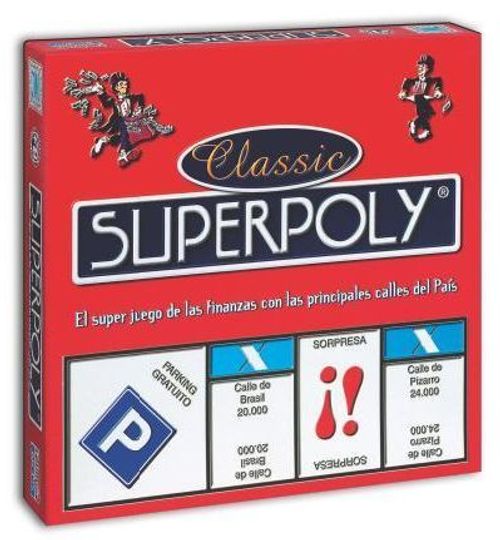
Superpoly
Superpoly Rulebook
Table of Contents
Table of Contents
- Equipment
- Setup
- Money
- Starting the Game
- Salary
- Landing on an Unowned Property
- Landing on a Privately Owned Property
- Owner's Advantages
- Landing on a Caja or Sorpresa Space
- The Banker
- The Bank
- Prison
- Visiting Prison
- Leaving Prison
- Houses
- Hotels
- When the Bank Has No Houses
- Selling Properties
- Mortgages
- Bankruptcy
- Important Note
- Abbreviated System
Equipment
The Superpoly set consists of the following:
- A game board with spaces representing lots (solares), stations, "Prison", utilities and fines.
- Two dice and several tokens, which are placed on the board spaces according to the numbers rolled on the dice.
- 36 green houses and 18 red hotels.
- Two decks of cards, "Caja y Sorpresa" (Chest and Surprise).
- Title Deeds.
- Paper money of various values.
Setup
The table on which the board is placed must be fairly spacious, since each player must have their Title Deeds and money laid out in front of them.
Each player chooses a token. There are as many tokens as there are players.
The Suerte (Luck) and Sorpresa (Surprise) decks are placed in the location indicated on the board.
Each player receives 300,000. One player acts as the banker and takes care of the Bank's funds.
Money
Each player is given 300,000 in the following bills:
- 1 bill of 100,000
- 6 bills of 20,000
- 5 bills of 10,000
- 11 bills of 2,000
- 7 bills of 1,000
- 5 bills of 200
Starting the Game
Dice are rolled to see who begins. The player who rolls the highest number starts from START, rolls the dice and places their token on the space corresponding to the number rolled. Turns pass to the left.
Tokens remain on their spaces until a later roll moves them to a new space. More than one token may occupy the same space.
Depending on the space where a token lands, the player may buy properties, pay rent to the owner of a property, collect bonuses (primas), draw a Surprise or Caja card, or even go to "Prison".
If a player rolls doubles, that is, equal numbers on both dice, they record the number rolled and roll again. If doubles come up again, they roll once more. If doubles are rolled a third time in a row, they go to "Prison", without losing the rights from the previous moves.
Salary
Whenever a player passes START, they collect 40,000 from the Bank, except in the specific cases indicated by certain Caja or Sorpresa cards.
Landing on an Unowned Property
When a player lands on an unowned property, they may acquire it by paying the Bank the stated price. In this case the Bank hands the corresponding Title Deed to that player.
If the player is not interested in the property, it is put up for auction at a starting amount lower than the stated price, and it passes to whoever offers the most.
Landing on a Privately Owned Property
If, by the dice, or by following an instruction on a Caja or Sorpresa card, a player lands on a property that already has an owner, the player must pay the owner the rent indicated on the corresponding Title Deed.
If the property has houses, hotels, etc., the rent to be paid is greater.
If the owner's right to the property is mortgaged, there is no rent to pay. To know whether a property is mortgaged, check its Title Deed.
NOTE: If the owner does not demand payment of the rent before the next player rolls the dice, the owner loses that right.
Owner's Advantages
When a player manages to hold all the lots of the same letter group (grupo de letras), for example Calvo Sotelo and Avenida de Cataluña, the owner is authorized to charge a double rent on those lots even without building houses on them. This applies to the lots that are not mortgaged, even if another lot in the same letter group is mortgaged.
The advantage of having houses or hotels on the lots is that a much higher rent is charged than on a property without buildings.
Landing on a Caja or Sorpresa Space
When a player lands on a Caja or Sorpresa space, they lift the top card of the corresponding deck and read what it says. Once read, the card is placed at the bottom of the pile.
The "Get out of Prison" card is kept until it is used. Afterwards it is likewise placed at the bottom of the corresponding deck.
A player who is not interested in such a card may sell it to whoever wants it.
The Banker
Generally the banker is one of the players. However, when more than five players take part, it is advisable that the banker not be a player.
The banker must keep their own money properly separated from the Bank's money. The banker pays and collects, and directs the game.
The Bank
When a player lands on spaces where fines must be paid, the payment goes to the Bank.
For the Bank to operate properly, the banker should have a small table beside them, which holds the game components already listed under "Equipment" as the basis for carrying out the Bank's functions.
Besides the 40,000 paid each time a player passes START, the Bank pays the players the prizes and benefits indicated on the Caja and Sorpresa cards. The Bank supplies the players with the houses and hotels they need, in exchange for the corresponding payment. Likewise, it pays the stated amount to the players who mortgage their properties.
On the other hand, the Bank collects the price of properties, fines and fees (tasas) that players pay when they land on spaces that call for it, and when they follow the instructions of the Caja and Sorpresa cards.
Prison
A player goes to "Prison" in one of three ways:
- By landing on the space that says "Go to Prison" (Vaya a Prisión).
- By drawing the Sorpresa card that prescribes it.
- By rolling doubles three times in a row with the dice, as indicated above.
Visiting Prison
During the normal, repeated laps around the board, when a player lands directly on "Prison" it is considered merely a visit. The player proceeds with the next roll as if they had landed on any other space.
Leaving Prison
A player leaves "Prison" in one of three ways:
- By rolling doubles on the dice on the first or second attempt after entering "Prison".
- By having, or acquiring, the Caja or Sorpresa card that says: "To get out of Prison".
- By paying 10,000. If the player pays, they leave at the third roll, which is mandatory. They must still pay the 10,000 to the Bank.
Houses
To build houses, a player must own a complete letter group, for example Calvo Sotelo and Avenida Cataluña. Houses must be built evenly across the lots of the same letter group.
When a player needs money, they may dismantle the houses they have built, selling them back to the Bank. The Bank pays no more than half of what the seller paid for them.
Hotels
When four houses have been built on each lot of the same letter group, the price of a fifth house is paid to the Bank. The fifth house is not placed; instead a hotel is placed on the lot, and the four houses that were on that lot are returned to the Bank.
When the Bank Has No Houses
When the Bank runs out of houses or hotels, the player who needs them must wait until they are available again. If several players need them, they are disputed by auction.
Selling Properties
Lots, stations and utilities may be sold by one player to another in a private transaction, to whichever player pays the most for them.
When selling, the houses or hotels on those lots must first be sold back to the Bank. Once this is done, the lots may be handed to the player who pays the most for them.
Mortgages
Properties may be mortgaged to the Bank. The mortgage value is stated on the corresponding Title Deed.
When a player again has money, the mortgaged properties may be redeemed. The player returns to the Bank the money it gave, increased by ten percent.
To mortgage properties that have buildings on them, the buildings must be sold first.
When a player buys a mortgaged property from another player, they may redeem it immediately by paying the mortgage value plus ten percent, as stipulated. If they defer doing so, they must pay an additional ten percent surcharge.
Bankruptcy
When a player must pay more money than they have, they must try to provide the Bank with the houses and hotels they own, and their mortgaged properties.
If, with this, they cannot raise the money needed to cancel the debt with the creditor, they may pay the creditor with their properties. The minimum value in these cases is the one marked on the game card.
If, even with the value of the properties, the player cannot cover the debt, they are declared bankrupt. The player leaves the game, withdrawing their token from the board. Before doing so, they must hand to the creditor all the money and properties they have.
Important Note
This game requires close attention. Each player must be very alert to demand, at the right moment, the payment of the rents due.
Under no pretext may a player make signs to another player to alert them that they should demand that someone else pay. This is each player's own responsibility, and each player must be very sharp, because if the rent is not claimed before the next player rolls the dice, the right is lost.
Abbreviated System
Because a game of Superpoly lasts approximately two hours, there is a shorter way to play for when there is not much time.
To do so, the Title Deeds are shuffled, and without looking at them, two are dealt to each player. Once the players have paid the Bank the price of the properties they have been dealt, the game continues according to the rules.
If the time available is so short that it is plainly clear the normal game or the abbreviated game cannot be finished, the players agree to end the game at a fixed time. The player who has the most money at that moment wins, counting the bills and the value of the properties they own. The value of the properties is the one indicated in the tables on the game card.
Scan note: the second page of the source ends at this point. The text visible on the scan is complete at this point, but it is possible that further abbreviated-system rules were on a page not included in the scan. Some words in the scan are hard to read; they were transcribed with the most likely reading, and the dealing of two Title Deeds per player is the item most worth checking against a physical copy.