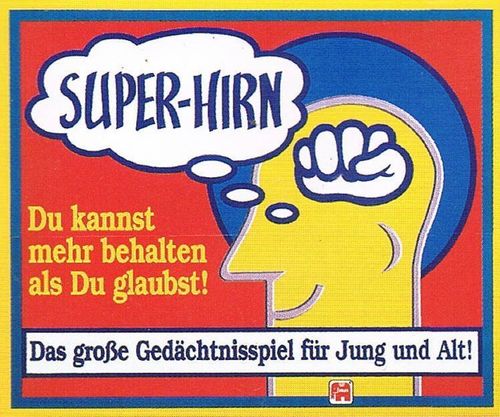
Super-Hirn
Super-Hirn Rulebook
Table of Contents
Table of Contents
Contents of the Box
Game board, 100 yellow question cards, 236 red question cards (note: yellow and red cards may be packed together), 6 playing pieces, 1 large playing piece, 4 Kim cards (they are named after the Kim game, a well-known method for training visual memory; the character Kim appears in the work of Rudyard Kipling and Baden-Powell, founder of the Scout movement), 1 small Kim card, 1 die.
Setup
Place the large playing piece on the start field with the arrow. The question cards are shuffled and stand upright within reach in the box. Keep the yellow cards together in one compartment; distribute the red cards at random across two other compartments. The small playing pieces stand in the middle of the board at the start of the points track. Lay the 4 Kim cards and the small Kim card beside the board. Pencils and notepaper are also made ready.
Brief Description of the Game
Whoever is on turn rolls the die and moves the blue piece forward in the direction of the arrow. The field the piece lands on determines what must be done: on a red field, a red question must be answered; on a yellow field, the player is given a yellow question, which he must answer the next time he is on turn and lands on a green field with the blue piece. There are also some special fields. Correct answers score points. These are recorded on the points track in the middle of the board. The winner is the player who first reaches sixteen and then wins the Kim game.
The Game
Most questions in this game can be played at three levels: beginner, advanced and very advanced. For the first round we suggest the middle level. If this proves too hard, take the easier level; if it is too easy, choose the hardest level. It is also possible for players at different levels to play together. If you have mastered a certain level with ease, dare to try a higher level.
The Yellow Fields
When a player with the large playing piece lands on a yellow field, his left-hand neighbour takes one of the cards with the yellow questions and reads it aloud. If the card provides for it, the other players answer the question. These answers are written on a slip of paper. The player places this slip together with the question card in front of him so that he cannot see the question and the answer. When the player lands on a yellow field again, he lays the new card with a new answer slip next to the first one. They must be laid out so that it is clear which question was asked first. In this way a row of questions and answer slips can lie in front of the players. Yellow questions are only answered later; the information must be kept in the head for a while. Since one often has several questions lying in front of oneself, it can get quite crowded in the head!
The Green Fields
Only when the player lands on a green field is a yellow question answered. First the question that was asked first is answered. The other players check, using the card and, if applicable, the slip, whether the answers agree. The next time the player lands again on a green field, he answers the next question, and so on. If he has no yellow questions in front of him, he is unlucky; nothing happens. For each yellow question that the player answers correctly at his level, he receives 2 points. His own playing piece in the middle of the board may therefore be advanced two fields.
The Green-Yellow-Red Fields
Here the player may choose what he wants: red, yellow or green. See the description above. A player who has many yellow questions lying in front of him chooses green; if he has no yellow ones, he chooses yellow.
Red and Green with a Frame
On such a field the player receives double points: 2 points for red and 4 points for green. If the player has no yellow card and lands on a framed green field, he is unlucky and nothing happens.
Man with Glasses
The player may look at a yellow card with the answers once more. He may choose which one he takes.
Man with Mask
The player may answer a yellow question of one of the other players. If he answers it correctly, it brings him 2 points.
Two Men (Duel)
The player chooses an opponent and lays out the Kim cards and the small card. He decides how many Kim cards he wants to play with: 2, 3 or 4. The player and his opponent may look at the cards for 30 seconds. Then the two players look away, and a third player places the small Kim card on one of the pictures. Afterwards the two duellists write down what has been covered. Two points are to be distributed: if both give the correct answer, each receives 1 point; if both answer incorrectly, there are 0 points; if one player gives the correct answer, he receives 2 points. If the game is played by two people, the game is played twice, and each covers a picture for the other. The points distribution stays the same.
The Finale
A player who reaches number 16 with his playing piece plays THE FINALE the next time. In the finale the Kim game, already known from the duel, is played again. The player plays at his own level, that is, 2 cards for the easy level, 3 cards for the middle level and 4 cards for the hardest level. He may look at the cards for 30 seconds and then turns around. One of the other players covers a picture. Do you know which one? If you do not know, try again with other Kim cards when it is your turn. If your answer is right, you are the WINNER, provided no one beats you to it!
In the Memory Kitchen
To improve memory performance it is useful to know something about how memory works. Three phases play an important role in remembering: the perception of the information, the storing of the information, and the bringing forth of the information.
Concentration is the most important factor for achieving a good result. Do not let yourself be distracted! Attention is strongest when the information has special properties. And if the information is not so special, one can of course make it into something special.
If you want to remember where a key lies, imagine a giant key standing in the corner of the room. The same can be done with words that you have to remember while playing: exaggerate!
We perceive information with our senses. Things imprint themselves on the memory in three ways, depending on the sense organ used:
- Verbal
- Visual
- Experience
The verbal memory takes care of words and phrases, the visual memory holds on to images, and experience preserves the perceptions of other senses. Exact boundaries cannot always be drawn, but when remembering a series of words the verbal memory is called upon.
Whoever looks at pictures and tries to remember them relies on his visual memory. Whoever wants to learn to tie shoelaces or play tennis needs experiential memory. Most people are better at one than at the other, and this can be used. One can work on the information before it is stored.
If you have a stronger visual memory ("I never forget a face"), you can make a picture of words or names. Picture the thing to be remembered in front of you, and if possible in as much detail as you can. If your verbal memory is stronger, name as much as possible of the pictures, situations and actions: say what you see or what you have to do.
Remembering works even better when you create a connection between the words you have to remember. Make a little story out of them. It is easier to remember a story than loose words. The best results are naturally achieved when you combine all three kinds. Use the kind of memory that suits you best, make up a story and exaggerate it, because exaggeration makes things vivid and memorable. Surely it is time for an example:
You have to buy a chicken and shampoo at the supermarket and then also find a present for Aunt Anna. If you imagine a life-size rooster with a soaped comb, which rings at Aunt Anna's with a present in its claws, there is a good chance you will still remember the matter next month!
One last short theory. It deals with the storing of information. For this there are three memory systems available: the ultra-short memory, the short-term memory and the long-term memory. The differences speak for themselves. If you have to remember a series of words, as with the red questions of the game parts "Which word is missing?" and "Do you remember it?", then the last words are stored in the ultra-short memory; from these the sounds still vibrate a little. If you are to reproduce these words, you must name them first. They have disappeared after a few seconds. Try to fit the other words into the short-term memory; then they stay longer.
That should be enough for the start. If you want to know more about how memory works (it is very fascinating!), look in a book. Do not expect your performance to rise sharply after reading this section. Practice makes the master. Thinking in pictures, and stringing them together, takes some practice.
But the useful effect of this practice can be quite high. And what is nicer than combining the useful with the pleasant?
Super-Hirn, the only thing you forget is the time!
The Red Fields
This game is started by the eldest player. He rolls the die and moves the large blue playing piece in the direction of the arrow. Then these rules state what must be done:
When the player with the large playing piece lands on a red field, he takes a red card from the box at his left-hand side. The red cards show various memory game variations. If a player solves the task correctly on an ordinary red field, he receives one point. This means he may advance his playing piece one field in the middle of the board. No notes may be made for any of the games in this category.
Further explanations follow:
A. Which Word Is Missing?
Under the title there are 8 words that fit the title. Depending on the player's level, the player to the left reads out, apart from the title, 4, 6 or 8 words. The words are read out slowly, loudly and clearly. Then the reader reads the words once more, but leaves out one word. And the question is naturally: "Which word is missing?"
B. Do You Remember It?
On the card there are 10 words. The neighbour reads them all out slowly and clearly once. The player tries to remember them. Then he names - depending on his level - 4, 6 or 8 words.
C. Alphabetical Order
A series of well-known lines of text is to be read. Most players will know the lines. The fellow player on the left chooses a line and reads it out once. Then the player must name the words in alphabetical order. If a word occurs twice or several times in the sentence, the word must also be named twice or several times. If several words begin with the same letter, the second letter naturally determines which word must be said first, and so on.
Whoever makes a (small) mistake must wait until he is on turn again.
D. Reading the Card
Look at the plan for 30 seconds. Keep a pen and paper ready. The card is then taken away. Whoever plays at the easiest level draws only the red connecting lines and makes a cross at the spot where the small figures stood. At the middle level the player draws the correct figures and states whether they are white or black. At the highest level something difficult is expected: figures, colours and lines must all be reproduced correctly.
E. Quartet Game
Everyone knows the quartet game: all cards are shuffled and dealt out. The cards are made up of series of four each (a quartet). Complete quartets must be collected.
Whoever is on turn asks the other players for the quartet cards he needs. In keeping with the well-known quartet game, the ability to concentrate is called upon here. It is important to keep in mind that a quartet always consists of 4 cards. So if it is a quartet "Predators", four predator cards must be distributed among the supposed players.
It is about deducing which cards the last player in the hand is holding. All players say which cards they hold in their own hand, except the last one. His hand must complete all the quartets of the others.
An example should make this clear: there are three players, and therefore also three quartets. Hans has 2 predators, 1 rodent and 3 birds of prey. Karin has 1 predator, 2 rodents and 1 bird of prey. Which cards does Susanne have then?
The answer: 1 predator and 1 rodent! First one always gets to hear how many players there are and how many quartets are involved. The quartets are named to each player in the same order. Reading out several times makes the task easier. At the most difficult level it is read out only once.
F. Learning Swahili
You would surely never have thought you would learn Swahili once more! On the card there are 6 words with the corresponding translation. The fellow player on the left reads all six out with the translation. Swahili words are mostly easy to pronounce and sound pleasant. Some words are generally known, e.g. "Daktari" and "Jenga". The reader reads all of them out with the correct meaning. If the level is easy, he then reads out one word in Swahili and asks for its meaning.
If the player plays at the middle level, the reader chooses two words whose translation must be named. At the most difficult level the player must name the translation of three words.
G. Questions, Questions, Questions
Yes, a dummy can answer more than ten questions in ten ways, it is often claimed. That is certainly true if this dummy only asks about details. The left-hand neighbour reads the whole text aloud. Depending on the player's game level, he then reads 1, 2 or 3 questions from the back of the card. The questioner chooses the questions.
H. Position Game
The reader first reads the question above the text, then the text itself. Depending on the level of the player, he reads the text a second or third time. The player names the new order as his answer.
I. That Is the Question
This seems easier than it is. First the player hears what to pay attention to, then the text follows. But these small texts are so full of information that it is hard to remember everything. Depending on the player's level, the text is read 1, 2 or 3 times. At the end the question is asked.