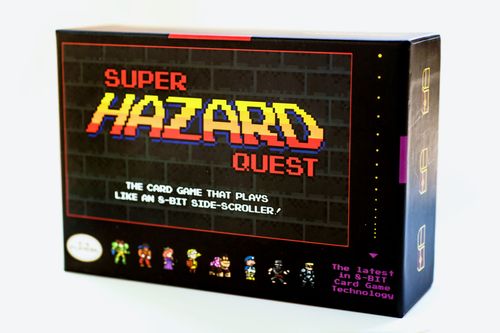
Super Hazard Quest
Super Hazard Quest Rulebook
Table of Contents
Table of Contents
What's in the Box
- 54 Item Cards
- 26 Dungeon Cards
- 2 Instructional Cards
- 8 Character Tokens
- 16 Crystal Shards
- 1 Instructional Manual
The Basics
Super Hazard Quest is a modular board game. The board (or DUNGEON, as we'll call it) is made up of jumbo sized DUNGEON CARDS. Each card represents a room. Shuffling these cards before each game ensures no two DUNGEONS will ever be the same!
All heroes begin on the same DUNGEON CARD. When a new room is entered, a new DUNGEON CARD is drawn from the top of the deck and placed. Thus, the DUNGEON builds as players explore.
Hidden among the DUNGEON CARDS is the dreaded SCRAMBLER. He's the final boss!
The first player to defeat a final boss is the winner. But the SCRAMBLER is a powerful monster and his only weakness is a mystical CRYSTAL.
CRYSTALS are also hidden among the DUNGEON CARDS, guarded by MINI-BOSSES. Players explore the DUNGEON, searching for the SCRAMBLER and these MINI-BOSSES.
There are two SCRAMBLERS in the DUNGEON DECK - red and blue. There are also two CRYSTALS (also red and blue). The color of the CRYSTAL must match the color of the SCRAMBLER in order to successfully defeat him.
The first player to reach a SCRAMBLER while holding a CRYSTAL of a matching color is crowned the ultimate hero and winner of the game.
Setting Up a Game
Each player selects their hero token. Next, everyone draws a random DUNGEON CARD from the deck. Notice that each DUNGEON CARD lists a STAGE NUMBER (located in the top left corner).
The player that draws the lowest STAGE NUMBER places that card center on the table, facing themselves. This is the STARTING CARD and the player that drew it will go first. Other players follow clockwise.
The other DUNGEON CARDS are shuffled back into the deck. Hero tokens are placed at the top of the CHECKPOINT flag on the STARTING CARD. Each player is dealt five ITEM CARDS.
Note that some DUNGEON CARDS don't have a STAGE NUMBER. These instantly disqualify a player from going first. If no player draws a card with a numerical STAGE NUMBER, they all draw again.
Editor's note: the Setting Up section places the STAGE NUMBER in the top left corner of a DUNGEON CARD, while the Glossary entry for Stage Number places it in the upper right hand corner. Both are transcribed as printed.
Navigating Hazards
See these guys? They're called COMBAT HAZARDS. These critters will get in your way while navigating the DUNGEON.
You'll notice there's a word written above each one. That's the name of its corresponding ACTION. Passing each COMBAT HAZARD requires one use of the ACTION listed.
So how can you use ACTIONS? Most ACTIONS are granted by ITEM CARDS.
ITEM CARDS will always explain what ACTIONS they grant, or what they can do. Players hold five ITEMS in their hand at a time. But at the end of a turn, the ITEMS used are DISCARDED.
Moving from one DUNGEON CARD to another also requires an ACTION. A DUNGEON CARD can have up to four possible exits (up, down, left, right) and each one is blocked by a DIRECTION HAZARD.
Like their combat variants, DIRECTION HAZARDS always list the name of the ACTION they require.
It's worth noting that DIRECTION HAZARDS are only encountered when leaving a DUNGEON CARD, not when entering. Another way to think of this is that DIRECTION HAZARDS are only encountered when traveling in the direction their arrow points.
This also means that upon leaving a DUNGEON CARD, the player enters into the next room and ignores the first DIRECTION HAZARD they encounter, or a wall if that stands in their way.
So, we're talking about eight HAZARDS total - that's four DIRECTION HAZARDS and four COMBAT HAZARDS. There are also eight heroes. And this is no coincidence! That's because each hero has a unique INHERENT ACTION.
This INHERENT ACTION can be used as often as the player likes, without having to use an ITEM CARD. Each hero's INHERENT ACTION is listed on their player token below the character sprite.
Taking Your Turn
You may have noticed - most DUNGEON CARDS have a flag off to the left side. This is called a CHECKPOINT.
Players move between CHECKPOINTS during their turn and may pass as many as they like. But all turns must end on a CHECKPOINT. In most cases, this means passing multiple HAZARDS in a single turn. Whenever a turn ends and a CHECKPOINT is reached, heroes slide to the top of the flag and wait for their next turn.
There are two types of turns that can be taken, but we'll talk about STANDARD TURNS first. A turn is considered STANDARD if any of the following take place:
- An ITEM is played properly.
- A Hero moves from one CHECKPOINT to another.
- The DUNGEON is expanded further.
When a STANDARD TURN begins, players slide their hero token to the bottom of the CHECKPOINT and begin moving along the floor of the DUNGEON in accordance to the PROPER MOVEMENT demo card. With each HAZARD encountered, the player shows their opponents how they'll pass.
If this involves using an ITEM CARD, that card is placed face up on the table for other players to see. Played ITEMS make up the ACTIVE HAND. The cards in the ACTIVE HAND remain on the table until the end of the turn. Any or all ITEMS in a player's hand can be added to the ACTIVE HAND, as long as each ITEM is properly used once.
When the turn ends, the ITEMS in the ACTIVE HAND are discarded and new ones are drawn to use next turn. Five ITEMS are always held by the player.
If a player lacks the ACTIONS required to take a STANDARD TURN, they may instead take a DISCARD TURN. In this case, they may DISCARD as many ITEMS as they wish and draw new ones to replace them. Nothing else may be done during this turn.
Defeating Bosses
To defeat a MINI-BOSS, the player must first occupy the CHECKPOINT of that Boss's DUNGEON CARD. From there, defeating a MINI-BOSS requires a combination of four ACTIONS to be played in a single turn. The names of these ACTIONS are listed above them.
A MINI-BOSS does not need to be defeated in order to pass it. Rather, defeating a MINI-BOSS earns the player a BOSS PRIZE, listed in the upper right corner of the DUNGEON CARD.
There is no limit to the number of times a MINI-BOSS can be defeated, or to the number of BOSS PRIZES earned.
Possible BOSS PRIZES are:
- Any Future Item: Player may go into the ITEM DECK, choose an ITEM and add it to their hand.
- Any Discarded Item: Player may go into the DISCARD pile, choose an ITEM and add it to their hand.
- Blue or Red Crystals: The key to defeating THE SCRAMBLER.
Once a MINI-BOSS is defeated, the turn continues as usual. This means if the BOSS PRIZE is an ITEM (either a Future Item or a Discarded Item) that card may be played in the current turn or stored in the player's hand for later.
Also bear in mind that the once the new ITEM DECK is empty, the DISCARD pile is reshuffled, turned over and becomes the new ITEM DECK.
Wounded Heroes
Just because a player has earned a CRYSTAL doesn't mean they get to keep it! When a new area of the DUNGEON is entered and new DUNGEON CARDS are placed, players may encounter additional HAZARDS that prevent them from reaching the next CHECKPOINT. In this case, their hero gets WOUNDED.
If WOUNDED, a player's turn ends instantly and they must return to the CHECKPOINT where their turn began.
Additionally, all CRYSTALS (if held by that player) are lost. Hitting a Dead End or a SCRAMBLER (without holding its matching CRYSTAL) instantly WOUNDS the player as well.
To ensure safe travels, a player may choose to perform a LOOK. This is a safe way to expand the DUNGEON without risk being WOUNDED.
LOOKING is performed on a CHECKPOINT. The player first picks a blank area on the table, adjacent to the DUNGEON CARD they're on. They then draw a new DUNGEON CARD and place it in that space. LOOKING ends a turn instantly. If no blank spaces are available adjacent to Dungeon Card, a LOOK cannot be performed.
Players may also WOUND each other through something we call HERO BATTLE. For more information on this, see the Advanced Strategies section.
Item Types
There are three types of Item Cards a player may find: ACTION ITEMS, HAZARD ITEMS and SPECIAL ITEMS.
ACTION ITEMS grant the player use of the ACTIONS listed. There are four varieties of ACTION ITEMS:
- Dual Action Items offer one time use of a first and/or second ACTION.
- Super Items allow unlimited use of an ACTION on the turn they're played.
- Magic Items allow one time use of any of the eight ACTIONS a player chooses.
- Super Magic Items allow unlimited use of any single ACTION a player chooses that turn.
HAZARD ITEMS are the most versatile card in the game. These allow the player to add or change HAZARDS on any DUNGEON CARD.
Using the punch board HAZARD tokens, players choose and place new HAZARDS on the map, either in blank HAZARD Spaces or over exiting HAZARDS in the DUNGEON. These HAZARDS will remain on the map until another HAZARD ITEM is played over it.
There are two types of HAZARD ITEMS, divided between COMBAT HAZARDS and DIRECTION HAZARDS. The type of HAZARD chosen and where that HAZARD is played must respect these variants. This means DIRECTION HAZARDS must be played over existing DIRECTION HAZARDS and COMBAT HAZARDS must be played over existing COMBAT HAZARDS, or in blank COMBAT HAZARD spaces.
Both varieties can be used to initiate a HERO BATTLE, which is explained in the Advanced Strategies section.
SPECIAL ITEMS are extremely rare and powerful ITEMS that can alter the course of the entire game. The details of each ITEM are described on the card. Due to their powerful nature, they must be played on a CHECKPOINT and playing one forces a turn to end.
Advanced Strategies
RUNNING LEAP - If a player uses their entire hand in a single turn, and ends that turn on a CHECKPOINT, they may "Leap" one adjacent card further. All HAZARDS and proper directions are ignored. If there is no DUNGEON CARD in the direction they choose to "Leap", a new one is drawn and placed.
Note: A Running Leap may not be performed if a SPECIAL ITEM is used. SPECIAL ITEMS end a turn instantly and, in this case, cancel the Running Leap.
LOOKING (to end a turn) - Since LOOKING forces a turn to end, it might help to end most turns with a LOOK, even after a player has moved and reached a new CHECKPOINT. Ending turns with a LOOK ensures the Dungeon will expand even faster, earlier on in the game.
HERO BATTLES - Players can actually steal CRYSTALS from each other by way of a HERO BATTLE. This requires use of a HAZARD ITEM.
During their turn, if a player reaches a CHECKPOINT also occupied by an opponent, they may play their HAZARD ITEM (or ITEMS) face up and announce their intent to do BATTLE.
For each HAZARD ITEM played, the player requests an ACTION from their opponent. Bear in mind the type of HAZARD (Combat or Direction) must match the type of HAZARD ITEM played.
For each ACTION requested, the opponent plays the necessary ITEM. These ITEMS are moved into the DISCARD pile and new ones are drawn after the BATTLE is done. But if the opponent lacks the use of the ACTIONS requested, they lose their CRYSTAL to the player instead.
Glossary
- Checkpoint - Found on nearly every Dungeon Card, players must navigate between these during their turn.
- Combat Hazards - Found toward the center of Dungeon Cards, Combat Hazards require either the Stomp, Attack, Defend or Hide Actions.
- Crystal - The key to defeating The Scrambler. They are earned by defeating Mini-Bosses. There are two Crystals in the base game (Red and Blue). The color of the Crystal must match the color of The Scrambler in order to defeat him.
- Direction Hazard - Found on the edges of Dungeon Cards and encountered only when leaving a Dungeon Room. Direction Hazards require either the Climb, Dig, Lift or Unlock Actions (Representing Up, Down, Left and Right travel).
- Discard Pile - Made up of the Items previously used or discarded. When the Item deck is empty, the Discard pile is turned over, reshuffled and becomes the new Item Deck.
- Discard Turn - A turn in which a player does not move, play an Item or expand the Dungeon. Instead, that player takes a Discard Turn and discards as many Item cards as they wish.
- Dual Action Items - The most common type of Item Card, offering use of a first and/or second Action. These Actions are listed on the card.
- Dungeon - The modular "game board" where all Heroes explore, navigate and battle. The Dungeon is made up of jumbo sized Dungeon Cards.
- Dungeon Cards/Deck - The cards that make up the Dungeon. There are 26 total in the deck. The deck is shuffled before each game ensuring no two Dungeons are the same.
- Hazard - Refers to obstacles in the Dungeon. There are eight Hazards total, divided into two varieties: Combat Hazards and Direction Hazards. To pass any Hazard requires use its corresponding action.
FAQs
Can Mini-Bosses block a player from entering the next Dungeon room? No. A hero may move right past a Mini-Boss if they so wish. The only reason to defeat a Mini-Boss is to earn the player a Boss Prize.
Can Heroes hold multiple crystals? In theory, sure! There is no limit to the number of times a Mini-Boss can be defeated or to the prizes earned. However, if a Hero is wounded or loses a Hero Battle, they lose all of their crystals at once. This means there's no reason for a player to physically hold more than one crystal of each color.
Can Hazard Items be used against Mini-Bosses? No. But they can be used to steal Crystals from other players.
During a Hero Battle, are Hazard Items played all at once? Or one at a time? It's up to the player. For example, two Hazard Items could either be used for one, more powerful battle (where two Actions are requested) or two small battles (Where one Action is requested each time). But keep in mind that after any Hero Battle ends, the defending player draws new Items to replace the one(s) used right away.
Can a Hero backtrack midway through their turn? Technically no. Once moving, a player cannot turn back until they've reached a Checkpoint. Only at this point may they change direction.
Do Heroes encounter Hazards while moving vertically? Yes. If Climbing or Digging twice in a single turn, the hero must pass either of the two Combat Hazard spaces on the left or right side of the Dungeon Card before Climbing or Digging again.
Can I move onto the next Dungeon Card even if there isn't a proper entrance onto that card? Yes - as long as the player can pass the Direction Hazard on the Dungeon Card they're leaving, they may enter onto the next Dungeon Card, even if there isn't another Direction Hazard leading in. Bear in mind though, this means they won't be able to backtrack the way they came.
When wounded, does a hero return to the last Checkpoint they passed? Or to the Checkpoint they started on? Sadly, they must return to the Checkpoint they began their turn on. Think of choosing to end a turn like "Saving" your game. If you don't "Save" you must return back to the last place you did.
Can a player use a Trap Door to move an opponent onto a Dead End? It's a mean but strategic move - and it's totally fair! In this case, the player moved would hit the dead end, then return to the Checkpoint they had been on, losing any Crystal(s) held. Note: this does not mean the aggressing player steals those Crystals. The Crystals are simply removed.
Can players trade Item Cards? Sure… we don't see why not. But trading a card takes the place of a Discard Turn, meaning nothing else can be done. Also keep in mind there's only one winner… so be careful what you're trading and who you're trading with.
Can a player discard Items and Look on the same turn? No. Looking is considered expanding the Dungeon and therefore qualifies the turn as "Successful."
Can an Item be played even if the Action it offers isn't required? Every item played must be properly used at least once. However, that doesn't mean unlimited Actions need to be used in all cases. The Action on Item card may be used even if the Hero already has unlimited access to that Action. This is a great strategy for getting rid of cards a player may not want while still taking a successful turn.
Help! I'm stuck in the Dungeon and there's no way out! What should I do? Relax. Take a deep breath. There's always a way out, but in some cases it might involve working with opponents. Using the right Special Items will allow you to manipulate the Dungeon in such a way that will make it beatable.