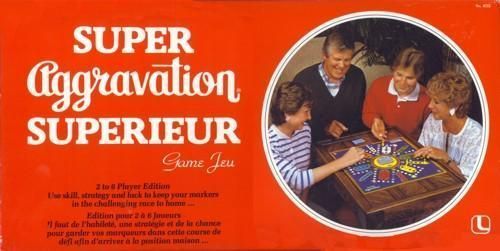
Super Aggravation
Super Aggravation Rulebook
Table of Contents
Table of Contents
The Object of the Game
The winner of the game will be the first player to move all four markers around the board from Base to Home Safe. (You don't have to Aggravate the other players in order to win, but it sure helps!)
Playing the Game
Shuffle together the red and blue card decks and place them at the centre of the game board. Each player chooses a set of coloured markers and places them in the Base Row relative to their colour. Players each roll the die once; the player rolling the highest number starts the game. Game play proceeds to the left of the starting player.
A one or a six must be rolled in order to move a marker out of the base position into the first position of the starting row. Players roll the die once per turn and then move a marker which has been Started the exact number of positions shown by the number on the die.
Players have two choices when a one or a six is rolled. They can either move a new marker out of their base or they can move a marker already in play. The rolling of a six always entitles a player to an extra turn if the first six was used. This also applies when a marker is moved from the Base to the Starting Row.
Moves
Unless instructed by a Super Aggravation Card, players cannot jump over or land on their own markers. Players can jump over their opponents' markers. However, if a marker lands on the spot occupied by another player's marker, the original marker is Aggravated (sent back to its Base position). The Aggravating marker then occupies the spot instead.
Aggravated markers are moved onto the board again with a one or a six as before. Markers are subject to Aggravation any place on the board except their Base or Home Safe positions.
Super Aggravation Cards
There are 20 red cards which contain a majority of Aggravating directions and 20 blue cards which contain a majority of Beneficial directions. But be careful, as both decks contain hidden surprises which can help you or add to your Aggravation!
The red and blue decks are shuffled together and placed at the centre of the game board. Players must draw the top card from the deck if they land on a Red star position, but have an option to draw or not to draw the top card if they land on a Gold star position. Players drawing a card must follow the card instructions. Instructions apply to the marker positioned on the star. Once used, replace the card at the bottom of the deck. Two blue cards (Anti-Aggravation and Aggravation Insurance) may be saved for use on a future turn. Once used, these cards are to be returned to the bottom of the deck.
Only when following Card Instructions can players jump over or land upon their own markers. However, if your marker lands upon one of your own markers, you must Aggravate your marker back to Base.
Taking a Short-Cut
The six corner Short-Cuts: The corner Short-Cuts are shown by a yellow dotted circle in the corner positions on the playing board. These Short-Cuts can be used when a marker lands exactly in the corner position. Beginning with his next turn, the player can move the marker around the board in the corner positions the number of moves allowed by his roll.
Players can use all or part of their allowed moves in these corner positions. They can move around the corner Short-Cuts until they hit the row leading to their Home Safe position. They then continue moving down the row with whatever moves remain (Figure 1).
Super Short-Cut
The Super Short-Cut: The ring position in the centre of the board is a Super Short-Cut. It can be used from any place on the board when a player rolls the exact number that will position their marker in the ring (Figure 2).
A one must be rolled in order to leave the Super Short-Cut.
Short-Cuts are optional moves that a player can make if they want to. They're great because they shorten the length of time it takes to move around the board. But remember... you can be Aggravated from the Short-Cuts, too!
Figure 1
Marker is at position (A). A Five is rolled and it is moved around the corner Short-Cuts to the Home Safe row (B). There are two moves left to make down the row.
Figure 2
Marker can be moved three positions from position (A), so it goes exactly into the Super Short-Cut ring (B). You can be Aggravated from the Super Short-Cut. Only one player may occupy the Super Short-Cut ring at a time. When a one is rolled, the marker is moved from the Super Short-Cut to the corner position in its Home Safe row (C).
Home Safe
You need an even roll to get 'Home Safe.' [sic: the source copy says "even"; the base Aggravation rules require an exact count, so this may be a source error. Transcribed as printed.] If your roll gives you more moves than you need to get into your safety position, you cannot move. You must wait until your next turn to try and roll the number needed to go 'Home.'
Partnership Play
Your partner will play the position opposite you on the playing board. Game play is similar to individual play except [sic: the printed sentence ends here, with the list of differences that follows]:
- A player can jump over his partner's markers. However, if the only move available lands your marker on the spot occupied by your partner's marker, you must Aggravate the marker. You cannot pass and wait until your next turn to continue play.
- When one partner has all his markers Home Safe, he can continue to roll the die in turn. The partner still playing then moves his marker the number of moves allowed by the roll. If no move using the number is possible, the roll is voided and the next player takes his turn.
The game is won when all markers of both partners are Home Safe.
Team Play
Each team consists of three players. Team members are seated alternately around the board (each player will be seated between players on the opposite team).
The game is played as in Partnership Play except for the following (the printed copy numbers both items "1)"; the second is numbered 2 here):
- A player with all markers Home continues to roll in turn. If both his teammates are still on the board, he must declare, before rolling the die, which teammate is to use the number he rolls. The player must then move the number rolled, even though the move may result in the Aggravation of one of the third teammate's markers.
- When the markers of two team members are Home, the players both roll the die in turn. The team member still on the board moves his remaining markers according to the rolls.
The game is over when all markers of one team are Home Safe.