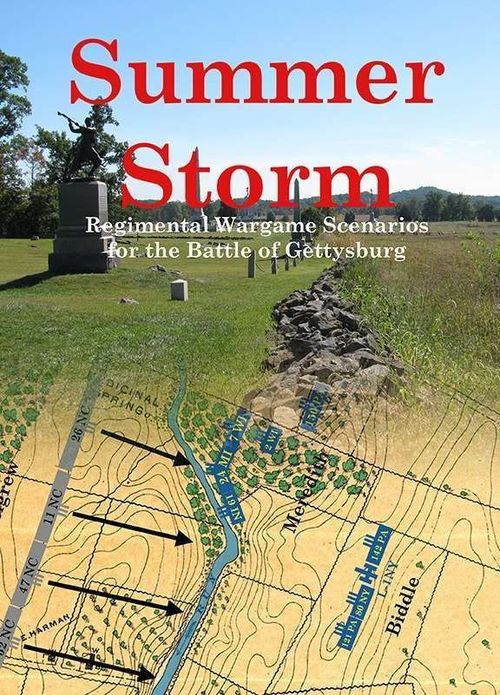
Summer Storm: Regimental Wargame Scenarios for the Battle of Gettysburg
Rulebook PDF: Historic Imagination · PDF
Summer Storm: Regimental Wargame Scenarios for the Battle of Gettysburg Rulebook
Table of Contents
Table of Contents
Game Overview
This battle depicts the opening infantry fight at Gettysburg on the morning of July 1st. Its two brigades against two across woods, wheatfields, and undulating terrain. Can the Confederates knock the Union off balance before they can consolidate and counterattack?
The scenario map is 5'x 4'. The battle starts at 10:30 AM and ends on Turn [10/7/5], or when one side can no longer continue based upon the fatigue rules of the game being played.
Terrain
The terrain consists mainly of McPherson Ridge extending north-south across the map, with plenty of wheatfields, fences, and woods to break up the landscape. The ridge and hills on this side of town really are "gentle". For the most accuracy, hills should only be ½” per elevation, though in this scenario, there is only one level. Elevations of 1” are fine if that is all that is available. The hills should be beveled gradually; try to avoid cliffs at the edge of the hillsides.
An unfinished railroad parallels the Chambersburg Turnpike to the north. There are no rails, but the right of way has been levelled. Units can travel along the bed at trail movement. Units in the railroad bed can use the banks as cover, and receive a cover benefit for any fire across the bed. This benefit does not apply if the fire is coming down the right of way in either direction.
Willoughby Run is not deep, but the banks can be steep. It confers a cover benefit to any unit in the stream deployed along the banks.
There is a small quarry along the east bank of the stream west of the McPherson farm. This feature is about an inch wide on the game table. It is impassable terrain. Any unit, or portion of a unit if applicable, that takes fire across the quarry gets a cover benefit.
The woods on the map, particularly Herbst Woods but including all the woods shown, were very open with little underbrush. Visibility should be for light woods, and movement should only be hindered by about an inch per turn. The orchards act as light woods for visibility. Movement is also as light woods for infantry and cavalry regiments in line of battle, disorder, or field columns. They are open movement for units in column and skirmish formation. They have no effect on the movement of artillery batteries.
Units in wheatfields and cornfields receive an additional cover bonus if they are lying prone. Standing units, moving or firing, do not receive this bonus. In addition, enemy units firing from a higher elevation will negate this advantage.
Image caption (Major General Henry Heth): not transcribed.
Deployment
Deploy the opposing forces on the board as shown. Cutler's brigade has just taken position along the ridge, and Davis is closing fast. Archer and Meredith are on a collision course in Herbst Woods. The 6th Wisconsin enters the board on Turn [1/1/1] at the southeast corner of the board at 1. General Reynolds begins the game next to the 2nd Wisconsin. All brigade generals may begin anywhere within an inch of a regiment in their brigade. There is no record of either division commanders being close to the combat. However, General Wadsworth was most likely on Seminary Ridge to the east. He may enter the board anywhere on the eastern edge of the board south of the Chambersburg Turnpike any time after Turn [5/4/3].
The Confederates had artillery stationed on Herr Ridge to the west. They fired at McPherson Ridge throughout the day, and did cause casualties. To simulate this, the Confederate player controls Pegram's Battalion as off-board artillery. They may fire from any point at the shaded area marked 2. Simply calculate the distance from the edge of the board to the target, and add an additional foot. Line of sight begins at the edge of the board as well, blocking most targets behind McPherson Ridge and Herbst Woods.
While there would technically be cavalry and a horse battery leaving the area of the McPherson farm, they had positive orders to leave and have not been represented in the scenario. This is an infantry fight.
Image caption (Major General John F. Reynolds): not transcribed.
The two map pages of the sample (the terrain map and the deployment map with the unit counters and the shaded off-board artillery area) are not reproduced as text; the deployment is given in the text above.
Victory Conditions
There are no terrain based Victory Conditions. The fighting continues until one side or the other can no longer continue based upon the morale and fatigue rules of the game being played. After the battle has finished, add up the Victory Points based upon unit casualties. The side with the most Victory Points wins.
Order of Battle
Union
Army of the Potomac
First Army Corps
MG John F. Reynolds [+2]
1st Division
BG James S. Wadsworth [+2]
1st Brigade
| Unit | ES | 20 | 30 | 40 | 50 | 100 | Status | Arm. |
|---|---|---|---|---|---|---|---|---|
| BG Solomon Meredith [+1] | 1,894 | 94 | 63 | 48 | 39 | 19 | ||
| 19th Indiana | 328 | 16 | 11 | 8 | 7 | 3 | 4 | R |
| 24th Michigan | 476 | 24 | 16 | 12 | 10 | 5 | 2 | R |
| 2nd Wisconsin | 282 | 14 | 9 | 7 | 6 | 3 | 4 | R |
| 6th Wisconsin | 424* | 21 | 14 | 11 | 8 | 4 | 4 | R |
| 7th Wisconsin | 384 | 19 | 13 | 10 | 8 | 4 | 4 | R |
* Includes 100 man Brigade Guard that fought with the regiment.
2nd Brigade
| Unit | ES | 20 | 30 | 40 | 50 | 100 | Status | Arm. |
|---|---|---|---|---|---|---|---|---|
| BG Lysander Cutler [+1] | 1,566 | 79 | 53 | 39 | 32 | 16 | ||
| 76th New York | 375 | 19 | 13 | 9 | 8 | 4 | 3 | R |
| 84th New York* | 318 | 16 | 11 | 8 | 6 | 3 | 4 | R |
| 95th New York | 241 | 12 | 8 | 6 | 5 | 2 | 4 | R |
| 147th New York | 380 | 19 | 13 | 10 | 8 | 4 | 2 | R |
| 56th Pennsylvania | 252 | 13 | 8 | 6 | 5 | 3 | 3 | R |
* Also known as the 14th Brooklyn.
Artillery Brigade
| Unit | ES | Status | Armament |
|---|---|---|---|
| Battery B, 2nd Maine | 117 | 2 | 6x 3" R |
Confederate
Army of Northern Virginia
Third Army Corps
Heth's Division
Archer's Brigade
| Unit | ES | 20 | 30 | 40 | 50 | 100 | Status | Arm. |
|---|---|---|---|---|---|---|---|---|
| BG James J. Archer [+1] | 1,193 | 59 | 39 | 30 | 24 | 11 | ||
| 13th Alabama | 308 | 15 | 10 | 8 | 6 | 3 | 3 | R |
| 5th Alabama Battalion | 135 | 7 | 5 | 3 | 3 | 1 | 4 | R |
| 1st Tennessee Provisional Army | 281 | 14 | 9 | 7 | 6 | 3 | 4 | R |
| 7th Tennessee | 249 | 12 | 8 | 6 | 5 | 2 | 3 | R |
| 14th Tennessee | 220 | 11 | 7 | 6 | 4 | 2 | 4 | R |
Davis' Brigade
| Unit | ES | 20 | 30 | 40 | 50 | 100 | Status | Arm. |
|---|---|---|---|---|---|---|---|---|
| BG Joseph R. Davis [+1] | 1,707 | 116 | 76 | 57 | 47 | 23 | ||
| 2nd Mississippi | 492 | 25 | 16 | 12 | 10 | 5 | 3 | R |
| 42nd Mississippi | 575 | 29 | 19 | 14 | 12 | 6 | 2 | R |
| 55th North Carolina | 640 | 32 | 21 | 16 | 13 | 6 | 2 | R |
Pegram's Artillery Battalion
| Unit | ES | Status | Armament |
|---|---|---|---|
| Crenshaw's Virginia Battery | 76 | 3 | 2x 12 lb. N, 2x 12 lb. H |
| Fredericksburg Virginia Battery | 71 | 3 | 2x 12 lb. N, 2x 3" R |
| Letcher Virginia Battery | 65 | 3 | 2x 12 lb. N, 2x 10 lb. P |
| Pee Dee South Carolina Battery | 65 | 3 | 3x 3" R |
| Purcell Virginia Battery | 89 | 3 | 4x 12 lb. N |
The battalion's ES figure printed on the source's header line for Pegram's Artillery Battalion is 366 (the sum of the five batteries).
Image caption (Matthew Brady photograph of the northeast corner of Herbst Woods, taken July 15th, 1863): not transcribed.
Optional Rules
There are no Optional Rules for this scenario. It's a pretty straightforward fight.
Author's Notes
This is a nice, small fight. I've always been fascinated by this opening round of the battle, and the famed Iron Brigade is one of my favorite units to study. It's also a great introductory scenario for testing a new set of rules.