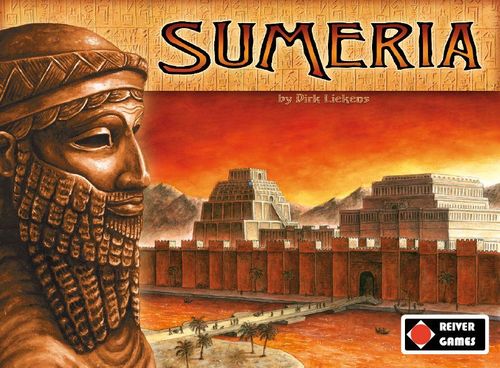
Sumeria
Sumeria Rulebook
Table of Contents
Table of Contents
Game Materials
The game board depicts 8 City-States, each with one city, 3 towns, and 3 villages, all connected by trade routes.
-
City
-
Town
-
Village
-
Trade route
-
Turn track
-
1 first player marker (large pawn)
-
1 turn marker (large white pawn)
-
36 Influence tiles: 9 Economy, 9 Military, 9 Political, 9 Religion
-
56 trader markers (14 in each of the 4 player colors)
-
8 City-State tiles
-
1 bag
Setup
Each player receives trader markers of one color:
- 14 for a 3-player game
- 10 for a 4-player game
The remaining pieces go back in the box and are not used during the game.
Place the 8 City-State tiles in random order at the bottom of the game board as shown. Their position determines their importance during the course of the game. The 3 leftmost are the City-States, ordered in ascending order, that will be scored at the end of the round. The order of the 3 City-States changes according to the actions of the players.
Put all the Influence tiles in the bag and draw 6. Place them on the spaces at the bottom left of the board, as shown in the illustration.
The turn marker is placed on space 1 of the turn track on the board.
A first player is designated at random; they receive the first player pawn.
Starting with the first player, players place one of their traders in a city, town, or village on the board. Each location may hold only a single trader.
Cities are more important than towns, which are themselves more important than villages. It is wise to have traders spread out across the board, and particularly in the City-States that are about to be scored.
This is repeated until each player has placed:
- 8 traders in a 3-player game
- 5 traders in a 4-player game
Players place their remaining traders in front of them.
Course of the Game
A game is played over 6 rounds. During each round, players (starting with the first player) take 3 turns.
On their turn, a player must carry out one of the following 3 actions:
- Add one of their traders to the board, or
- Move one of their traders on the board, or
- Remove one of their traders from the board.
Add one of your traders to the board
A player takes one of their remaining traders from their reserve and places it on an empty space on the board. This City-State has now gained influence. The tile of this City-State is then swapped with the one to its left, in order of importance (if possible).
If all of a player's traders are already on the board, this option is not available.
Move one of your traders on the board
A player moves one of their traders along any stretch of a trade route to the next location in that direction.
You may jump over any traders (opponents' or your own) but must stop at the first empty location.
When you arrive at an occupied city, you may continue along any trade route leaving that city.
The circled trader in the illustration can move to the 3 locations indicated by the arrows.
If a trader ends its move in a City-State different from the one it left, the destination City-State gains influence. The tile of this City-State is then swapped with the one to its left, in order of importance (if possible).
Remove one of your traders from the board
A player takes one of their traders present on the board and returns it to their reserve. This City-State then loses influence. The tile of this City-State is swapped with the one to its right, in order of importance (if possible).
Once all players have completed their turn, the turn marker is advanced along the turn track.
End of a Round
A round ends when all players have completed their 3 turns. At the end of each round, it is determined who controls each of the 3 City-States, in order of importance.
The 3 leftmost City-States are the most important (the leftmost being the most important), and the players with the most influence in these City-States gain power in the form of Influence tiles.
For each of these City-States, the player with the most traders in that City-State gains control of it; the player with the second-highest number of traders becomes second. Ties are broken using the locations within that City-State.
In case of a tie, the tied player who has a trader in the city wins. If the tie persists, the tied player with the most traders in the towns wins. If there is still a tie, the tied player who played first during that round wins.
- The player who gains control of the first City-State chooses 2 of the 3 Influence tiles above that City-State's tile. The second-place player receives the remaining Influence tile.
- The player who gains control of the second City-State chooses 1 of the 2 Influence tiles above that City-State's tile. The second-place player receives the remaining Influence tile.
- The player who gains control of the third City-State receives the Influence tile above that City-State's tile. The second-place player receives nothing.
If there is no trader in a City-State being scored, all its Influence tiles are discarded. Likewise, if only one player has traders in either of the first 2 City-States, that player has the choice of Influence tiles, but the remaining tiles are discarded.
The board is then reset for the next round:
- The turn marker is placed back on space 1 of the turn track.
- 6 Influence tiles are placed back above the 3 City-States, drawn at random from the bag.
- The first player for the next round is determined. The player who had the fewest traders for the first City-State is last for the round; the player to their left therefore receives the first player marker. If there is a tie for the fewest traders in the first City-State, this tie-breaking process is repeated for each City-State until there is a single player with the fewest traders.
- The first 3 City-State tiles (the 3 that were just scored) are set aside. The remaining tiles are moved 3 ranks to the left (so the 4th City-State becomes the 1st). Then, finally, the 3 scored City-States are placed back in reverse order (i.e. as the 8th, 7th, and 6th).
Before / After: the illustration shows the City-State row shifting left by 3 and the 3 just-scored tiles returning to the right end of the row in reverse order.
Players who collect Influence tiles during the game must place them in front of themselves so that everyone can see them.
End of the Game
6 rounds are played so that all the Influence tiles come into play.
Each player scores points with their Influence tiles. Points are earned for each of the 4 types of Influence tile according to the following table:
| Number of tiles of one type | 1 | 2 | 3 | 4 | 5 | 6 | 7 | 8 | 9 |
|---|---|---|---|---|---|---|---|---|---|
| Points | 1 | 3 | 6 | 10 | 15 | 21 | 28 | 36 | 45 |
The points earned are then totaled; the player with the most points wins. In case of a tie, the tied player with the most Influence tiles of a single type wins. If the tie still persists, all tied players share the win.
Scoring Example
Dirk, Jack, and Paul played a game together. The scoring is as follows:
| Player | Economy | Military | Political | Religion | Total |
|---|---|---|---|---|---|
| Dirk | 4x = 10 | 2x = 3 | 4x = 10 | 5x = 15 | 38 |
| Jack | 3x = 6 | 2x = 3 | 5x = 15 | 1x = 1 | 25 |
| Paul | 2x = 3 | 5x = 15 | 0x = 0 | 3x = 6 | 24 |
Dirk wins.
Acknowledgements
Dirk thanks: Nicky, David, Bart, Sam, Gunther, gameclub "3 Promille," and especially his family.
Reiver Games thanks, for their playtesting and proofreading: Paul Allwood, Chris Barnard, Spencer Booth, Andy Evans, Chris Funk, Paul Graham, Steve Kearon, Michael Kröhnert, Richard Lea, W. Eric Martin, Vin Petrol, Louise Pope, Mal Ross, Duncan Sangster, Harald Schindler, Chris Sorrell, Lisa Willcox, and Paul Willcox.
Illustrations by Harald Lieske (www.haraldlieske.de).
For more information about Sumeria and other games, visit the Reiver Games website: www.reivergames.co.uk
Sumeria, its rules and illustrations, are protected by copyright © Reiver Games 2009. All rights reserved.
Warning
Not suitable for children under 3 years. Contains small parts that may be inhaled or swallowed.