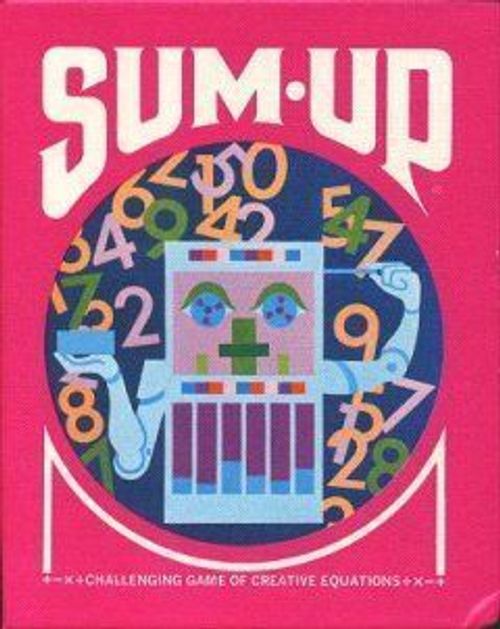
Sum-Up
Sum-Up Rulebook
Table of Contents
Table of Contents
Play
The dealer (hand number 1) places the hourglass in the hole of the card tablet. Now, within the running time of the hourglass (about 5 minutes), each player must first form, from their own hand, an addition that yields as high a sum as possible. Any number of cards may remain over. The cards must be arranged in the hand in a sensible way, and the addition must be written down within the allowed time (for checking and scoring) in the column provided for it on the prepared sheet, under the number of one's own hand, and secretly.
Example: The player with hand 4 holds the following cards: 0, 0, 4, 4, 6, 6, 6, 8, 8, 9. From these he could form the following addition: 800, 64, 864 (800 + 64 = 864), whereby the cards 6 and 9 naturally remain over for him. He enters in the first column (+), next to the number 4 (his hand): 800 + 64 = 864.
Transcriber's note: the printed example leaves the cards 6 and 9 over, but the addition shown (800 + 64) uses the cards 8, 0, 0, 6 and 4, which would leave 4, 6, 6, 8 and 9. The text is transcribed as printed.
Whoever first notices that the time is up (hourglass run out) calls "Stop!". From now on no more entries may be made. Players who have not yet noted anything enter a zero in the appropriate place. Once every result is recorded, all notes are turned over. Now each player passes his cards, together with his hand card, to his left-hand neighbour. The hourglass is turned over, and each player tries to form an optimal addition from these foreign cards. These equations too are recorded, next to the number that the hand card shows.
This is repeated until every player has worked through every hand.
Round 2: Subtraction
This first round is followed by the second, subtraction. Here too the aim is to achieve as high a result as possible, i.e. to subtract as little as possible from as high a first number as possible. The third number is scored.
Rounds 3 and 4: Multiplication and Division
When every player has played every hand, round 3, multiplication, follows, and then round 4, division, where in the latter too a high result again matters. Of course, before each round the number cards are collected, shuffled and dealt out anew.
Winner
The player with the highest total sum wins.
About the Game
The time for forming an equation is generous, so players should tackle the task without haste, even with apparently "impossible" cards. Here one simply has to give up several cards and be content with a relatively low result, which is better than none at all. After all, the opponents also have to cope with this "impossible" hand, and they should first try to do better. Of course one forms one's equations face down in the hand, just as one keeps one's notes secret.
[The panel ends mid-sentence here. The remainder of this section is on a part of the sheet that was not photographed.]