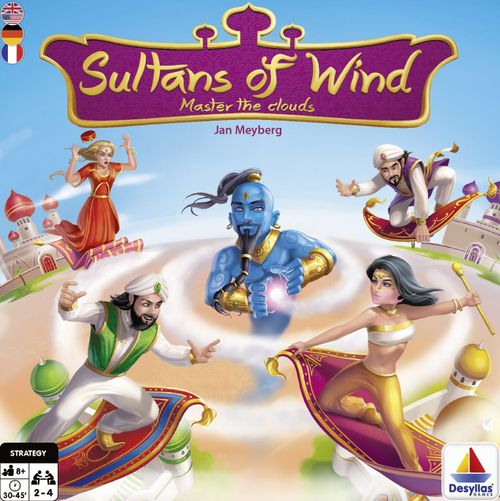
Sultans of Wind
Sultans of Wind Rulebook
Table of Contents
Table of Contents
Components
- 32 Wind Tiles, in 4 different colors (Wind strength shown in the upper left corner)
- 12 wooden Carpet Pawns (in 4 different colors)
- 12 Cloud Tiles (each showing free spaces and blocked spaces)
- 1 Game Board
- 1 Djinn Pawn
- 1 Djinn Favor Card
- 4 Player Screens
The Wind Tile actions are shown pictorially on the printed tiles and in the "Visual description of action" panel; the text of each action is given under Wind Tile Actions below.
Your friend Djinn is here to help you! Each Cloud Tile consists of 9 spaces, 5 of which are blocked by clouds. You can move your Carpets only through empty spaces…
Game Overview
Sultans of Wind is a strategic game, where players have to program their actions each turn, choosing 2 Wind Tiles amongst 8 different ones, and guide their carpets through an ever-changing maze of clouds towards the opposing players' Palace. By using the Djinn's power, players can manipulate the Game Board to their benefit. If they are skillful enough, they can even catch the Djinn flying through the clouds, in which case the Djinn must grant them a wish! The first player to land all his carpets on the opposing Palace is the winner.
Game Setup
Place the Game Board at the center of the table. Each player chooses a color and receives 2 Carpet Pawns in a 3 to 4 player game and 3 Carpet Pawns in a 2 player game, a Player Screen and 8 Wind Tiles of the same color.
Each player starts from their Palace, which matches the color they choose, and place their Carpets on the indicated spaces of their Palace. Next, players place their Screen on their Wind Channel, which is located behind their Palace. All starting spaces are used in a 2-player-game. In a 3 to 4 player game, the dashed space on the starting area stays empty.
Shuffle the Cloud Tiles, spread them randomly onto the Game Board and flip them face up (the blue side showing clouds should be face up).
Note: In a 2-player-game choose colors on opposing sides of the board. In this way, the race between the 2 carpet crews can begin correctly!
Each player slides their Wind Tiles into face up their Wind Channel in any order they wish. There will be 4 visible Tiles and 4 hidden ones behind each Player Screen. The player, whose visible Tiles have the highest total Wind Strength, places the Djinn Pawn on any of the four spaces on the middle of the Game Board (This is the only time that the Djinn Pawn may be placed on a space with a cloud) and takes the Djinn Favor Card. In case of a tie, the player that most recently flew amongst the clouds, receives the Djinn Favor Card and places the Djinn Pawn onto the Game Board.
Gameplay
Each round consists of 2 phases:
- Choose 2 Wind Tiles and determine Turn Order
- Action Phase
1. Choose 2 Wind Tiles and determine Turn Order
Each player secretly chooses 2 of the 4 Wind Tiles located behind his screen and holds them secretly in his hand. When all players have done so, they reveal their chosen Tiles, and the player that has the highest total Wind Strength on his chosen tiles, plays first, followed by the player with the second highest Wind Strength and so forth. In case of a tie the player who has the Djinn's Favor goes first. If the tie is not between players that might have the Djinn's Favor, the player who is closer, in a clockwise order, to the player with the Favor goes first.
Example for Determining Turn Order:
Anthony, , Ben and Shara start their first round of the game. Shara has the Djinn's Favor. After all the players choose their Tiles, they reveal them:
- Anthony reveals a number 8 and a number 3 Tile for this round.
- Ben reveals a number 8 and a number 5 Tile for this round.
- Shara reveals a number 7 and a number 4 Tile for this round.
- John reveals a number 5 and a number 6 Tile for this round.
Ben has the highest total Wind Strength (13), while the other three are tied for a total of 11. Ben starts with his turn. Shara is next (as she has the Djinn's Favor), followed by John (he is the closest, clockwise, player next to Shara) and the last player is Anthony.
Note: the example names three players as Anthony, Ben and Shara, and then refers to a fourth player as John; the printed text leaves a blank where the fourth name belongs in the first sentence. Transcribed as printed.
2. Action Phase
Players now get to resolve their chosen Tiles. Each player, in turn order, plays the actions featured on their Wind Tiles. A player can choose which Tile's action to resolve first and then resolves the second one. The first Wind Tile's action has to be carried out completely before the second Wind Tile's action may be resolved. As soon as a player has completed the action of a Wind Tile, he/she places the corresponding Wind Tile onto the leftmost side of his/her Wind Channel and slides the rest of the tiles 1 space to the right.
You have to be very smart when choosing Wind Tiles. They not only let you play first, but determine your whole strategy. When you play a Wind Tile, you have to place it at the end of your Wind Channel, so it will be available again in later rounds! So be very careful when you choose a Tile, and plan ahead!
Wind Tile Actions
Each Wind Tile has a Wind Strength in the upper left corner and a visual description of its action.
"Move" Wind Tiles (Wind Strength 1, 5 and 7):
A player may move 1 of his/her Carpets up to 3, 6, or 12 spaces on the Game Board, depending on the number that is shown on the Tile. A player may choose not to move the full distance allowed by the action. This movement may not be split between different Carpets.
Movement is only allowed horizontally or vertically (never diagonally) into any adjacent space. A Carpet can move and change direction freely during its movement. Pawns may not move into or over spaces occupied by clouds, Carpets (even your own!) or me, the Djinn! The only exception to this rule is Tile number 3, which be explained below.
"Changing Clouds" Wind Tile (Wind Strength 2):
A player may swap the position of two adjacent Cloud Tiles without changing their orientation. In order to do so, the player picks one of the two desired Tiles out of the Game Board, shifts the other into the resulting gap and repositions the first Tile back into the Board without changing its orientation. Players can use this action even if the Cloud Tile is occupied by Carpets or the Djinn.
"Move Through" Wind Tile (Wind Strength 3):
A player may move one of his/her Carpets up to 2 spaces. This movement may not be split between different Carpets. This action allows movement over clouds, Carpets or even the Djinn, but may not end the movement in an occupied space.
"Turbulence" Wind Tile (Wind Strength 4):
A player may change the orientation of any Cloud Tile. In order to do so he/she picks up the Cloud Tile out of the Board, turns it into the desired orientation and places it back. Players can use this action even if the Cloud Tile is occupied by Carpets or the Djinn.
"Call Djinn" Wind Tile (Wind Strength 6):
A Player removes the Djinn Pawn from the Board and places it onto a Cloud Tile without any Carpets on it. By doing so, the player wins the Djinn's Favor Card.
"Move Djinn" Wind Tile (Wind Strength 8):
A player may move the Djinn Pawn up to 4 spaces. A player may choose not to move the full distance allowed by the action. By doing so, the player wins the Djinn's Favor Card. Whenever a player moves the Djinn's Pawn by playing Tile number 6 or 8, he/she wins the Djinn's Favor, and places the Favor Card in front of him/her.
Djinn's Wish
So what is your wish if you find me among the clouds? Remember, you cannot wish for more wishes or make someone fall in love with you… How about this! An extra action!
There are 2 ways for the Djinn to grant a wish:
- A player moves 1 of his/her Carpets onto a Cloud Tile with the Djinn Pawn and finishes its movement there. The moved Carpet must not have been located on this Cloud Tile at the start of its movement.
- A player uses Wind Tile number 8 to move the Djinn onto a Cloud Tile containing one or more of his/her Carpets, and finishes its movement there. The Djinn must not have been located on this Cloud Tile at the start of its movement.
After finishing a movement which grants a wish and sliding the Wind Tiles back into the Wind Channel, the player that won the wish may immediately choose another Wind Tile from behind his/her Screen and play it as a free action. The player must immediately resolve the extra action of the chosen Tile and slide it back into the Wind Channel.
End of a Round
After all players finish their actions, the round ends. Each player should have 4 Wind Tiles behind their screen at the end of each round.
End of Game
The first player to move all of his/her Carpets onto the starting spaces on the opposite side of the Board wins the race, becoming the new "Sultan of Wind"!
In the rare case that a starting space on a Palace is occupied by another Pawn, then it's enough to reach a space adjacent to the blocked starting space in order to win the game.
Q&A
Q: Do the immoveable 3x3-squares (containing the starting spaces) count as Cloud Tiles as well? A: Technically yes. But they are (obviously!) not affected by "Changing Clouds" and "Turbulence" Wind Tiles (Wind Strength 2 and 4).
Q: What happens if the Djinn's Favor changes during a round and the player order should change as well, because of two players with tied total Wind Strength the other sits closer to the Djinn now? A: Player order is determined in phase 1 of a round, but the favor can only change during phase 2. Thus nothing happens, the player order is preserved.
Q: In case of a 3-player-game, it is possible that I don't have a player on the opposing side of the board. On which starting spaces do I have to move in order to win? A: Just move onto the starting spaces on the opposite side of the board, no matter wether they "belong" to a player or not.