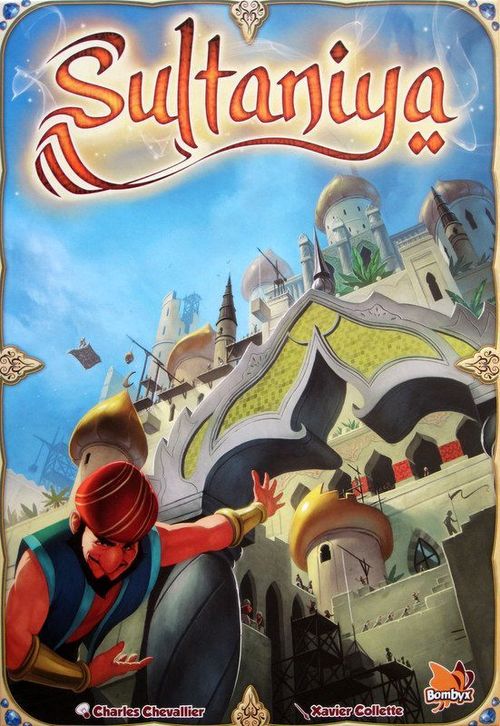
Sultaniya
Sultaniya Rulebook
Table of Contents
Table of Contents
Object of the Game
Each player will have to build the most beautiful palace of Sultaniya in front of them, starting with the constructions already present on their individual boards. At the bottom of the board, the palace elements through which each player will score victory points are indicated. The player with the most victory points at the end of the game will be declared the winner and will become the new Grand Vizier of Sultaniya!
The players will place, at the top of the board, the tiles of the doors to the desert (blue tiles), and place the walls (red tiles) on top of those. The third level will be occupied by the different princely residences (green tiles). Finally, the golden rooftops (golden tiles) will crown these splendid structures. To help them in their task, the players will be able to call upon the powers of the Djinns in exchange for precious sapphires.
The levels of a palace, from bottom to top:
- The doors to the desert (blue)
- The walls (red)
- The princely residences (green)
- The golden rooftops (gold)
Contents
- 4 double-sided individual boards, representing your character on the land which is allotted to you for the construction of your palace (with construction already begun and specific victory point scoring)
- 93 double-sided tiles, including 20 ground levels, 20 first floors, 28 second floors, and 25 rooftops
- 10 Secret Objectives
- 55 Sapphires
- 4 Djinns
- 1 score track and 4 double-sided score tokens
Setup
-
The tiles are removed from the box, then:
- with 2 players, the tiles marked "3+" and "4+" are removed;
- with 3 players, the tiles marked "4+" are removed;
- with 4 players, all tiles are used.
Four piles are made, in a line, in the middle of the table: on the left, the ground levels (blue), then the 1st floors (red), followed by the 2nd floors (green), and finally, all the way to the right, the rooftops (with the sky).
-
The Sapphires are placed in a pile on the table. This is called the Treasure.
-
Each player chooses a board. Depending on their choice, some players will get Sapphires, others will already have at their disposal built parts, some of which will be worth victory points, and finally, some will have guards present. A board, as well as the tiles which are added to it, is called a Palace.
With 4 players, for ideal game balance, we suggest you take the following four boards:
- one-dot side: Ali Baba, Anîs, Dunyazad, and Scheherazade
- or two-dot side: the Sultan Shahriyar, the Vizier Ja'far, Aladdin, and
The first player is randomly determined and can begin play!
Game Turn
On their turn, a player can Build, Call on a Djinn, or Pass their turn.
Build
-
On their turn, a player can choose one of the four piles and reveal tiles from it. They then take one or more tiles which they place in front of the pile. The maximum number of tiles available in front of a pile is three: the tile on top of the pile remains visible, but a player may never take it.
Thus, if there are already two tiles available in front of a pile, the player will only be able to reveal a single one to reach the maximum of three available tiles: the ones which had already been revealed, and the one they've just revealed.
-
Then a player must take a tile from among those available. They can either take a tile from in front of the pile from which they have just revealed tiles or from in front of another pile.
-
To finish, the player must place that tile in their Palace, while following these rules:
- On the first turn, the tile must be placed adjacent to one of the three tiles represented on the player's board.
- The tiles must be placed staggered when compared to the row immediately beneath them.
- The artwork on the tile must always match and line up with the other adjacent tiles.
- A tile can only be played in a Palace if at least one tile or the base made by the individual board is beneath it, as foundations are always needed to build higher.
- A tile cannot be placed beyond the vertical limit of the board, including the two Secret Objectives placed on either side of it. The allocated land isn't infinite, and even the desert has frontiers.
Once a tile is played, the player may no longer move it (unless the red Djinn is played: see Power of the Djinns).
Be careful: the tiles are double-sided, so a tile can be played face up or face down in order to flip the left and right constructions.
On their turn, if a player plays a tile with one or more Sapphire symbols on it, they must take from the Treasure an equivalent number of Sapphires. These Sapphires allow players to gain victory points if they have the corresponding Secret Objective. But these Sapphires are also, and more commonly, used as currency to pay for the services of the Djinn.
Calling on a Djinn
With the Sapphires at their disposal, a player can call on one of the Djinn, who will come to their aid. Only a single Djinn can be called per turn. Each Djinn has a Sapphire cost which must be paid to the Treasure when the Djinn is called.
Once the cost is paid, the player takes the Djinn and places it next to their Palace. Then its power is applied: see the description of each power in Power of the Djinns.
Be careful: If a player uses a Djinn to build one or two tiles with Sapphire symbols, they do not take the corresponding Sapphires, as it's the Djinn who did the building.
After their turn, the player will keep the Djinn next to their Palace until another player calls upon that Djinn and takes it for themselves, as one of the Secret Objectives allows a player to win points depending on the number of Djinn(s) possessed by the player.
If a player already has a Djinn next to their Palace and wants to call upon it again, they must simply pay its Sapphire cost to the Treasure and apply its power without moving the Djinn.
Pass Their Turn
If a player cannot or does not want to play, they can skip their turn and take 2 Sapphires from the Treasure.
End of Game
When a player builds their 5th rooftop tile (top floor), the other players have one last remaining turn before the game ends. To determine the winner, each player counts their victory points (VP) according to the scoring symbols indicated on their board, and the corresponding symbols in their Palace, but also according to their Secret Objectives.
The player moves, as the score is tallied, their token on the score track.
The scoring symbols
-
+1 point per window or tower present in the Palace (depending on the scoring symbol present on the board of each player). Some tiles from the top floor have two windows and two towers; these are thus worth two victory points to their owner, no matter what the scoring symbol indicates on their board.
-
+3 points per cupola or garden present in the Palace (depending on the scoring symbol indicated on the board of each player).
-
+6 points per complete gate or minaret present in the Palace (depending on the scoring symbol present on the board of each player). A complete gate or minaret is made up of three tiles: two uprights plus a lintel for the gate and two uprights plus a pointed roof for the minaret.
Be careful: there are only two lintels when playing with two players, and three when playing with three or four players. Similarly, there are only two pointed minaret roofs when playing with two players, and three when playing with three or four players. However, some tiles from the top floor contain a lintel or a pointed minaret roof, which are considered to be a complete gate or complete minaret.
-
+9 points to the player with the most guards, +6 points for the second, and +3 points for the third. With four players, the fourth wins nothing. In case of a tie, the tied players both gain the lower number of points between the two positions.
-
Some tiles for the top floor contain a small scoring symbol indicating "+4" or "+5". The player who owns this kind of tile in their Palace simply wins +4 extra points or +5 extra points.
The Secret Objectives
Then, each player reveals their Secret Objectives and tallies their victory points this way:
- +1 point per symbol (indicated on the Secret Objective: guard, Sapphire, tower or window) present on the floor of their Palace which contains the most of them.
- +1 point per symbol (indicated on the Secret Objective: guard, Sapphire, tower or window) present on the column of their Palace which contains the most of them. To that total, the player adds 1 extra victory point. Be careful: it's not the tiles containing these symbols which must be aligned, but the symbols themselves.
- +2 points per Djinn figure present next to the player's Palace.
- +1 point for each complete pair of Sapphires a player has. Unlike the other two Secret Objectives which concern Sapphires, in this case, the Sapphire symbols in the Palace aren't what are counted, but the Sapphires themselves.
The player who has the highest score wins, and the Sultan, seduced by the magnificence of his palace, names them Grand Vizier! In case of a tie, the player with the most Sapphires wins.
At the end of the game, we suggest you gather the tiles of each floor in groups according to the number of players (2+, 3+, 4+) before returning them to the box. This will allow you to start the next game in under a minute.
Power of the Djinns
- Blue Djinn — 1 Sapphire: For a Sapphire, the player takes all the exposed tiles in front of a pile and returns them to the bottom of that pile. Then, they must reveal up to three others of the same pile. Finally, they can take an exposed tile (from that pile or from another) and place it in their Palace, following the construction rules previously explained.
- Red Djinn — 2 Sapphires: For two Sapphires, the player can move one of the tiles of their Palace to another free space in their Palace, or return it to the bottom of the corresponding pile. Then, they can build normally.
- Green Djinn — 2 Sapphires: For two Sapphires, the player can build twice on their turn. They can thus reveal tiles from two different piles and then choose two tiles from among all of those exposed, and place them in their Palace following the construction rules previously explained.
- Yellow Djinn — 3 Sapphires: For three Sapphires, the player takes one of the piles. The player then secretly looks at the tiles in the pile. The player chooses one, which they must then place in their Palace, following the construction rules previously explained. They then return the pile to its space without changing the order of the tiles.
Variants
Solo Variant
The player sets up the game by using only the tiles for two players. They will play until they've built 5 roof tiles (last floor) while attempting to reach the highest score possible. They are limited to 20 game turns. To keep track of these turns, the player can use the score track.
Variant for Experienced Players
You like playing Sultaniya but you'd like a somewhat "rougher" game? Then try playing with the Secret Objectives revealed from the start. Player interaction will only be more intense!