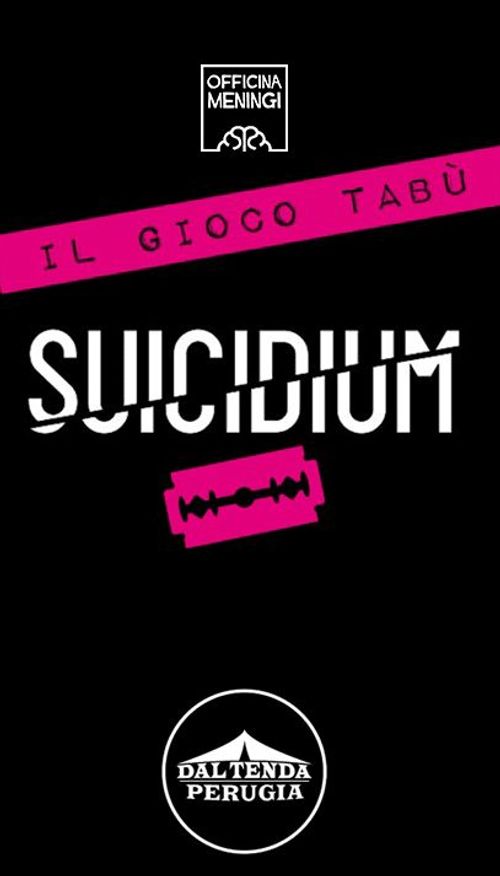
Suicidium
Suicidium Rulebook
Table of Contents
Table of Contents
Setup
Shuffle the action deck and the object deck separately and place both face down in the center of the table. Everyone rolls one die: whoever rolls the lowest number is the first player.
Each participant starts the game with 10 will-power points. Starting with the first player and proceeding clockwise, each player draws 7 action cards without revealing them to the opponents.
If you own one of the limited editions, shuffle the character cards and draw one at random as well. Reveal it and place it beside you for the whole game. Apply its effects as indicated.
Reminder
On his or her turn, each player must perform at least one of the following actions (he or she may perform both):
- draw at least one card [source marker in the Italian text, "TAGLIATA LA PARENTESI" ("parenthesis cut"), left as printed; the sentence closes here in the source]
- play at least one action or event card in the main phase
If some effects prevent you from performing one (or both) of these actions, see the F.A.Q.
Survive Mode
How to win: by remaining the last player in the game (keep your will-power points high and reduce your opponents' to zero).
How to lose: by drawing two identical object cards, or the suicide booth.
Draw Phase
At the start of his or her turn, each player may choose to draw one or more action cards, up to the starting number (7 cards, no more). Before drawing, he or she declares to the opponents how many cards he or she intends to take.
If the player already has 7 cards, he or she may still choose to discard one, and only one, without applying its effects, and then draw another.
Each card added to the hand causes the loss of one will-power point to the player who drew it. If the will-power points reach zero in this way, the phase ends and the player must immediately draw an object card (see ZEROING).
Main Phase
In this phase, the active player may place on the table up to a maximum of 3 cards from his or her hand, face up in front of himself or herself, declaring the order of resolution (which will activate first, which second and which last) and who will suffer their effects (himself or herself, or the opponents).
Here are all the possible options:
- You may play point cards to raise your own will-power points, keeping in mind that the limit of 10 cannot be exceeded.
(Example: a player is at 6 will-power points and plays on himself "you become prime minister (diventi premier): +3 will-power points" and "you enter the school of magic (entri alla scuola di magia): +2 will-power points", for a total of 6+3+2=11. The extra point is automatically lost and the player reaches 10 will-power points.)
-
You may play point cards to lower the will-power points of one or more opponents. If a player's will-power points reach zero, that player must draw an object card (see ZEROING).
-
You may play bonus and malus (and bonus/malus) event cards to penalize your opponents or to advantage yourself. You may also play response cards, for example to strengthen the effects of a point card, while keeping to the limit of 3 cards played in total in this phase.
Note: If a card has lasting effects (example: "Narcolepsy (Narcolessia): an opponent skips the draw phase on his or her next turn"), and it is not cancelled in the response phase, the player who suffers it must place it in front of himself or herself until its effect runs out (in this specific case, until the end of his or her next draw phase), and then discard it.
- You may pass (but you must have drawn at least one card in the draw phase).
Before the effects are calculated (see the resolution phase), the opponents may play response cards to cancel or multiply the effects of the cards played, as described below.
Response Phase
When the first player has finished declaring the cards of his or her main phase, each opponent, one at a time and clockwise, may play up to a maximum of 3 response cards (and no other type) to modify their effects.
If there are 3 or 4 of you, you may also play responses on the cards played by earlier opponents (so the third player in turn may respond to the second, and the fourth may respond to the third and to the second). Some examples are given in the F.A.Q.
Once the opponents' response round is over, the active first player also has the chance to play up to a further 3 response cards from his or her hand (if he or she has any), either to counter the opponents' cards or to advantage himself or herself further.
If the opponents have placed no response on the table, the active player may play no further response cards and must pass directly to the RESOLUTION PHASE.
Resolution Phase
In this phase the active player applies the effects of the cards, to himself or herself or to the opponents, taking into account the order declared in the MAIN PHASE and the effects of any responses. Resolution happens in succession (first card and its responses, second card and its responses, and so on), and then all played cards are placed face up on the discard pile.
EXAMPLE: Vincenzo and Lucia are challenging each other. The first is down to 1 will-power point, the second to 2. It is Vincenzo's turn and he chooses as first card "gorging on gummy bears (scorpacciata di orsetti gommosi): gain 1 will-power point", targeting himself. As second card he plays "Mors tua, vita mea: ° lose 2 will-power points and an opponent gains 2, OR ° gain 2 will-power points and an opponent loses 2", choosing the second option: +2 to himself and −2 to Lucia. Lucia responds with "parliamentary immunity (immunità parlamentare): cancel the effect of a point card", to avoid reaching zero (and therefore drawing an object card). Since Lucia has played a response, Vincenzo could play up to 3 in turn, but he has none in hand, so the game moves to the resolution phase: "gorging on gummy bears" increases Vincenzo's will-power by 1 point, while "Mors tua, vita mea", cancelled, has no effect. [the source's example continues: "[tagliato il resto]", i.e. "[rest cut]", left as printed]
ZEROING (AZZERAMENTO)
If a player's will-power points have been reduced to zero, that player must draw a card from the object deck, reveal it to the opponents and place it face up beside himself or herself.
If it is the suicide booth, or if the player comes to possess two identical object cards, the game is over for him or her: he or she must discard his or her hand of action cards and shuffle the object cards back into their deck.
Otherwise, he or she restores his or her will-power points to 10, discards all action cards in hand and immediately draws 7 new ones (without losing any will-power points), keeping beside himself or herself the object card(s) drawn previously. Any lasting effects (such as being unable to draw or play cards for a turn) are cancelled.
During the resolution phase, zeroing a player's will-power points stops the sequential activation of the cards: any subsequent cards are cancelled.
The game then continues, until only one player remains!
EXAMPLE: Andrea, Vincenzo and Erica are all at 1 will-power point. Andrea is the active player and, as first card, plays "steal candy from a child (Rubi le caramelle a un bambino): ° lose 1 will-power point and an opponent gains 1, OR ° gain 1 will-power point and an opponent loses 1", choosing the second option, with targets himself and Vincenzo. As second card he plays "Panic attack (Attacco di panico): an opponent may not play point cards in his or her next turn", targeting Erica. Vincenzo has no responses. Erica plays "Quit smoking (Smetti di fumare): reverse the sign (or signs) of a point card" on "steal candy from a child". Andrea has no responses. In the resolution phase, "Quit smoking" reverses the effect of "steal candy from a child", causing Andrea to lose his last life point, while Vincenzo gains 1 (reaching 2). Because Andrea has been zeroed, the sequence of card activation stops, and "Panic attack" is discarded without its effects being applied. Andrea must draw an object card; he finds the suicide booth, and for him the game is over.
END OF DECK
If the action deck runs out, each player, starting from the one who drew the last card, must immediately draw an object card. If a player draws the suicide booth or comes to possess two identical objects, he or she has lost, and must discard the action and object cards in his or her possession before the respective decks are reshuffled so they can be used again.
If the player is still in the game, the active player may complete any draw from the new deck (if he or she had announced a draw of 4 cards and only 2 remained in the deck, he or she is entitled to draw the 2 missing, incurring the foreseen loss of one will-power point per card) and then resume the game.
Depression Mode
How to win: by reducing your own will-power points to zero before the others, so as to draw two identical object cards or the suicide booth.
How to lose: by allowing another player to commit suicide first.
Draw Phase
At the start of his or her turn, each player may choose to draw one or more action cards, up to the starting number (7 cards, no more). Before drawing, he or she declares to the opponents how many cards he or she intends to take.
If the player already has 7 cards, he or she may still choose to discard one, and only one, without applying its effects, and then draw another.
Each card drawn causes the loss of one will-power point to each opponent. If a player's will-power points are reduced to zero in this way, he or she must draw an object card at the end of the active player's draw phase (see ZEROING).
Main Phase
In this phase, the active player may place on the table up to a maximum of 3 cards from his or her hand, face up in front of himself or herself, declaring the order of resolution (which will activate first, which second and which last) and who will suffer their effects (himself or herself, or the opponents).
Here are all the possible options:
-
You may play point cards to lower your own will-power points. If a player's will-power points reach zero, that player must draw an object card (see ZEROING).
-
You may play point cards to raise the will-power points of one or more opponents, keeping in mind that the limit of 10 cannot be exceeded.
(Example: a player is at 9 will-power points and has a card played against him, "you marry a rich heiress (sposi una ricca ereditiera): gain 2 will-power points", for a total of 9+2=11. The extra point is automatically lost and the player returns to 10 will-power points.)
- You may play bonus and malus (and bonus/malus) event cards to penalize your opponents or to advantage yourself. You may also play response cards, for example to strengthen the effects of a point card, while keeping to the limit of 3 cards played in total in this phase.
Note: If a card has lasting effects (example: "Narcolepsy (Narcolessia): an opponent skips the draw phase on his or her next turn"), and it is not cancelled in the response phase, the player who suffers it must place it in front of himself or herself until its effect runs out (in this specific case, until the end of his or her next draw phase), and then discard it.
- You may pass (but you must have drawn at least one card in the draw phase).
Before the effects are calculated (see the resolution phase), the opponents may play response cards to cancel or multiply the effects of the cards played, as described below.
Response Phase
When the first player has finished declaring the cards of his or her main phase, each opponent, one at a time and clockwise, may play up to a maximum of 3 response cards (and no other type) to modify their effects.
If there are 3 or 4 of you, you may also play responses on the cards played by earlier opponents (so the third player in turn may respond to the second, and the fourth may respond to the third and to the second). Some examples are given in the F.A.Q.
Once the opponents' response round is over, the active first player also has the chance to play up to a further 3 response cards from his or her hand (if he or she has any), either to counter the opponents' cards or to advantage himself or herself further.
If the opponents have placed no response on the table, the active player may play no further response cards and must pass directly to the RESOLUTION PHASE.
Resolution Phase
In this phase the active player applies the effects of the cards, to himself or herself or to the opponents, taking into account the order declared in the MAIN PHASE and the effects of any responses. Resolution happens in succession (first card and its responses, second card and its responses, and so on), and then all played cards are placed face up on the discard pile.
EXAMPLE: Luigi and Maria are playing. Luigi is at 10 will-power points and first plays "cosmic love (l'ammmore cosmico): add 3 will-power points to yourself and to an opponent", with targets himself and Maria (who is at 5 will-power points), and then plays "your goldfish dies (ti muore il pesce rosso): lose 1 will-power point", targeting himself. Maria has no response cards. In the resolution phase, "cosmic love" increases by 3 the will-power points of both target players: Luigi stays at 10 (10+3 = 13, but the 3 extra points are immediately cancelled, keeping the player at 10), while Maria goes to 8 (5+3). The card "your goldfish dies", which Player 1 played on himself second, then takes him regularly from 10 to 9 will-power points.
Note: the Italian example labels the first player "Giocatore 1" (Player 1) in its last sentence, as printed.
ZEROING (AZZERAMENTO)
If zeroing occurs during the draw phase, the affected player waits while the active player completes the draw, and only then draws the object card. In any case, the loss of points stops at zero, even if the number of cards drawn is greater than the points held.
If a player's will-power points have been reduced to zero, that player must draw a card from the object deck, reveal it to the opponents and place it face up beside himself or herself.
If it is the suicide booth, or if the player comes to possess two identical object cards, he or she has won the game.
Otherwise, after drawing the object card, he or she simply restores his or her will-power points to 10. He or she keeps the action cards already in hand, and keeps beside himself or herself the object card(s) drawn previously. Lasting effects (such as being unable to draw or play cards for a turn) are maintained.
If zeroing occurred during the resolution phase, the sequential activation of the cards does NOT stop: the player returns to the game and normally suffers the effects directed at him or her by any subsequent cards (the same applies to the other players).
The game then continues until there is a winner!
END OF DECK
If the action deck runs out, every player immediately recovers 3 will-power points. A player who would exceed the limit of 10 must discard one card for each extra point (if he or she has one), but remains at 10.
All discarded cards are reshuffled. The active player may complete any draw from the new deck (if he or she had announced a draw of 4 cards and only 2 remained in the deck, he or she is entitled to draw the 2 missing, causing the foreseen loss of one will-power point to the opponents for each card) and then resume the game.
F.A.Q.
The F.A.Q. below is the publisher's base-game F.A.Q. from the official blog page (suicidiumgame.blogspot.com/p/regole.html). The F.A.Q. entries for the "Suicidium Party" expansion are omitted, as this rulebook covers the base game only.
What kinds of cards are there in Suicidium?
- Object cards: 13, pink/black back: 4 razor blades, 4 nooses, 4 poisons and 1 suicide booth.
- Action cards: 97, all different, black/grey back, divided into:
- points: black border, positive and negative numbers in the top left;
- event: grey border, pink/black face icon in the top left;
- responses: pink border.
How does a turn work?
- First phase: draw.
- Second phase (main): the active player may play up to 3 action cards of any type from his or her hand [including response cards combined with point cards, for example doubling a +3 card]. Their effects do not activate yet; first the opponents' responses must be awaited.
- Third phase (response): each opponent, clockwise, has the right to respond to the active player's cards, applying up to 3 response cards from his or her hand. The active player closes this phase and, if at least one opponent has played at least one response card, has the right to play up to 3 response cards from his or her hand to modify the effects of his or her own cards [including on cards that received no opponent responses].
- Fourth phase (resolution): the effects of the cards are applied, calculating any effects of the responses; then the cards are discarded. The exception is event cards with lasting effects (if they have not been cancelled): the player who received them places them in front of himself or herself until their effect runs out (that is, until the end of his or her next turn).
Who can I play point cards on?
Point cards can be aimed at any player (yourself included).
I received a card that makes me skip the draw phase on my next turn, but I have no useful cards to play in hand... may I pass?
The obligation on each turn is to: draw (at least) one card OR play (at least) one action card. If you cannot draw, you are still forced to play a card from your hand.
I received the Talent Show marathon card. What do I do?
The card text says "an opponent skips the main phase on his or her next turn (may draw, but may not play cards)" — but by the rule in the previous F.A.Q., he or she must in any case draw (at least) ONE card.
I received a card that makes me skip the main phase on my next turn, so I cannot play cards, but I already have 7 in hand and am at 1 will-power point in Survive mode... may I pass?
The obligation on each turn is to: draw (at least) one card OR play (at least) one action card. You are therefore forced to discard one card from your hand and draw a new one (losing the last will-power point).
I was played against with both a card that makes me skip the draw phase and another that makes me skip the main phase on my next turn. What do I do?
This is the only case in which you must pass without doing anything, because the effects of the cards prevail.
I have 7 cards in hand. How many can I change?
Only one, in the draw phase, and first you must discard one card you own.
I have 6 cards in hand. Can I draw one and change one?
No, you can only draw one.
In Survive mode, if I am at 2 will-power points, can I declare that I am drawing 3 cards?
No. Each card causes the loss of one will-power point, and zeroing automatically ends the draw as well. You may declare (and draw) 2 cards.
How does point loss work when I draw?
- In Survive mode you lose one will-power point for each card drawn.
- In Depression mode you cause the loss of one will-power point to the opponents for each card drawn.
Do "Krampus alla gamba" and "C'è la crisi", which make players draw and discard cards from an opponent's hand, cause will-power loss?
No. No EVENT card (grey border) that makes an opponent draw or discard from hand causes the loss of will-power points.
Can I cancel a card that has the effect of "cancel a point / any / event card"?
Certainly. Let us see an example. Marco, Luisa and Gino (in that order) are playing in Depression mode. It is Marco's turn; after drawing, he plays just one card: "Spoiler: subtract 3 will-power points from yourself and from an opponent", with targets himself and Gino. Marco is at 2 will-power points and has already drawn a razor blade; he hopes to draw another to win, while Gino is at 5 and certainly does not mind losing 3 points. The response phase begins: Luisa (who is also at 2 will-power points), in her response turn, plays "Suspense!: cancel the effect of a point card" to cancel the point loss of "Spoiler". Now the response turn passes to Gino, who plays "Two of spades (Due di picche): cancel the effects of any card" on Luisa's "Suspense!". The response turn returns to Marco, who plays nothing further, and who may apply, in the resolution phase, the effects of "Spoiler": reducing his own will-power points to zero and subtracting 3 from Gino.
Can I double a card that has the effect of "double the will-power points lost or gained with a point card"?
You cannot double the response card itself, but you can double the point card it was played on, with a cumulative effect. Let us clarify with an example. Lisa, Federico and Andrea are playing in Survive mode. It is Lisa's turn; she does not draw and plays just one card: "gorging on gummy bears: gain 1 will-power point", targeting Andrea. Federico, in response, plays "Wasabi suppository (Supposta di Wasabi): double the points lost or gained with a card". Andrea has no responses, and the turn returns to Lisa, who closes with the response card "Latte +: double the points lost or gained with a card" to double "gorging on gummy bears" once more. (Note: Lisa, being the first player in turn, could place a response on the table only because Federico had played one before her; otherwise she could not have.) The result is: +1 +1 +1, that is +3 for Andrea.
Can I cancel a response card played by an opponent with a response card that cancels an event card?
No, only with a response card that cancels any card.
How does the point die work?
The dice of the limited edition start at 0, with a value of 10, and in place of the 1 they have the skull symbol (teschio). In gameplay, the skull is considered as the last will-power point.
Other F.A.Q. entries from the blog (not reproduced here): the blog page's F.A.Q. for the expansion ("Suicidium Party") covers the insertion of new cards, Strabismo di Venere, Macchina del tempo and all'arrembaggio; these belong to the expansion and are not part of this base-game rulebook.